
Viewers short on space
You want to show a film to a group, but there’s little room between the seats and the projection wall. Start by checking where the projector can go and the throw distance, rather than focusing on resolution.


First, measure the distance from the lens to the wall and work out what image size will fit. Choose an ultra-short-throw projector if it needs to sit close to the wall, a short-throw model if you have more room, or a portable model if flexibility matters and you can darken the room. Then check that your film source is compatible and that everyone can hear the sound clearly.
You want to show a film to a group, but there’s little room between the seats and the projection wall. Start by checking where the projector can go and the throw distance, rather than focusing on resolution.
You want everyone at your garden film night to see and hear the film clearly. Check the room’s lighting, the connection to your film source and the sound before choosing a model.
You want to put the projector away afterwards or use it somewhere else. Think about setup and power, too. A portable model doesn’t remove the need to check the throw distance.
First, measure the available distance from the lens to the wall and the clear wall width. Compare these with the placement details for the exact model, then check the picture, film source, sound and power supply.
| What to consider | What should you check? | Who is this important for? |
|---|---|---|
| Throw distance | Measure the distance from the lens to the wall and the clear wall width, then compare these with the specifications for your preferred image size and exact model. | If space between the projector and the wall is limited, I want to know whether the image I want will fit. That’s why around 36% of consumers prioritise the space needed for setup. |
| Visibility | Check whether you can darken the room during the film, and compare brightness figures only after checking the unit of measurement given. | If several people are watching, I want to take the room’s lighting and intended image size into account. Around 29% of consumers put visibility first. |
| Film and sound | Check that the connections work with your film source, then test the picture and sound using your own file and the intended seating positions. | If I’m showing my own film to a group, I want to know in advance that my source works and that the sound can be heard from the seats. Around 21% of consumers prioritise playback and clear sound above all else. |
| Setup and power | Check that the projector can be placed where you intend to use it, and that the power supply or stated battery life is suitable for the screening. | If I want to put the projector away or use it in different places, I want to know how it can be set up and powered. Around 14% of consumers make flexibility their main consideration. |
A large stated image size doesn’t tell you whether the lens can be positioned at the required distance in your room.
For the exact model, check the image size you want, the clear wall space and the distance from the lens to the wall together.
A battery-powered projector may be easy to move, but that doesn’t mean it can project the same image size close to the wall as an ultra-short-throw model.
Choose based on the throw distance first, then consider portability and power.
A speaker or smart feature doesn’t prove that your film file and connection will work, or that everyone in the group will be able to hear the sound clearly.
Test the complete playback setup and sound from the intended seats before screening the film.
The TH671ST and TK705STi are examples you can use to compare the stated throw distance of each model.
The EH-LS670B is an example of an ultra-short-throw projector, while the EH-TW6150 shows why you should check the throw distance of a standard projector separately.
The CineBeam S PU615U is an example of an ultra-short-throw projector.
The PX3-PRO, PT1 and L9Q are examples of ultra-short-throw projectors with different stated image sizes.
The MoGo 4 is worth considering if you want a projector that’s easy to move and set up.
These Joybuy products are projectors for home use. Compare the throw distance and connections of each model with your room and film source.
 Image unavailable
An option if you want to connect a film source and project the picture from a spot close to the wall.
The product details give a throw ratio of 1.17:1 and an adjustable stand. The title lists native 1080P, 520 ISO lumens, Google TV and two 5 W speakers.
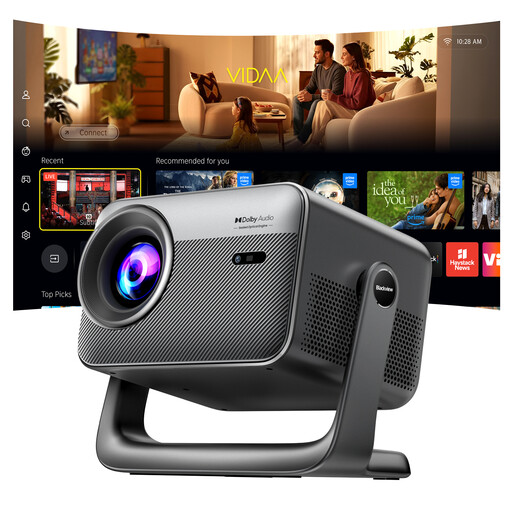 Image unavailable
An option to compare if brightness and flexible viewing angles matter for your film night.
The title lists 1000 ANSI lumens, native 1080P and 360° rotation. The product details mention autofocus and wireless screen sharing; check that screen sharing is compatible with your film source.
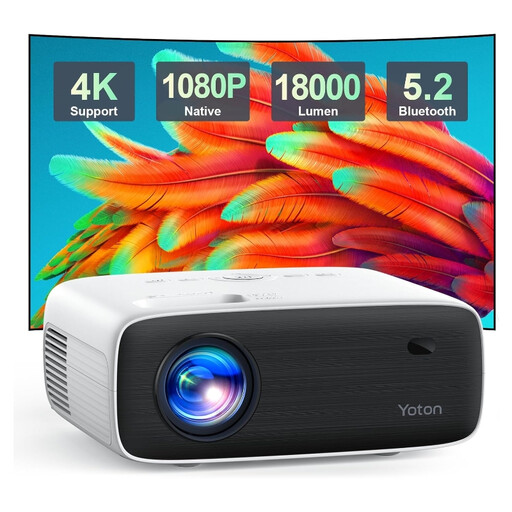 Image unavailable
An option if you want to connect an external film source and compare the built-in sound with your setup.
The title lists native 1080P. The product details mention HDMI, USB and AV, Bluetooth 5.2 and a built-in speaker. Check which connection your film source needs.
 Image unavailable
An option to consider if the projector needs to sit close to the wall and you want built-in sound.
The product details list a throw ratio of 0.18:1, a throw distance of 0.26–0.4 m, HDMI 2.0 and two 10 W speakers. Check the distance required for your preferred image size.
 Image unavailable
An option if there’s a suitable spot close to the wall; check the distance needed for your preferred image size in your room.
The title lists XGA resolution and 3600 ANSI lumens. The product details mention a throw ratio of 0.49, HDMI and a built-in 10 W speaker.
Measure the clear wall width and the distance from the planned lens position to the wall. Then check the placement details for the exact model and the image size you want. For example, Epson gives a distance of 2.34–3.81 m for an 80-inch image on the EH-TW6150.
It depends on your laptop’s outputs and the projector’s inputs. BenQ lists two HDMI inputs for the TH671ST. Test your own laptop, any adapter you need and your film file to make sure the picture and sound work.
According to ACM ConsuWijzer, online purchases generally come with a statutory 14-day cooling-off period from delivery, although there are exceptions. If a product breaks sooner than you could reasonably expect with normal use, you can also ask the seller to resolve the issue. The law does not set a general fixed warranty period of two years.
That depends on the rights to the film and music, and on the specifics of the screening. The Dutch Government says you may need permission to use other people’s protected material, and that a private copy for personal use must not be made public. Ask the creators or other rights holders what is allowed for this screening.