
Viewer with limited space for positioning
Wants to know where the lens can go before deciding on picture size or resolution. A short-throw or ultra-short-throw projector calls for a different set-up.


First, decide how wide you want the picture to be, then measure the distance from the lens to the wall. A short-throw projector is suitable if you can place it in front of the seating area, while an ultra-short-throw model needs a position close to the wall. Next, consider the ambient light and check the source resolution, streaming options, audio and maintenance requirements. Neither type of projector is right for every narrow living room without taking these factors into account.
Wants to know where the lens can go before deciding on picture size or resolution. A short-throw or ultra-short-throw projector calls for a different set-up.
Watches nature documentaries when the living room isn’t completely dark and needs to balance brightness against ambient light and picture size.
Looks for detail in the programme, clear spoken dialogue and compatibility with their chosen streaming source.
First, measure the available space for your desired picture size. Then consider lighting, the picture source, sound and maintenance.
| What to consider | What should you look for? | Who is this important for? |
|---|---|---|
| Throw distance and picture size | Measure the distance from the lens to the wall and the usable wall width. Compare these with the specifications for your desired picture size on the exact model. | If I want a large picture, the projector needs to fit in the right position. Around 33% of consumers give priority to finding a suitable place for it. |
| Ambient light and brightness | Decide whether you’ll mainly watch during the day or in the evening, and compare brightness figures on the same measurement basis. | If you can’t always darken the room, you’ll want to know whether your chosen picture size will work in the available light. Around 27% of consumers prioritise watching in ambient light. |
| Detail in nature footage | Compare the native resolution, any picture enhancement and the resolution of the programme you’re watching. | If I mainly want to see detail in feathers, fur and landscapes, I consider both the projector and the source material. Around 20% of consumers cite picture detail as their main concern. |
| Streaming and clear audio | Check that your preferred app or external HDMI source works with the model, and look at the available audio connections. | If you want to follow the commentary without any fuss, you’ll want to check your playback source and sound set-up in advance. Around 13% of consumers give playback and sound top priority. |
| Maintenance and running costs | Check the light source type, its stated lifespan in the specified mode and any additional equipment your set-up requires. | If I want to factor in additional maintenance or equipment, I look beyond the projector itself. Around 7% of consumers put maintenance first. |
The distance required depends on the specific model and picture size. So a large maximum diagonal doesn’t automatically mean the picture will fit in your living room.
Measure the space and compare the result with the throw distance for the exact model.
You may need to find a different position for the projector or use a suitable screen.
Epson describes the EH-TW6150 as 4K PRO-UHD with picture enhancement. Consider this type of label alongside the resolution of your playback source and the model’s technical specifications.
As well as checking the marketing description, read the resolution specifications for the projector you’re considering.
Your set-up may also need a screen, a playback source or external audio. Samsung recommends a dedicated UST screen for optimum viewing with the Premiere 7.
Check what you already have and what your chosen projector type needs for your intended set-up.
A screen, playback source or external audio equipment may take up extra space and make your set-up more complicated.
The TH671ST is an example of a Full HD short-throw projector designed to be positioned in front of the viewers.
The EH-LS670W offers an ultra-short-throw option, while the EH-TW6150 is a lamp-based model with a standard throw distance.
The Premiere 7 LPU7D is an ultra-short-throw laser projector designed to sit close to the wall.
This selection at Joybuy includes short-throw and standard projectors, as well as models with built-in streaming. Check whether each model’s placement will work in your living room.
 No image available
The title mentions short-throw projection and built-in Google TV; check the distance required for your desired picture size.
520 ISO lumens; native 1080P; built-in Google TV; two 5 W speakers.
 No image available
Its native 1080P specification makes this model worth comparing for Full HD source material. Check the distance required for your desired picture size.
Native 1080P; 1000 ANSI Lumens; Whale TV OS.
 No image available
The title mentions built-in apps and an adjustable picture size; check that your preferred app and available space suit your needs.
Picture size of 50–200 inches; Wi-Fi 6; Bluetooth; automatic picture correction; 180° rotation.
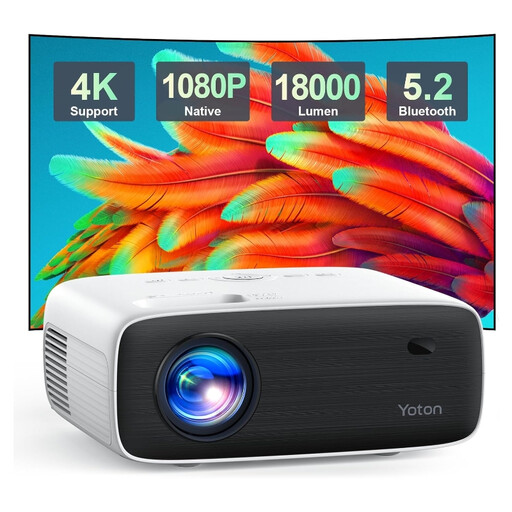 No image available
The native 1080P specification may be worth considering if you watch programmes with Full HD source material; check the connections and positioning for your set-up.
Native 1080P; 4K LCD.
 No image available
A model worth comparing if a standard throw distance is possible; measure the space for your intended picture size.
The product information gives a throw distance of 1–8 m. This range alone doesn’t show which distance is right for your desired picture size.
Measure the distance from the lens to the projection surface and the usable wall width. Compare both measurements with the specifications for your desired picture size on the exact model. For example, Epson Netherlands gives a throw distance of 2.34–3.81 m for an 80-inch picture on the EH-TW6150; this measurement doesn’t automatically apply to an ultra-short-throw model.
It depends on the projector and your set-up. Samsung Netherlands says that the Premiere 7 can project onto a flat wall, but recommends a dedicated UST screen for optimum viewing. Check that your chosen position has a suitable wall and enough width, and consider whether you may need a screen.
Check the light source type and the usage mode on which the stated lifespan is based. In the Netherlands, a product must meet reasonable expectations; the Dutch Government states that the seller must provide a solution if something goes wrong. Any manufacturer’s warranty does not replace your statutory rights.
According to EUR-Lex, equipment designed for 50–1.000 V AC falls under the EU Low Voltage Directive and must carry a CE marking when placed on the EU market. Check the details of the specific device; this general rule does not independently confirm that a particular projector on sale is compliant.