What should you look for?
Short-throw projection
A good fit if: there’s still space in front of the wall or screen and the lens distance is right for your preferred image size. BenQ gives an approximate distance of 1.5 m for a 100-inch image with the TH671ST; Epson specifies a throw ratio of 0,6:1 for the EB-W56S.
The trade-off: the projector sits further into the room than with ultra-short-throw projection. The models mentioned also have different resolutions: the BenQ TH671ST is Full HD, while the Epson EB-W56S is HD-ready.
Ultra-short-throw projection
A good fit if: you want to keep the walkway clear and have a stable spot close to the wall or screen. LG gives distances of 8,1 cm for a 40-inch image and 39,3 cm for a 100-inch image with the CineBeam S PU615U.
The trade-off: check the exact positioning measurements and make sure the projection surface is flat. A short throw doesn’t automatically mean more detail; Epson, for example, describes the EB-685W as HD-ready WXGA.
For a workshop film in a narrow living room, the main factors to check first are the space available for your setup, ambient light, the level of detail you want and the connections you need.
| What to consider |
What should you check? |
Who should pay particular attention? |
| Throw distance and walkway space |
Measure the distance from the lens to the projection surface and the image width you want. Compare these with the distance chart or throw ratio for the exact model. |
If you want to keep your narrow room clear and avoid having a projector or cables in the walkway, start with the distance required. Around 36% of consumers prioritise a suitable image size and clear walkway space. |
| Visibility in ambient light |
Decide whether you can darken the room, and only compare brightness figures when they use the same measurement method. |
If you can’t show the film in a fully darkened room, you’ll want to know whether the image will be clear enough for your lighting conditions and chosen image size. Around 29% of consumers prioritise visibility in ambient light. |
| Film detail |
Check the projector’s native resolution and the film’s resolution. A large image can’t add detail that isn’t in the source. |
If you want to follow small movements or objects in the workshop film, check the resolution of both the projector and the source. Around 21% of consumers give detail the most attention. |
| Connections, audio and setup |
Check that the film source’s outputs are compatible with the inputs on the exact model, that the audio setup is sufficient, and that you have somewhere to route the cables. |
If you want to set up the film without awkwardly routed cables, check the source, audio and available space in advance. Around 14% of consumers prioritise this practical combination. |
Projectors on Joybuy
These projectors on Joybuy are options to compare for watching films in a living room. For each model, check the stated throw ratio, resolution, connections and audio features against your own setup.
 Image unavailable
XGIMI Vibe One, Full HD 1080p, Match Night EU Edition with projection screen and stand
Could suit you if you want to compare a projector with a specified throw ratio and built-in film-watching features.
The stated throw ratio is 1,3:1. The product information lists Full HD 1080p, Google TV, a built-in battery, 250 ISO lumens and two 3 W JBL speakers. This version comes with a projection screen and stand.
Joybuy
 Image unavailable
Yaber L2, native 1080p, Google TV and dual 5 W speakers
Could be worth considering if you want to weigh up a short throw ratio against the space available in your room.
The product information lists a throw ratio of 1,17:1, native 1080p, 520 ISO lumens, HDMI, Google TV and two 5 W speakers. It also mentions a 360° gimbal and compatibility with a flexible stand.
Joybuy
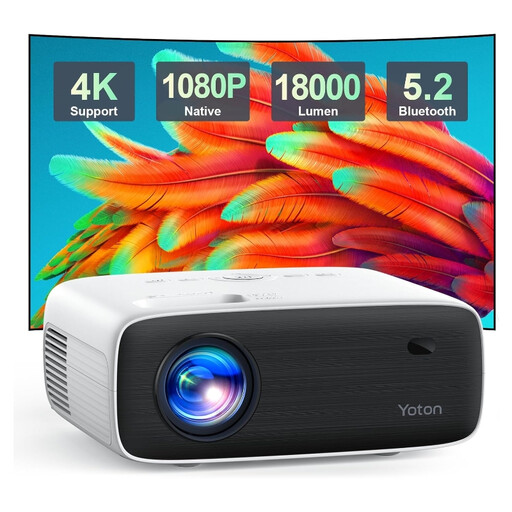 Image unavailable
Yoton Y6, Bluetooth 5.2, native 1080p and 4K input
Could suit you if its stated native resolution, wired connections and audio features work with your film source and viewing setup.
The product information lists native 1080p and support for 4K input. Connections include HDMI, USB and AV; Bluetooth 5.2 and a built-in speaker are also listed.
Joybuy
 Image unavailable
Magcubic HY350Max, native 1080p, 900 ANSI lumens and Android 14
Could be an option to compare if the stated 1:1 ratio works with the distance and image size you want to check.
The product information lists native 1080p, a 1:1 ratio, 900 ANSI lumens, autofocus and keystone correction. It also mentions HDMI, USB, Wi-Fi 6, Bluetooth 5.4, Android 14 and a built-in 15 W speaker.
Joybuy
 Image unavailable
Optoma H117ST short throw, WXGA 1280 × 800
Could suit you if the stated short-throw distance works in your room. You’ll also want to consider the native resolution when viewing small details in a film.
The product information lists a throw ratio of 0,52:1, a distance range of 0,4 to 3,4 m, WXGA 1280 × 800, 3800 ANSI lumens, HDMI and a built-in 10 W speaker. Full HD input isn’t displayed at native Full HD resolution.
Joybuy
Frequently asked questions
How can I tell if the image will fit in my narrow living room?
Measure the distance from the lens to the wall or screen, as well as the available image width. Compare both measurements with the throw ratio or distance chart for the exact model. The term ‘short throw’ on its own doesn’t give you exact measurements.
Can I point an ultra-short-throw projector at an ordinary wall?
Check that the wall is flat enough where you plan to place the image. LG notes that obstacles and uneven surfaces can limit automatic screen adjustment on the PU615U. Samsung says the Premiere 7 can project onto a flat wall, but recommends a suitable ultra-short-throw screen for the best viewing experience.
How should I compare projectors if I can’t fully darken the living room?
Only compare stated brightness when the figures use the same measurement method, and take your preferred image size and the available light into account. BenQ describes ANSI, light source and LED brightness as different types of measurement, so simply comparing the figures side by side isn’t like-for-like.
Can I show a film at a commercial pottery workshop?
For a business or organisation showing films to employees or guests, the Dutch Ondernemersplein states that a screening licence is required, including when using a download or streaming service. Whether this applies to a specific event depends on who is showing the film and who it is for; a private film night isn’t automatically the same situation.
What product and purchase terms should I check in the Netherlands?
Check that the projector you want to buy has the required CE marking. The Dutch government (Rijksoverheid) lists this as a requirement for electrical products placed on the EU market. According to the Rijksoverheid, consumers buying online from a business generally have 14 days to change their mind, subject to applicable conditions. ACM ConsuWijzer also makes clear that your statutory guarantee is separate from any manufacturer’s warranty.


