
Organisers showing text and maps
You’re showing slides or historical maps and want people in the back row to be able to make out the details. Check the native resolution and test the smallest relevant content at the image size you plan to use.


Start with the smallest text and map details that people need to read from the back row, then match the brightness and throw distance to the room. A mains-powered projector with a higher stated brightness may be suitable if the lights will stay on, while a portable battery-powered model is useful when you need to move it around or project without a mains socket. Beforehand, also test the connection and check that spoken explanations can be heard at the back of the room.
You’re showing slides or historical maps and want people in the back row to be able to make out the details. Check the native resolution and test the smallest relevant content at the image size you plan to use.
You want to keep the lights on during the talk. Compare stated brightness figures measured using the same method, and test the image with the lights on as they’ll be during the event.
You move between venues or don’t always have a mains socket where you need to set up. So consider portability and check that the battery life is long enough for your chosen picture mode.
Best for: keeping text and maps legible for a group with the lights on. Epson lists Full HD and 4,600 lumens for the EB-L260F; ViewSonic lists Full HD and 5,000 ANSI lumens for the LS740HD.
Keep in mind: check the throw distance, positioning and noise separately. The stated brightness alone doesn’t guarantee that the image will be legible in your room.
Best for: when you can dim the room reasonably well and want a projector that’s easier to move. Epson specifies Full HD and 3,000 lumens of both white and colour light output for the CO-FH02.
Keep in mind: check that the smallest text is legible at your preferred image size. If the lights will be on, also compare models with higher stated brightness.
Best for: when you need to move the projector or don’t have a mains socket nearby, and can dim the room well. XGIMI lists Full HD and up to 2.5 hours of video playback in Eco mode for the MoGo 4.
Keep in mind: the stated battery life applies to Eco mode. Don’t compare ISO and ANSI lumen figures as though they use identical measurement methods.
First consider what needs to be legible on screen and where you can position the projector. Then assess brightness, sound and power in your actual setup.
| What to consider | What should you check? | Who is this important for? |
|---|---|---|
| Legibility of slides and maps | Check the native resolution, sharpness across the whole image and the smallest actual slide from the back row. | As an organiser, I want people to be able to read place names, dates and map details; around 29% of consumers prioritise legibility. |
| Visibility with the lights on in the evening | Make a note of which lights will stay on, check how the brightness figure was measured and test your preferred image size. | As a host, I want to keep the lights on without losing sight of the projected content; around 23% of consumers prioritise visibility in ambient light. |
| Throw distance and positioning | Measure the distance between the lens and screen, and check the image size, optical zoom and whether you can position the projector straight on. | If my room has a fixed or awkward spot for the projector, I want to know in advance whether the image will fit; around 18% of consumers make the setup their main consideration. |
| Speech and source connections | Check the connection for your source and test the audio from the furthest seat. If necessary, look for a suitable audio output. | As an organiser, I want the explanation to be easy to hear and the video source to connect; around 18% of consumers prioritise speech and connectivity. |
| Portability and battery use | Check whether mains power is available and compare the length of the full talk with the battery life in your preferred picture mode. | If I’m projecting in different venues, I don’t want to rely on having a mains socket where I set up; around 12% of consumers prioritise portability or battery use. |
ANSI, ISO, LED and light-source figures may be based on different measurement methods. A figure on its own therefore won’t necessarily tell you how clearly you’ll see the image in a lit room.
Note the measurement method and assess the image with the planned lighting and image size.
BenQ says that digital correction can affect sharpness, among other things. This is particularly worth bearing in mind when showing small map labels.
First measure the throw distance, then line up the projector as straight as possible.
XGIMI lists up to 2.5 hours of video playback in Eco mode for the MoGo 4; that figure doesn’t automatically apply to other settings.
Compare the length of the full talk with the battery life in the mode you plan to use, and arrange mains power if needed.
An HDMI input doesn’t tell you whether your source will connect to it, and a built-in speaker won’t necessarily be audible to everyone in the room.
Connect your actual source in advance and test a spoken section from the furthest seat.
You may need a suitable adapter, cable or external speaker.
Epson offers the compact Full HD CO-FH02 and the Full HD EB-L260F laser projector, among other models. Which is better suited to your event will depend partly on the room lighting and setup.
ViewSonic positions the European LS740HD as a Full HD laser installation projector, including for lecture theatres.
BenQ positions the LH650 as a Full HD laser projector for meeting rooms.
XGIMI offers the European MoGo 4 as a portable Full HD projector with a built-in battery.
This selection includes projectors with stated Full HD or 1080p specifications, including portable models. Check the brightness and connections of the specific model to make sure they suit your room and source.
 No image available
The built-in battery and portable design are well suited to a setup you want to move around.
 No image available
The stated native 1080p resolution is worth considering if you want to project slides and maps; test legibility in the room itself.
 No image available
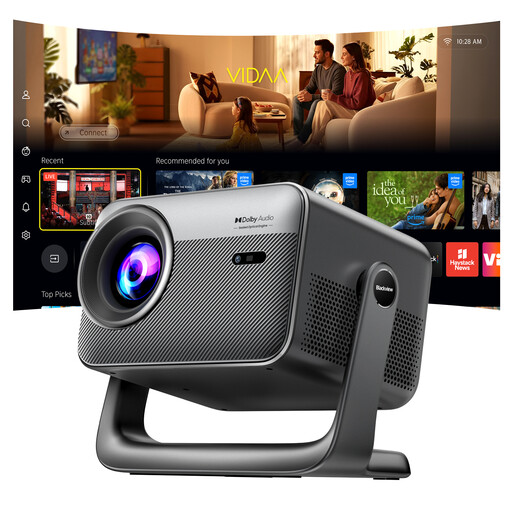
The native 1080p specification makes this model worth considering for slides and map details; check the image size and legibility at your venue.
 No image available
The portable design and built-in battery may suit you if you project in different venues.
 No image available
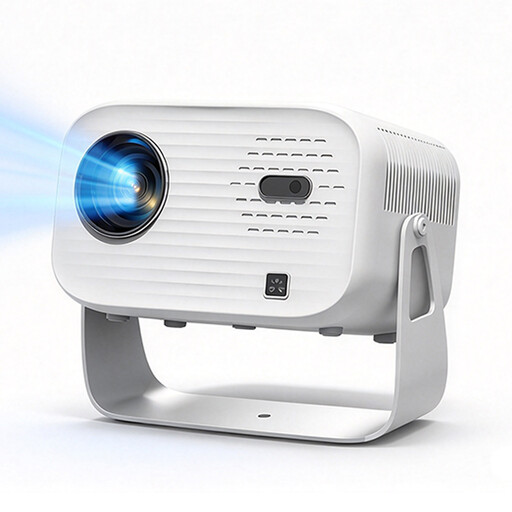
The rotating stand gives you another positioning option; check in advance that you can aim the projector straight at the screen from that spot.
If possible, position the projector directly in front of the screen first, then focus the image. Digital keystone correction can fix a skewed image, but BenQ says it can affect sharpness, image size and picture quality, among other things. So test the correction with the slides you’ll use during the talk.
It depends on the room, the number of listeners and the recording. Test spoken content from the furthest seat and, if necessary, check whether there’s a suitable audio output. For example, ViewSonic specifies a 3.5 mm audio output for the LS740HD.
Compare the full length of the talk with the battery life in the picture mode you plan to use, and arrange mains power if needed. XGIMI’s stated maximum of 2.5 hours for the MoGo 4 applies to video playback in Eco mode.
No. Don’t assume you can show any recording without permission. The Dutch government distinguishes between private use and distributing or making copyrighted work available to the public. Check the terms of use and permission for the specific talk and event.
For an electric projector, check that it has the required CE marking and the relevant EU product safety information. XGIMI also warns that the coin cell in the MoGo 4 mini remote control must be kept out of children’s reach.