
Watching with a group in a bright room
You want people at the back of the room to see the image without having to block out all the light. The brightness you need depends partly on the ambient light and image size.


Start by choosing an image size that’s easy to see from the back of the room, then check whether the projector can handle it in the available light. Next, compare the throw distance, how well it displays fine details and subtitles, and the connections for your media source and audio. The maximum image size alone isn’t enough to make the right choice.
You want people at the back of the room to see the image without having to block out all the light. The brightness you need depends partly on the ambient light and image size.
You’re looking for a wide image, but need to allow for seating, walkways and the distance between the lens and the screen.
You want to see fine lines, material textures and subtitles, and need to check that your media source and audio connection will work with the setup.
First decide on your preferred image width and consider the light in the room. Then check the positioning, detail reproduction and audio connection.
| What to consider | What should you check? | Who is this important for? |
|---|---|---|
| Visibility of a large image | Compare the stated brightness, including the measurement standard used, with your preferred image size and the ambient light. | When watching with a group in a room that won’t be completely dark, I want everyone to be able to see the image. Around 36% of consumers put visibility of a large image first. |
| Image width and positioning | Measure the distance from the lens to the screen and compare it with the throw ratio and available screen width. | If seating or walkways limit where I can position the projector, I want to know whether I can get a wide enough image from the space available. Around 29% of consumers give positioning top priority. |
| Architectural details and subtitles | Check the imaging technology and resolution, the focus and the source resolution for your planned viewing distance. | If I want to make out lines, material textures and subtitles from further away, readable detail is my main concern. Around 21% of consumers say detail readability matters most when choosing. |
| Audio and playback | Check that the projector connects to your intended media source and find out what options are available for external audio. | When watching as a group, I want everyone to hear the commentary and play programmes without any hassle. Around 14% of consumers start by looking at audio and playback options. |
As the projected image gets larger, the light is spread over a wider area. Ambient light can also make the image harder to see.
First decide on your preferred image width and consider the lighting during viewing, then compare the models.
If the image isn’t clear enough in your chosen setup, you may need to change the screen arrangement or choose another projector.
The throw ratio links the distance from the screen to the image width. Positioning options vary between models.
Measure the space available and check it against the throw ratio and any optical zoom on the exact model.
You may need to reposition the projector or use suitable mounting equipment to align it correctly.
Imaging technologies labelled 4K and brightness figures based on different measurement standards aren’t necessarily equivalent.
Check the imaging technology and measurement standard listed for each model. Don’t compare figures as if they measure the same thing under the same conditions.
The TK705STi is worth considering if you want to set up a group viewing experience with a limited throw distance.
The EH-TW7100 is worth comparing if you need flexibility for positioning and alignment.
The UZ38X is worth looking into if 4K UHD and a laser light source are on your wish list.
The HORIZON S Max offers an approach to consider if you want to move your entertainment projector around regularly.
These Joybuy products are designed for home entertainment and flexible setups. For each model, compare the image size, brightness, positioning and connections with your room and media source.
 No image available
An option to compare if you’re looking for a flexible setup and want to stream programmes through Google TV.
Native 1080p FHD, 800 ANSI lumens and Google TV.
The stated battery life is up to 2 hours, so you may need a power supply for longer screenings.
 No image available
A model to compare if 4K UHD and connectivity options for group viewing are important to you.
The product name lists 3,800 lumens, 1.3× zoom and a 15 W speaker.
According to the product description, a projection screen and media source aren’t included.
 No image available
A model to compare if you’re looking for a flexible setup with built-in Google TV.
The product information lists 520 ISO lumens, native 1080p and a 1.17:1 throw ratio.
Professional installation is recommended for ceiling mounting.
 No image available
An option to compare if you want to be able to position the image in different directions.
The product name lists Wi-Fi 6, automatic image correction, 180° rotation and connections for HDMI, USB drives, phones and laptops.
The stated screen size is 50–200 inches. Check that it suits your viewing distance and room.
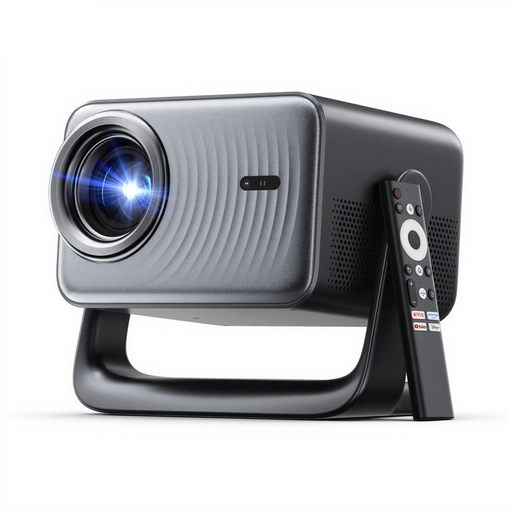 No image available
A model to compare if you’re looking for 4K support and flexible positioning.
The product name lists 1,000 ISO lumens, 4K support, and built-in Netflix and VIDAA OS.
The product name also lists automatic focus and keystone correction.
First measure your preferred image width and consider any daylight or artificial light that will remain on during viewing. The same light output is spread over a larger area when the projected image is bigger, so compare the stated brightness alongside the image size.
Measure from the lens to the projection surface. Divide that distance by your preferred image width to work out the throw ratio you need, then check the range supported by the exact model.
It depends on the room and setup. Check the audio output on the exact model in advance and make sure the commentary can be heard from the back row. Built-in speakers alone don’t guarantee that the sound will be powerful enough for every group.
When you buy remotely from a business, you generally have a 14-day cooling-off period, according to the Dutch government. Check the applicable terms and exceptions before placing your order.