What should you look for when choosing?
First, work out how much light will stay on and how much space the projector has. Then consider portability, your film source and sound.
Fixed and bright
Best when: some lights need to stay on and there’s enough distance to achieve your desired picture size.
Trade-off: a stated light output alone doesn’t guarantee good contrast in your room.
Short throw
Best when: furniture or walkways leave little space between the projector and the screen.
Trade-off: fixed zoom, as BenQ specifies for the TK705STi, limits your flexibility when positioning it.
Portable and temporary
Best when: you want to put the projector away after the film night and can darken the room well.
Trade-off: Anker states that the Nebula Capsule Air has 150 ANSI lumens and a two-hour playback time; consider the film’s length and the viewing conditions.
| What to consider |
What to look for when buying |
Who is this important for? |
| Picture visibility in ambient light |
Note which lights will stay on and decide on the picture size; compare brightness using the same measurement standard. |
If I’m projecting for a group with some lights on, I want to know whether the picture will remain visible in those conditions. Around 29% of consumers prioritise a picture that’s visible in ambient light. |
| Throw distance and positioning |
Measure the available distance and desired picture width; check the throw ratio and optical adjustment options. |
With furniture or a walkway nearby, I want to position the projector somewhere practical without compromising on picture size. Around 29% of consumers give priority to finding a suitable position. |
| Set-up and pack-away |
Check the power supply, stated battery life and space needed for each new set-up. |
If the room needs to be cleared afterwards, I want to be able to move and store the projector easily. Around 21% of consumers prioritise quick set-up and pack-away. |
| Film source and sound |
Check the connections for your film source and the right audio connection for your speakers. |
When I’m using my own player or speakers, I want to be able to check the whole set-up in advance. Around 21% of consumers prioritise connecting their film source and sound. |
Projectors for flexible film nights
This Joybuy selection includes portable projectors for temporary film nights and a model with a short throw ratio for a tight set-up.
 No image available
XGIMI Vibe One, Match Night EU Edition
Suited to a temporary set-up when a built-in battery and the supplied screen and stand are useful.
Full HD 1080p; 250 ISO lumens; Google TV; HDMI.
The description states up to 1.2 hours of video playback in Eco mode; check whether this is enough for your planned film.
View at Joybuy
 No image available
Yaber L2
Could suit you if the projector needs to sit close to the screen and you want to use built-in streaming and speakers.
Native 1080P; 520 ISO lumens; 1.17:1 throw ratio; Google TV; dual 5W speakers.
The product description lists a rotating gimbal, auto focus and keystone correction.
View at Joybuy
 No image available
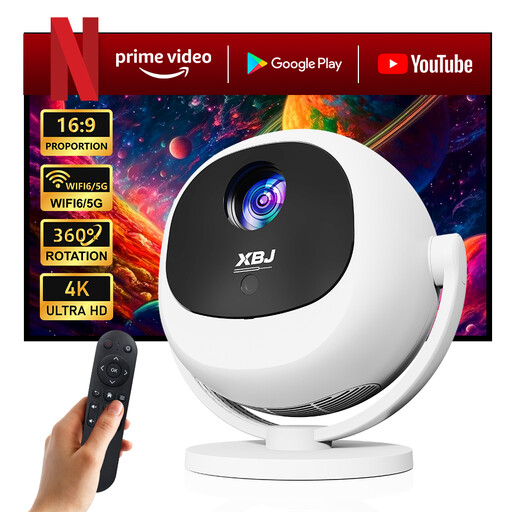
Android 13 projector, 1080P HD
Suited to a set-up where you want to adjust the projector’s direction or connect an external film source.
1080P HD; Wi-Fi 6; Bluetooth 5.0; 360° rotating stand; built-in streaming apps; HDMI compatibility.
View at Joybuy
 No image available
XGIMI MoGo 4, Match Night EU Edition
Suited to a portable film set-up if a built-in battery and Google TV fit the way you plan to use it.
Full HD 1080p; 450 ISO lumens; Google TV; Harman Kardon audio; built-in battery.
The description lists a supplied screen with stand and 360° control.
View at Joybuy
Frequently asked questions
How do I work out whether a projector will suit our shared space?
Measure the distance between the lens and the screen, and decide on your desired picture width before ordering. Then check the throw ratio and zoom on the exact model: BenQ lists a fixed zoom and a 0.8:1 ratio for the TK705STi; Epson specifies optical zoom and lens shift for the EH-TW7000.
Are a streaming app and built-in speakers enough?
That depends on your film source, seating and preferred speakers. Epson lists two HDMI ports for the EH-TW7000; BenQ lists HDMI, a 3.5mm audio output and eARC, among other connections, for the TK705STi. Check that your equipment is compatible, and test the picture and sound in advance.
What if the projector breaks down soon after I buy it?
When you buy as a consumer in the Netherlands, you have a statutory guarantee as well as any manufacturer’s warranty. ACM ConsuWijzer says the seller is responsible for providing an appropriate solution if a product used normally doesn’t meet what you could reasonably expect. There isn’t one fixed statutory guarantee period for every projector.
Can I screen a film in a shared entertainment space without extra permission?
According to Ondernemersplein, a Dutch government website for businesses, a business or organisation needs a film licence to screen a film to employees or guests, even if it’s streamed. The venue alone doesn’t determine which rules apply; decide who will have access and check what permission is needed for the specific screening.


