
Student with limited presentation space
You want to present a portfolio without placing the projector at the back of the room. Measure the available distance from the wall and the image width you want before choosing a model.


First, measure the available distance from the wall and the image width you want. Then choose between an ultra-short-throw projector, a short-throw model or a portable projector with a longer throw. For fine typography and colour assessment, native resolution, room lighting and the projection surface matter too. A stated colour gamut does not guarantee that the projected image will exactly match your design file.
You want to present a portfolio without placing the projector at the back of the room. Measure the available distance from the wall and the image width you want before choosing a model.
You present typography, illustrations or blocks of colour and want to check whether the native resolution, image size and projection surface are suitable for discussing details. Epson also highlights the flatness of the projection surface and possible glare as factors to consider.
You want to carry the projector easily and present files from your own device. As well as checking the weight, make sure the required throw distance and connections suit your setup.
| What to consider | What should you check? | Who is this important for? |
|---|---|---|
| Space and image size | Measure the available distance between the lens and the wall, the image width you want and the space for the device. Compare these measurements with the throw-distance chart for the exact model. | If space is limited, you’ll want to know whether the projector can produce the image you want from a practical position. Around 29% of consumers put placement space first. |
| Detail and colour | Check the native resolution, not just the input resolutions supported. View your own files at the intended image size and on the wall you plan to use. | If you’ll be discussing small text and subtle design details during the presentation, check in advance how they look at your chosen size. Around 23% of consumers prioritise portfolio details. |
| Visibility in ambient light | Take into account the stated light output for the model, the image size and whether you can darken the room. If possible, test it under the lighting you’ll have during the presentation. | If you can’t always darken the room, you’ll want to know whether your work will remain visible in the available light. Around 18% of consumers are most concerned about visibility in ambient light. |
| Portability and connections | Check the weight and power supply, and whether your laptop’s video output is compatible with the projector’s inputs. Also check if you’ll need an adapter. | If you regularly move between rooms, you’ll want to take the projector with you and connect it to your presentation source. Around 18% of consumers prioritise portability and connections. |
| Complete setup and after-sales support | Check which components and connections you’ll need, and review the seller’s terms and the applicable warranty and returns policy. | If you want to keep the cost of your complete setup affordable and know what support is available, look beyond the projector itself. Around 12% of consumers prioritise total cost and after-sales support. |
According to BenQ, the GV50 has a throw ratio of 1.2:1, while the LH600ST+ is listed at 0.69–0.83:1. A projector’s dimensions therefore don’t tell you how much distance you’ll need to get the image width you want.
Start by measuring the available distance and comparing it with the throw ratio of the exact model.
BenQ lists the GV50 as supporting input up to 4K UHD, with a native resolution of 1920 × 1080 pixels. These two specifications don’t mean the same thing.
Check the native resolution and view small text at the image size you actually plan to use.
BenQ notes that keystone adjustment can affect sharpness and the edges of the image.
Position the projector as squarely as possible to the projection surface and check the result with your own files.
A model’s stated colour gamut doesn’t prove that your complete setup will reproduce colours exactly. The wall, settings and ambient light all play a part too.
View representative files in the room you plan to use, and don’t rely on the projection alone for a final colour assessment.
The LH600ST+ and GV50 show two different setups: short-throw projection versus a portable projector with a longer throw.
The EB-760W is an example of an ultra-short-throw projector designed to be placed close to the projection surface.
The ML1080ST is an example of a short-throw option for anyone who values a short throw and portability.
These projectors may be suitable for portfolio presentations in a limited space. Check the required throw distance, connections and suitability for your image size for each model.
 No image available
May be suitable if you want to place the projector close to the wall. Check the distance required for your preferred image width.
 No image available
May suit you if you want to present from a laptop. Check the throw distance and make sure the connections are compatible with your device before you buy.
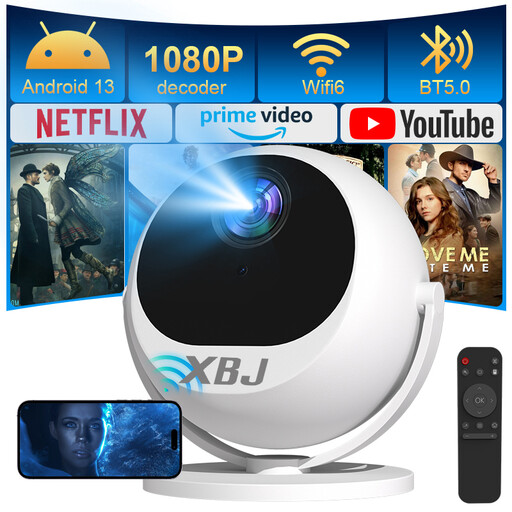
Native 1080P; 8K supported; Android 14; Wi-Fi 6; Bluetooth 5.4; 180° rotation.
 No image available
May work well for presentations from a laptop. Check that the required throw distance and connections suit your room and source device.
Full HD 1080P; 500 lumens; 360° rotation; Wi-Fi, Bluetooth and HDMI according to the product name.
 No image available
The short-throw designation may be useful if the projector needs to be placed nearby. Check the distance required for your image width.
3600 ANSI lumens; DLP; XGA resolution (1024 × 768). XGA resolution is worth considering if your portfolio includes very fine typography.
 No image available
Could be an option if you’re looking for a short-throw model for presentations. Check the throw distance and image size against your space, and view your own files.
3000 ANSI lumens; 3LCD; WXGA resolution (1280 × 800). This resolution is worth considering if your portfolio includes very fine typography.
Measure the image width you want and the available distance between the lens and the projection surface. Compare these with the throw distance for the exact model, and allow for space for the device and cables too.
Check the projector’s native resolution and view your files at the image size you plan to use. For example, Epson lists 1280 × 800 pixels for the EB-760W. Whether fine text remains legible also depends on your chosen image size and setup.
Digital keystone correction can adjust the image shape, but BenQ notes that this can also affect sharpness and the edges of the image. So position the projector as squarely as possible and check the result with your own files.
Test your laptop’s video output, the projector input, any adapters, the power supply and your presentation files in advance. When you arrive, also check the throw distance, projection surface and available light.
If you buy online as a consumer, ACM ConsuWijzer says you generally have up to 14 days after delivery to change your mind, subject to applicable exceptions. The seller is also responsible for the statutory guarantee if a product doesn’t perform as you could reasonably expect under normal use. If your purchase is mainly for business use, the same consumer protections don’t automatically apply.