
Student with a visually rich portfolio
Shows illustrations, photographs and typography, and wants fine details to remain easy to see. Check colour-critical work on a screen you know and trust as well.


Start with the available projection distance and ambient light: these determine whether the image size and brightness you want will work in the room. Then consider the projector’s native resolution, connections and power supply. A battery-powered projector is useful if you move between rooms, while a brighter mains-powered model may be an option if it’s difficult to darken the room. No specification can prove colour accuracy when displaying your portfolio, so check colour-critical work on a screen you know and trust.
Shows illustrations, photographs and typography, and wants fine details to remain easy to see. Check colour-critical work on a screen you know and trust as well.
Takes presentations to different rooms and weighs portability and power options against the brightness required for each space.
Has limited distance between the table and the wall, and wants to check in advance that the image size, positioning and laptop connection will work in the space.
First, measure the available projection distance and work out how much you can darken the room. Then compare the native resolution, connections and power supply with your presentation needs.
| What to consider | What should you check? | Who is this important for? |
|---|---|---|
| Details and colours | Check the native resolution and, if possible, view your portfolio on the intended surface. Use a screen you know and trust for critical colour assessment. | If I’m showing small text, fine lines and colour-critical images, I want to assess the details without treating a stated colour gamut as proof of colour accuracy; around 25% of consumers give details and colours their top priority. |
| Ambient light | Make a note of whether you can darken the room and how large the image needs to be. Compare brightness figures along with their units of measurement. | If I’m presenting in a room that can’t be darkened properly, visibility comes first for me; around 25% of consumers give performance in ambient light their top priority. |
| Portability and power | Check the weight, built-in battery and the conditions attached to any stated battery life. Consider mains power if the presentation might run for longer. | If I often move between rooms or don’t know where the nearest socket is, I want to know whether the projector and its power supply will be practical to carry; around 19% of consumers prioritise portability and power. |
| Connection to your source device | Compare your laptop’s video output with the projector’s exact inputs and test the connection beforehand. | If I’m showing my portfolio from my own laptop, I want to be sure in advance that the devices can transfer the image; around 19% of consumers give connection to the presentation device their top priority. |
| Projection distance | Measure the distance from the lens to the wall and the image width you want. Check the model’s throw ratio and limit digital image correction where possible. | If the table is close to the wall, the image size you want must fit within the available distance; around 12% of consumers prioritise limited space and projection distance. |
A projector may accept a particular video signal without projecting at that resolution itself. The difference can be noticeable with small text and fine portfolio details.
Check the native resolution of the exact model variant.
Ambient light and image size affect how visible a projection is. What’s more, ISO and ANSI lumens aren’t directly comparable.
First, consider the lighting and the image size you want, then check the unit of measurement used for the brightness figure.
Digital keystone correction can crop the image or reduce its quality, which can matter when displaying small text.
Check the projection distance and position the lens as squarely as possible towards the projection surface before using digital correction.
Products with almost identical names may differ in their version or bundle. For example, the MoGo 4 Match Night EU Edition is a specific bundle, while the Capsule 3 Laser is a different model from the Capsule 3.
Before buying, compare the full model name, version and what’s included in the box.
BenQ offers compact models with different positioning options, as well as a separate lamp projector designed for mains power.
The Lifestudio Pop EF-61W is a portable Full HD projector for a compact setup.
According to XGIMI, the MoGo 4 combines a built-in battery with a rotating stand for different setups.
The Capsule 3 Laser is a compact projector for anyone who values portability and a built-in battery.
The N2 mini is a compact Full HD projector with a tilting stand.
These compact projectors at Joybuy offer different ways to display a design portfolio in a small space, from short-throw projection to models with a battery or adjustable positioning.
 No image available
The stated native resolution and HDMI connection are relevant if you want to show fine details from a wired presentation source.
Native 1080P; stated brightness 700 ANSI lumens; HDMI; autofocus and automatic keystone correction; stated projection size 40–200 inches.
 No image available
The built-in battery makes this model an option if you want to take the projector between presentation rooms.
Full HD 1080p; 450 ISO lumens; built-in battery; Match Night EU Edition with EA SPORTS FC 26 game code. XGIMI states up to 2.5 hours of video in eco mode.
 No image available
The stated short throw can be useful when the projector needs to sit close to the wall.
Native 1080p Full HD; HDMI; RGB triple laser; stated brightness 650 lumens; throw ratio 0.18:1; stated projection distance 0.26–0.4 m; net weight 1.72 kg.
 No image available
The HDMI connection and stated throw ratio are relevant if you’re presenting from a laptop and want to plan the setup in advance.
Native 1080P Full HD; stated brightness 900 ANSI lumens; HDMI; autofocus and automatic keystone correction; throw ratio 1:1. A large image is stated at 1.35 m.
 No image available
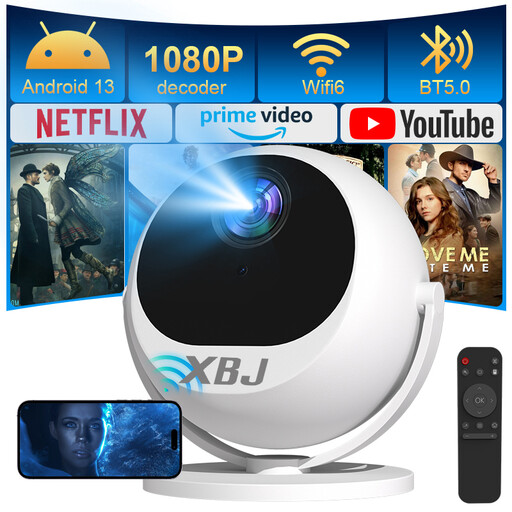
The rotating setup can be useful if you want to adjust the projection direction in a compact space.
Full HD 1080P; stated brightness 500 lumens; 360° rotation; automatic focus and keystone correction; HDMI and laptop compatibility listed.
Measure the distance from the planned lens position to the wall and decide how wide you want the image to be. Compare these measurements with the exact model’s throw ratio, or use a model-specific distance calculator. Try to limit digital keystone correction.
No. Check the projector’s native resolution, not just the input signals it accepts. This distinction matters if small text and fine lines need to remain legible.
That depends on both your source device and the exact projector model. Check in advance which screen-sharing feature or video input both devices support. For example, BenQ’s GV50 specifications list HDMI and USB-C DisplayPort input.
Applicable EU rules may require electrical and electronic equipment to carry CE marking. The Netherlands Enterprise Agency explains that CE is a conformity marking, not an independent safety certification. Check the product information that applies to the exact version.
According to the Dutch government, consumers buying at a distance are entitled to a 14-day cooling-off period in many cases. Check the applicable exceptions and the terms of the specific sale.