
Presenting a portfolio in ambient light
You want a small group to be able to view text and designs while keeping enough light on for a conversation. Compare the stated brightness with the lighting and image size in the room.


Choose a projector based on the available projection distance, the lighting during your presentation and the smallest details visitors need to read. In ambient light, a model with a higher stated brightness may be worth considering, while short-throw models can work well if there’s little space behind the seating area. For venues that vary and can be darkened, portability may be more important. Epson recommends matching brightness to the viewing environment, so test your own portfolio at the intended image size. Don’t rely solely on a projection to assess colour-critical work.
You want a small group to be able to view text and designs while keeping enough light on for a conversation. Compare the stated brightness with the lighting and image size in the room.
You can’t position the projector between the chairs or in a walkway. Start by measuring the distance to the wall or screen.
You set up your presentation in a different place each time and can control the lighting. Portability, power supply and a reliable connection to your laptop are important considerations.
| What to consider | What should you check? | Who is this important for? |
|---|---|---|
| Readability in ambient light | Compare the stated brightness and measurement unit with the room’s lighting. Test the smallest text at the intended image size. | If you want to keep the lights on during your presentation, visitors need to be able to view text and designs. Around 31% of consumers prioritise readability in ambient light. |
| Projection distance and seating area | Measure the distance from the lens to the projection surface and decide on your preferred image width. Check that the exact model can accommodate that combination. | If chairs or visitors take up the usual setup spot, you’ll want to position the projector close to the screen. Around 25% of consumers give limited setup space top priority. |
| Colour and fine detail | Check the native resolution and available picture modes. Assess colour-critical work using a suitable, controlled reference too. | If subtle colour differences and small graphic details are central to your work, don’t use the projection as your only colour reference. Around 25% of consumers prioritise colour and design details. |
| Moving the projector and connecting a laptop | Check that your laptop and projector support the same video connection, and test them with your own cable. Check whether the specific model has a battery. | If you often present at different venues, you’ll want to transport and connect your setup easily. Around 19% of consumers prioritise portability and connectivity over the other considerations. |
Resolution won’t make an unsuitable projection distance or an image that’s hard to read in the available light suitable by itself.
Measure the room and test your own text and images at the intended image size before making a decision.
Colour gamut and colour accuracy are different properties. Ambient light also affects how the projection looks.
Use the projection to discuss your work, but assess colour-critical choices using a suitable, controlled reference too.
Epson lists a lamp for the EB-FH52, while BenQ specifies an LED light source for the LH600ST. Don’t assume their maintenance requirements are the same.
Check the light source, maintenance instructions and warranty terms for the exact model.
The EB-FH52 reviewed here is designed for Full HD presentations at a standard projection distance; the EB-760W is designed for ultra-short-throw projection.
The LH600ST reviewed here is designed for short-throw projection; the GV50 is a separate portable range for venues where you can control the lighting.
The NeoPix 530 reviewed here is a compact Full HD home projector that you can include in your comparison for a portfolio setup in a darkened room.
These projector options are suited to different needs, including portability, image resolution and positioning in a small room. Check whether the image size, connections and lighting conditions work for your presentation with each model.
 Image unavailable
The built-in battery and included projection screen with stand are useful if you move your setup frequently.
Full HD 1080p; 250 ISO lumens; built-in battery; projection screen with stand.
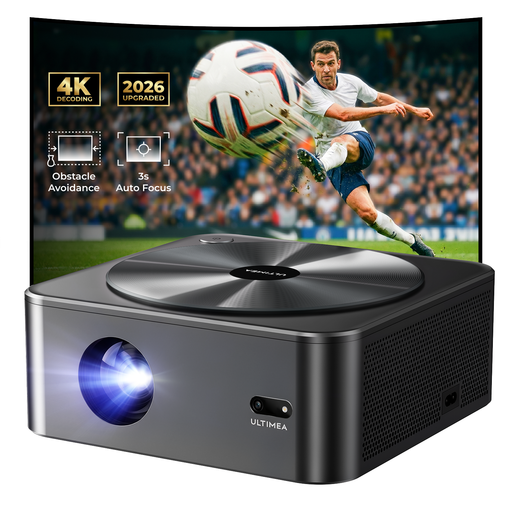 Image unavailable
Its stated resolution makes this a model worth comparing with your portfolio. Test text and images at the planned screen size in your presentation room.
HDR10; 1080p; 700 ANSI lumens.
 Image unavailable
The stated projection distance may suit a small seating area. Check the desired image size and positioning for your own setup.
Native 1080P; 1000 ANSI lumens; 4K support.
 Image unavailable
The portable design may suit you if you present at different venues. Check the positioning and connection for each setup.
Native 1080P; 700 ANSI lumens; 4K support.
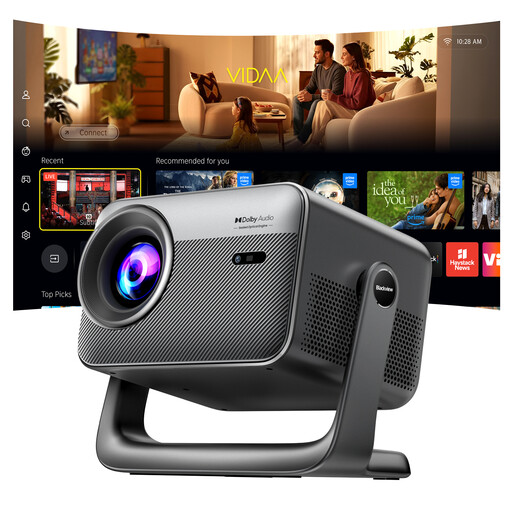 Image unavailable
The rotating design may suit a setup with a flexible projection surface. Decide in advance where you want to display the image.
Native 1080p; 1000 ANSI lumens; stated image size 40–150 inches; 360° rotation.
Measure from the intended lens position to the wall or screen, then decide on your preferred image width. Next, check the distance chart or throw ratio for the exact model. A short-throw projector can help when chairs take up the usual setup space.
That depends on the lighting, image size and model. Epson matches the required brightness to the viewing environment, so test the smallest text in your portfolio in the conditions you’ll have during the presentation.
No. Check that both devices support video over USB-C. BenQ specifies DisplayPort input via USB-C for the GV50, but that doesn’t confirm that your laptop or adapter outputs video. Test the connection beforehand; HDMI may be an alternative if both devices support it.
For a consumer purchase, the seller is responsible for the statutory guarantee if a product is faulty, as explained by the Authority for Consumers and Markets. For online consumer purchases, you’ll generally also have 14 days from delivery to change your mind, subject to legal exceptions. If you’re buying mainly for business use, don’t assume the same consumer protections apply.
Check the rights to third-party material separately from your choice of projector. The Dutch Government says that you generally need the creator’s permission to use copyright-protected work. Whether a particular school presentation falls under an exception depends on the circumstances.