
Daytime viewer with tall windows
Wants to watch opera recordings while daylight is coming in, and is mainly looking for guidance on light levels, projector brightness and screen size.


Start by checking the light where the image will appear. Reduce light entering the room where possible, then assess the stated light output alongside your preferred image size. Choose a projector to suit the distance in your room, and check how to connect your opera recording to your audio system. No stated lumen rating can guarantee a clear picture when sunlight falls directly on the screen.
Wants to watch opera recordings while daylight is coming in, and is mainly looking for guidance on light levels, projector brightness and screen size.
Wants to enjoy a large image with an existing soundbar, receiver or speakers, and needs to check that the projector, playback source and audio equipment have compatible connections.
Has little distance between the projector and screen, so is comparing standard, short-throw and ultra-short-throw options.
BenQ Netherlands describes ambient light and image size as factors that affect how clearly a projected image can be seen. So don’t compare lumen ratings alone: consider the exact screen position, your preferred image size and the space available for the projector.
| What to consider | What should you check? | Who is this particularly relevant to? |
|---|---|---|
| Visibility in daylight | Assess the light where you plan to put the screen, and compare light output figures measured on the same basis. Consider your preferred image size and whether you can block out the light. | If I want to watch during the day, I need to know how much light reaches the screen and whether I can cover the windows. Around 33% of consumers make daytime visibility their top priority. |
| Audio from the recording | Check the ports and supported audio formats on the projector, playback source and soundbar or receiver. ARC/eARC only works if the devices involved support it and are set up correctly. | If you want to listen to the opera through your own soundbar or receiver, check the connection between all your devices. Around 27% of consumers make compatibility with their preferred audio system their top priority. |
| Projector distance | Measure the distance from the lens to the screen and compare it with the throw ratio and preferred image size for the exact model. | If space is limited, I need to know whether the projector can produce the image I want from the available position. Around 20% of consumers choose mainly on the basis of whether the projector will fit their room layout. |
| Image detail | Check the image resolution separately from support for a 4K input signal, and remember to consider the light falling on the screen. | If I want to make out faces, costumes and subtitles clearly, I look at the resolution of both the recording and the projector. Around 20% of consumers make visible detail their top priority. |
Daylight on the projection surface can make the image less clear. BenQ Netherlands also explains that a larger image spreads the projector’s available light over a bigger area.
Assess the light at the actual screen position and compare light output figures only when they are measured on the same basis. Don’t expect a clear picture if direct sunlight falls on the screen.
Bear in mind that you may also need window coverings or a suitable projection screen.
A screen needs to suit the way the projector casts the image onto it. A screen designed for a different projection direction may not work with your planned set-up.
Before buying, check whether the screen is designed for standard, short-throw or ultra-short-throw projection, and for the projector’s position.
A mismatch could mean changing your set-up or buying a different screen.
Support for a 4K input signal does not, by itself, tell you what resolution the projector actually displays.
Check the displayed image resolution and supported source resolution separately, and compare them with your opera recordings.
For audio over ARC/eARC, the devices involved need to support the feature and be set up correctly. BenQ Support recommends checking the projector, soundbar and receiver together.
Check the connections and settings on your projector, playback source and audio system before choosing a model.
Depending on the connections available, you may need a different cable or to change the audio route.
The EH-TW7100 is an example of a standard home projector with lens shift.
The TH575i and TK705STi offer different placement options: standard and short-throw.
The UHZ66 is a laser projector designed for fixed installation.
The PX3-PRO is an example of ultra-short-throw projection.
These models give you a starting point for matching light output, image resolution and projection distance to your opera recordings and room. Assess the light falling on the screen separately: the stated figures don’t guarantee visibility in direct sunlight.
 No image available
An option to compare if you’re looking for a 4K UHD projector and want to take the distance to the screen into account.
The product information lists a laser light source, 3,800 lumens, a throw ratio of 1.21:1–1.59:1 and a projection distance of 1–8 m. It also lists two HDMI inputs. Check that the distance suits your preferred image size.
 No image available
A 4K projector to consider if image detail and flexible positioning matter to you.
The product information lists 3,000 ANSI lumens, an adjustable gimbal and automatic image correction. Compare the stated light output with the light levels and image size in your room.
 No image available
A 4K UHD laser projector to compare with the available room distance and your preferred screen size.
The product information lists 3,500 lumens, a throw ratio of 1.21:1–1.59:1, two HDMI 2.0 inputs and a projection distance of 1–8 m. Check that the distance suits your set-up.
 No image available
The short-throw distance may be useful if you have limited space between the projector and screen.
The product information lists a throw ratio of 0.52:1, 3,800 ANSI lumens, a distance of 0.4–3.4 m and a built-in 10 W speaker. The native resolution is WXGA 1280 × 800, so Full HD content won’t be displayed at native Full HD resolution.
 No image available
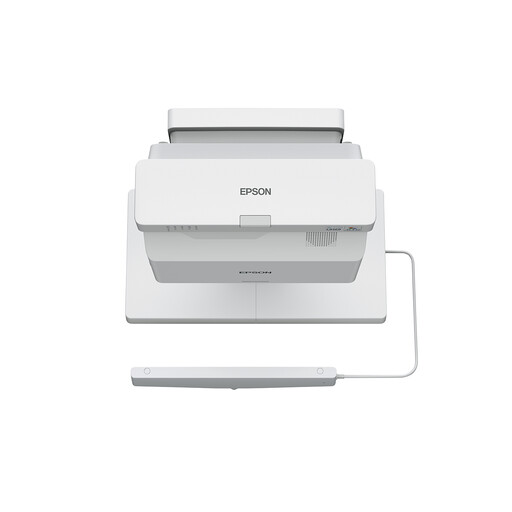
An ultra-short-throw projector to consider if you need to position the projector close to the projection surface.
The product information lists a throw ratio of 0.27–0.37:1, 4,100 ANSI lumens and a native resolution of WXGA 1280 × 800. Check that the resolution suits the image quality you want for your recording.
Not necessarily. Daylight on the screen can make the projected image less clear, and a larger image spreads the same projector light over a bigger area. So consider the screen position, image size and ways to block out the light too. Don’t count on a clear picture if direct sunlight falls on the screen.
Check the connections and supported audio formats on the projector, playback source and soundbar or receiver. For ARC/eARC, the devices involved must support the feature and be set up correctly. One model having eARC tells you nothing about other projectors.
Measure the distance to the intended screen position and compare it with the throw ratio of the exact model. Also check the light source type and model-specific maintenance instructions. The stated light source life is not a promise about how long other components will last.
For distance purchases, you generally have a 14-day cooling-off period, as explained by the Dutch government; exceptions may apply. You are also entitled to a product that is fit for purpose. The Netherlands has no fixed statutory warranty period; if a product is faulty, contact the retailer.
The Dutch government says that, under certain conditions, you may make a private copy for your own use, but you must not distribute it or make it available to the public. This doesn’t tell you whether a particular recording or streaming service allows it to be shown outside a private setting. Check the rights and terms of use for that recording.