
Host with a bright living room
You’re hosting a documentary night while light is still coming in through tall windows. You mainly want to know whether the picture, especially dark scenes, will remain visible.


Start by considering the daylight on the projection surface: a high stated brightness doesn’t guarantee that dark scenes will be easy to see when direct sunlight falls on it. Next, choose a standard-throw projector if you can position it at a suitable distance, or an ultra-short-throw model if your room is suitable for placing it by the wall. Also check the image size, playback source and sound.
You’re hosting a documentary night while light is still coming in through tall windows. You mainly want to know whether the picture, especially dark scenes, will remain visible.
You want subtitles and documentary footage to look sharp, and are weighing native resolution against brightness and image size.
You want to keep the projector and cables out of the way of your guests, and are checking whether placing it close to the wall will work in your room.
First, assess the light where you’ll be projecting. Then measure the image size and throw distance you need, and finally check how you’ll play the documentary and make sure your guests can hear the audio.
| What to consider | What should you look for? | Who should consider this? |
|---|---|---|
| Visibility in daylight | Compare the stated brightness and how it’s measured. Also consider whether you can block out light from the projection surface during the screening. Epson and Acer list their brightness specifications using different figures and terms. | If light is coming in through tall windows, you’ll want to know whether dark scenes will remain visible on your projection surface. Around 36% of consumers prioritise visibility in daylight. |
| Film detail and subtitles | Check the native resolution, not just which input signals are supported, and assess subtitles at your preferred image size. Epson lists Full HD for the EH-TW840; Acer lists a native resolution of 1280 × 800 for the X1329. | If detail in footage and subtitles matters to you, compare the native resolution with your source material. Around 29% of consumers make film detail their top priority. |
| Projector position and image size | Measure the available space and the image width you want, then compare them with the placement information for the exact model. Epson says the EH-LS800B can project an 80-inch image from 2.3 cm away from the wall. | If you can’t place the projector between guests or furniture, make sure a near-wall setup will work. Around 21% of consumers say positioning is the deciding factor. |
| Playback and sound | Check that your preferred app or HDMI source will work, and see which audio connections are available. BenQ lists a Google TV dongle included with the TH575i; Epson specifies a 2 W mono speaker for the EH-TW840. | If you want to start the documentary easily and make sure your guests can hear the dialogue, consider the entire playback and audio setup. Around 14% of consumers make this their top priority. |
Brightness figures may be based on different measurement methods or operating modes. What’s more, a high stated figure doesn’t automatically mean dark scenes will be visible in daylight.
Compare the measurement method and mode, and assess the light on your planned projection surface during the screening.
You may also need to block out the windows or adjust the screen position.
The Acer X1329 has a stated native resolution of 1280 × 800. Accepting a higher input resolution doesn’t change a projector’s native resolution.
Look for the native resolution in the specifications and check subtitles at your intended image size.
An ultra-short-throw model can save space by the wall, but it won’t stop daylight from falling on the image surface.
Consider positioning and incoming light separately, and check that the wall or screen and furniture layout will work with the exact model.
Epson specifies a built-in 2 W mono speaker for the EH-TW840. That specification doesn’t tell you whether dialogue will be easy for a group to hear in your room.
Check the audio output and test how clearly you can hear the sound from the seats. You may need external speakers or audio cables.
The models mentioned highlight different trade-offs between native resolution, brightness and positioning.
According to BenQ, the TH575i combines 1080p, a stated brightness figure and an included Google TV dongle.
The X1329 is an example of how to weigh stated brightness against native resolution.
Optoma Europe describes the GT3500HDR as an ultra-short-throw laser projector for home entertainment.
These product picks suit a documentary night, with models offering listed features for streaming, positioning or picture detail. Check that each model’s specifications and setup will work in your room.
 No image available
The listed built-in apps may be useful if you want to stream without a separate streaming stick. Check that your preferred service is available.
The product name lists Wi-Fi 6, Bluetooth, automatic keystone correction, 180° rotation and HDMI compatibility. It also lists an image size of 50–200 inches and digital zoom of 50%–100%.
 No image available
This model may suit anyone specifically looking for 4K UHD. Also check the space needed for setup and the light falling on the projection surface.
The product name lists 4K, UHD and Triple Laser. Don’t rely on those labels alone to judge how visible the image will be in your room.
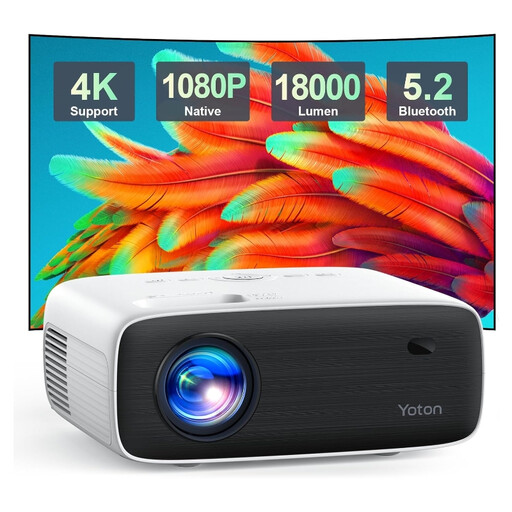 No image available
The listed native 1080P resolution may be worth considering if subtitles and film detail matter to you. Also check which connections your playback source needs.
The product name lists Bluetooth, 4K LCD and native 1080P. Check what these specifications mean for your source and the picture you want.
 No image available
If you’re considering this model, compare its throw distance and image size with the space available before deciding where to set it up.
Also check that the connections and audio setup suit your source and the sound you need for documentary night.
 No image available
The listed native 1080P resolution may matter if you’re considering film detail. Also check the positioning and light on the projection surface in your room.
The product name lists native 1080P, 900 ANSI, Android 14, 5G Wi-Fi 6, Bluetooth 5.4 and 180° rotation. It also mentions 8K support, which isn’t the same as native 8K resolution.
A stated lumen figure can’t guarantee that. Assess how much daylight reaches the projection surface, block out light if necessary and consider using a smaller image size.
Measure the available distance and the image width you want, then compare them with the placement information for the exact model. An ultra-short-throw model sits close to the wall, while a standard-throw projector needs a different position in the room.
First, check that you can play your documentary using the app or HDMI source you have in mind. BenQ lists a Google TV dongle included with the TH575i; Epson specifies a 2 W mono speaker for the EH-TW840. Whether the sound will be loud enough for your guests depends on the room and seating.
For eligible distance purchases, the Dutch government generally provides a 14-day cooling-off period. You’re also entitled to a product that’s fit for purpose; the Netherlands has no fixed statutory guarantee period. If there’s a fault, contact the seller.
This depends, among other things, on the film, the service and the nature of the screening. The Dutch government makes clear that copyright-protected material can’t automatically be made available to the public. For a public or business screening, check the rights for the specific film and service.
According to the Dutch government, when buying a new appliance, individuals can return an old, similar electrical appliance to the seller free of charge, including when buying online. A local recycling centre is another option.