
Viewer with a shallow unit
Wants to project a dance competition on a large screen without placing the projector at the back of the room. Measure both the available space on the unit and the distance to the wall.


Measure the space for the projector, the distance to the wall and your desired image width before choosing a model. A compact casing doesn’t automatically mean the projector can produce a large image from close up. An ultra-short-throw model sits close to the wall but still takes up space, while you can put a portable projector away after use. Also consider the light in the room and check that your video source and audio will work with your chosen projector.
Wants to project a dance competition on a large screen without placing the projector at the back of the room. Measure both the available space on the unit and the distance to the wall.
Can’t fully darken the room and wants to keep up with fast-moving action. Compare the stated brightness and any image processing features, but don’t treat these specifications as a guarantee of how the picture will look in your room.
Has no permanent spot for the projector and wants to clear the unit again after the competition. A compact model can be handy, provided the projection distance and setup also work for you.
The three setups address different space constraints, but in each case you’ll need a suitable place for the projector itself.
Suitable if: you have a suitable permanent spot close to the projection wall.
Trade-off: the short distance to the wall doesn’t save space on the unit itself.
Suitable if: you can place the projector between the seating and the wall, but don’t have room for a longer projection distance.
Trade-off: you’ll still need a suitable spot for the projector and the right distance between the lens and the wall.
Suitable if: you want to put the projector away after the competition and don’t need a permanent setup.
Trade-off: you’ll need to check the distance and image position each time you set it up again.
| Buying consideration | What should you check? | Who should give this more weight? |
|---|---|---|
| Will the setup fit? | Measure the available space on the unit, the distance from the lens to the wall and the width of the projection wall. Compare these measurements with the specifications for the exact model. | If my unit is shallow, I want to know whether both the projector and the image I want will fit without placing it at the back of the room. For around 36% of consumers in this situation, placement is the main buying consideration. |
| Will movement remain clear? | Check the stated brightness and its unit of measurement, whether you can darken the room and any motion features listed for the specific model. | If I want to follow fast-moving action during the competition, I take the light in my living room and the model’s image processing features into account. Around 29% of consumers prioritise visibility. |
| Can the projector be put away? | Check the dimensions, stand, power cable requirements and projection distance for the exact model. | If I want to clear my unit again afterwards, how easy the projector is to move and put away matters. For around 21% of consumers, tidying away is the priority. |
| Will the picture and sound work? | Check that the broadcast works through your chosen app or video source, and see which connections and audio outputs are available. | If I want to watch the competition with as little extra equipment as possible, I check the source and sound in advance. Around 14% of consumers put connectivity and audio at the top of their buying considerations. |
The distance from the lens to the wall affects the image size; the projector’s external dimensions won’t tell you this.
Measure the available distance and compare it with the specifications for the exact model before choosing based on size.
You may need to change the setup or use a suitable projection screen.
A short projection distance doesn’t mean the projector itself takes up no space.
Check the casing dimensions, lens position, clear wall space and ventilation clearance together as part of your setup.
Room lighting and the video source you use affect what you see during the competition. Specifications aren’t a real-world test in your living room.
Compare brightness with its stated unit of measurement, see whether you can darken the room and check which image features the specific model offers.
App availability and access to your chosen broadcast can vary between services and devices.
Check the broadcast, account requirements and a working connection for an external video source in advance.
Depending on your chosen source, you may need a separate player, cable or subscription.
The TH671ST is a specific short-throw model you can compare for its space requirements and connections.
The PX3-PRO is an example of an ultra-short-throw model designed for a permanent spot by the wall.
The Freestyle+ is a portable option if you want to move or put away the projector after watching.
The EH-TW7000 is a model to compare if image positioning and motion processing matter to you and you have room for a larger setup.
The N2 mini is a compact setup with an integrated stand.
These models are aimed at anyone looking to reduce the distance between the projector and the wall. Also measure the space for the device and check how much room your desired image will need.
 Image unavailable
A short projection distance and built-in audio could work well for a permanent setup for the competition.
Throw ratio 0.52:1; stated brightness 3800 ANSI lumens; DLP with WXGA resolution of 1280 × 800; HDMI and a built-in 10 W speaker. The product description also mentions a sports mode.
 Image unavailable
A portable ultra-short-throw model to compare if the projector needs to sit close to the wall.
Throw ratio 0.18:1 and stated projection distance of 0.26–0.4 m; native 1080p; RGB triple-laser light source; 650 lumens; HDMI 2.0. Dimensions are 252 × 157 × 62 mm.
 Image unavailable
A model to compare if you’re looking for a short throw ratio and can measure the required distance in advance.
Throw ratio 0.49; stated brightness 3600 ANSI lumens; DLP with XGA resolution of 1024 × 768; HDMI.
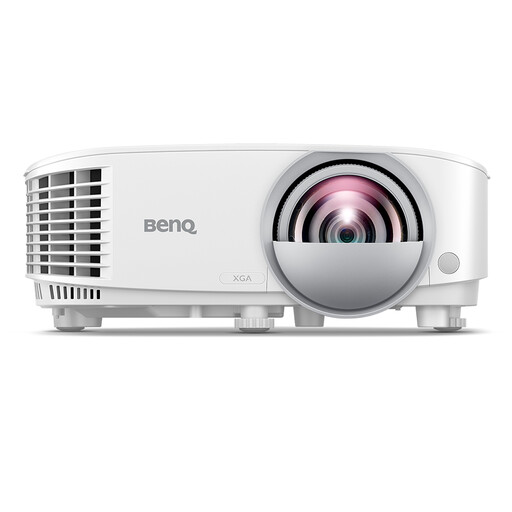 Image unavailable
Could suit anyone looking to compare short-throw projection and built-in audio for their chosen setup.
Throw ratio 0.61; stated brightness 3500 ANSI lumens; DLP with XGA resolution of 1024 × 768; built-in 10 W speaker.
 Image unavailable
A short-throw model to compare if you want to move the projector after use.
Stated brightness 3000 ANSI lumens; 3LCD with WXGA resolution of 1280 × 800; automatic vertical and horizontal keystone correction. The product description mentions a carrying case.
Measure from the intended lens position to the projection wall, then measure the available image width. Compare these measurements with the throw ratio or the distance and image size table for the exact model. Don’t just look at the projector’s external dimensions.
Follow the ventilation and cooling instructions for your chosen model. BenQ recommends placing portable projectors on a hard, flat, well-ventilated surface; soft fabrics can block the vents. Check the manual to see how much clearance your model needs.
According to ACM ConsuWijzer, you have a legal guarantee as well as any manufacturer’s or seller’s guarantee. If a product doesn’t meet reasonable expectations under normal use, the seller must offer an appropriate solution free of charge. In the Netherlands, there is no general fixed legal guarantee period of two years.
For many qualifying distance purchases from a business, you have a 14-day cooling-off period. The Dutch Government lists exceptions and, among other things, distinguishes between purchases from a private individual and purchases from a business.
Relevant EU product rules apply to electrical and electronic equipment, and CE marking may be required. The European Commission says the manufacturer is responsible for compliance and that CE marking isn’t a certificate from a central EU body. Check the product information for the specific device and the power supply included.