
Viewers with limited space to set up
You want to show a competition broadcast without the projector or cables taking over your small seating area. That makes the throw ratio and placement important considerations.


First, measure the distance between the lens and the projection surface, then decide what image width will be comfortable from your seats. Next, choose a model with a throw ratio suited to your space. In a room with the lights on, a model with a higher stated light output may be worth considering, while a portable, less bright projector may be a better fit for a room you can darken. Manufacturer information from BenQ, Epson and Optoma can help you compare models, but it is not a comparative real-world test.
You want to show a competition broadcast without the projector or cables taking over your small seating area. That makes the throw ratio and placement important considerations.
If you can’t turn all the lights off, consider the stated brightness alongside the image size and projection surface. Simply choosing the largest possible image isn’t enough to make an informed decision.
If you move the projector between different spots, practical points to consider include the power supply, connection to the video source and whether the sound is audible.
Start with the available distance and the image width you want. Then consider the ambient light and check that the source, power supply and sound set-up are suitable for watching.
| What to consider | What should you check? | Who is this important for? |
|---|---|---|
| Projection distance and sightlines | Measure the distance from the lens to the projection surface and the available width. Compare these with the throw ratio and image sizes for the exact model. | If I have limited space and want to keep the walkway clear, the projector needs to produce the image width I want from the available spot. This is a priority for around 42% of consumers who put set-up space first. |
| Visibility in ambient light | Work out how much light will be left on. Compare brightness figures only when the measurement basis is clear, and take the projection surface into account too. | If the room can’t be completely darkened during the competition, I want to weigh up the image size and stated brightness together. Around 33% of consumers prioritise visibility in ambient light. |
| Source, power and sound | Check that the video source output is compatible with the model’s inputs; consider the power supply and test the sound from the seats. | If I’m moving the projector or watching with a group, I want to know that the source will connect and the sound will be audible from the seats. This is the main concern for around 25% of consumers. |
The image width you can achieve depends on the distance to the projection surface and the space available. A large figure on its own doesn’t tell you whether the set-up will fit your seating area.
Before you buy, measure the distance from the intended lens position to the projection surface and check the throw ratio of the exact model.
You may need a different screen size or set-up position.
For the Optoma Photon Go, the manufacturer states 650 lumens in accordance with ISO 21118, as well as 1200 using a different measurement basis. These figures are not directly comparable.
Check the measurement method for each brightness figure and assess the model in relation to the light in your room.
The Joybuy title for the BenQ MW809STH lists XGA, while BenQ specifies this model as WXGA (1280 × 800). This difference may matter for the picture you want to display.
Before buying, check the full model name and resolution with the manufacturer and retailer.
The TH671ST is a Full HD short-throw model for an HDMI video source and limited set-up distance. The MW809STH is a separate WXGA model designed for education and presentations.
The EB-760W is an ultra-short-throw model designed to sit close to the projection surface, for example when the seating leaves little floor space.
The Photon Go is a portable ultra-short-throw option for a viewing set-up you can move around.
These Joybuy picks are suited to short projection distances and small spaces. The product names refer to different Full HD, XGA and WXGA versions; check the resolution and set-up requirements of the exact model.
 No image available
Suited to a small seating area where a short-throw set-up is preferred.
The product name lists 520 ISO Lumens, Google TV Built-in and Dual 5W Speakers. Check that the version on offer and its connections are suitable for your video source.
 No image available
Designed for a portable ultra-short-throw set-up; battery life is useful if there isn’t a plug socket nearby.
Optoma lists Full HD, a built-in battery and up to 1.5 hours of battery playback. The manufacturer states 650 lumens in accordance with ISO 21118, as well as 1200 using a different measurement basis; don’t compare these figures as if they were measured in the same way.
 No image available
The short throw is suited to a set-up with limited space between the projector and the projection surface.
The Joybuy product title lists XGA and 3600 ANSI Lumens. BenQ specifies WXGA (1280 × 800) for the MW809STH; check which version and resolution the product on offer has.
 No image available
The short-throw design suits a small room where you want to keep the distance to the projection surface short.
The product name lists WXGA, 3800 ANSI Lumens and 3D. Check that the resolution is right for the details you want to follow during the competition.
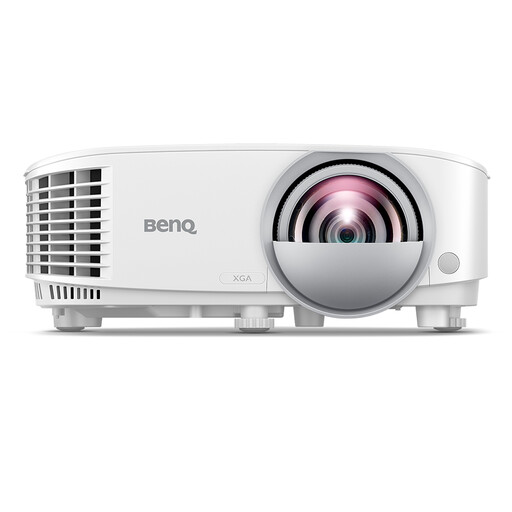 No image available
The short-throw design is useful when there’s little room for the set-up.
The product name lists 3500 ANSI Lumens, DLP and XGA (1024 × 768). Compare the resolution with the image details you want to see during the competition.
Measure the distance from the intended lens position to the projection surface, along with the available image width. Compare these with the throw ratio and image sizes for the exact model. Also check that the projector, cables and viewers won’t get in each other’s way.
That depends on the length of the event and the model. Optoma lists up to 1.5 hours of battery playback for the Photon Go; plan to use mains power if the viewing may last longer.
Check which items, such as a screen, suitable cables or extra sound equipment, you’ll need for your set-up. According to the Dutch government, consumers buying in the Netherlands are entitled to a product that works properly, and the retailer is the point of contact if there’s a problem; there is no fixed statutory guarantee period. For online purchases, you generally have 14 days to change your mind when this scheme applies.
That depends on the rights and conditions for the specific broadcast and venue. The Dutch government says that copyrighted material may not be made available to the public without permission; BumaStemra states that permission is needed to play music in public. So check the terms for both the broadcast and the music.