Start by considering the light levels where you’ll place the screen, your preferred image width and the distance between the lens and the screen. This will help you work out which brightness and throw ratio will suit your room. If you’ll be watching in daylight, pay particular attention to the stated light output. A short-throw model may be a good option if you have limited space for positioning the projector. Also check that your live source, connections and sound are suitable for your viewing event.
Who is this buying guide for?
Daylight viewers
You’ll be watching together with daylight or room lighting still on. So consider the combination of ambient light, screen size and viewing distance. Epson Netherlands points out that the viewing environment is an important factor when choosing brightness.
Viewers in compact spaces
You need to make room for seating and walkways, and there’s little distance between the projector and the screen. BenQ Netherlands highlights projection distance and screen size as factors to consider when choosing a set-up.
People organising a group viewing
You’re arranging the live source and commentary, and want to know whether there are rules for showing broadcasts in a business or organisation. The Dutch government’s Ondernemersplein explains the licensing requirements for showing TV broadcasts in these settings.
What should you look for when buying?
First, choose where to place the screen and decide on your preferred image width. Then compare the brightness and throw ratio of models that will fit that space, before checking your live source and sound.
| What to consider |
What to look for |
Who is this important for? |
| Visibility in daylight |
Check the light levels where you’ll place the screen and compare them with the stated brightness for your preferred image size. |
If I’m watching with a group during the day, I want to know whether the picture will remain visible at the chosen screen size. Around 31% of consumers prioritise daylight visibility. |
| Projection distance and positioning |
Measure the screen width and the distance from the lens to the screen, then compare these with the model’s throw ratio. |
If there’s little space behind the seating, I want to know whether the projector can produce the desired image width. Around 25% of consumers make limited positioning space their top priority. |
| Live source and commentary |
Check that the broadcast works with your chosen source and connections, and test the sound from the furthest seat. |
For a live event, I want to be able to play the broadcast and hear the commentary from every seat. Around 19% of consumers prioritise the live source and clear commentary. |
| Fast-moving race footage |
Check whether the exact model offers motion processing, and assess the broadcast using your chosen settings. |
If I’m following the race on a big screen, motion handling may matter more to me than a higher resolution. Around 13% of consumers make motion handling their top priority. |
| Maintenance and service |
Compare the light source’s lifespan in each operating mode and check the service terms for the exact model. |
If I use the projector regularly, I want to know in advance what to expect from the light source and service. Around 12% of consumers prioritise maintenance and service. |
Common buying pitfalls
-
Focusing only on the largest advertised image size
Ambient light, screen size and viewing distance all affect visibility. So the largest stated image size alone won’t tell you what the picture will look like in your room.
First, choose where to place the screen and the image width you want for your group. Then compare the brightness and projection distance of models that will fit the space.
-
Confusing 4K support with native 4K
The Optoma HD30LV is specified as Full HD 1920 × 1080 and can also process 4K input. That doesn’t make it a projector with native 4K resolution.
Check the native resolution separately from the supported input signals.
-
Assuming apps and a built-in speaker will cover everything
A projector won’t automatically give you access to the broadcast you want, and built-in sound won’t necessarily be suitable for everyone in a shared space.
Test the specific broadcast, source and sound set-up in advance. If you’re showing content in a business or organisation, check which licensing rules apply.
-
Treating the connections list as definitive
In the Optoma specifications consulted, the summary lists two HDMI connections, while the connections table lists one HDMI input.
For the exact HD30LV version, confirm how many inputs are available and whether they’ll accommodate the devices you need to connect.
Brands and models to consider
Epson
The CO-FH02 is worth comparing if you’re looking for a fixed Full HD set-up. The EH-TW7000 offers different positioning features, including lens shift and optical zoom.
- Epson lists 3,000 lumens of both white and colour light output and an HDMI connection for the CO-FH02. For the EH-TW7000, Epson also lists 3,000 lumens and frame interpolation.
- These model specifications don’t guarantee visibility in your room. Check which features and connections are included with the exact version.
BenQ
The TK705STi is a short-throw option to look into if there’s limited distance between the projector and screen. The TH575i is a separate Full HD range.
- BenQ specifies a throw ratio of 0.8, 3,000 ANSI lumens, MEMC and a sports mode for the TK705STi.
- First, work out whether the model can achieve your preferred image width from the available distance. The manufacturer’s claims about picture enhancement don’t guarantee the results in your room.
Optoma
The HD30LV is a lamp-based Full HD option to compare if its light output and standard projection distance suit your room.
- Optoma specifies 4,500 lumens and a throw ratio of 1.5–1.66:1. The stated lamp life varies by operating mode.
- The specifications don’t clearly state the number of HDMI inputs. Ask the seller to confirm this for the version on offer.
XGIMI
The HORIZON S Max is a portable option with a built-in adjustable stand and automatic picture adjustment.
- XGIMI lists 3,100 ISO lumens and automatic alignment features.
- ISO lumen figures aren’t directly comparable with lumen figures measured or labelled differently. The EU product page consulted says the model isn’t available there; check separately whether it’s available in the Netherlands.
Projectors at Joybuy
This selection includes projectors for group viewing, with a focus on short projection distances, flexible positioning and connecting a live source. If you’re watching an afternoon event, also consider how the stated brightness will work with your screen size and the ambient light.
 No image available
Yaber L2 native 1080P projector
The stated throw ratio of 1.17:1 may help when planning a set-up with limited projection distance.
The title lists 520 ISO lumens, built-in Google TV, two 5 W speakers and native 1080P. The description also mentions automatic focus and keystone correction.
View at Joybuy
 No image available
Video projector with built-in apps and 180° rotation
The stated rotation and automatic picture correction may be useful if you want flexibility when positioning your viewing set-up.
The title lists Wi-Fi 6, Bluetooth, HDMI compatibility, built-in apps, 50–100% digital zoom and a stated image size of 50–200 inches.
View at Joybuy
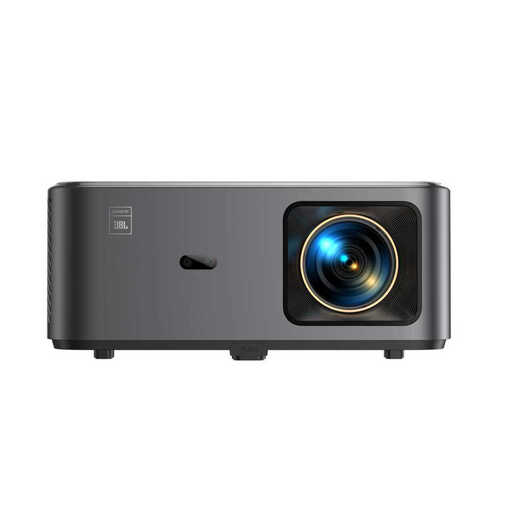 No image available
Yaber K2s projector
The listed HDMI connection and automatic picture correction are useful if you’re using an external live source and need to align the projector.
The product name lists native 1080P, Google TV, Wi-Fi 6 and 4K support; native 1080P is not the same as native 4K.
View at Joybuy
 No image available
Optoma H117ST short-throw projector
The stated throw ratio of 0.52:1 is designed for positioning close to the screen.
The product description lists WXGA resolution, 3,800 ANSI lumens, HDMI input and a 10 W speaker. WXGA is not native Full HD resolution.
View at Joybuy
 No image available
Magcubic HY350Max projector
The stated throw ratio of 1:1 may help you assess whether a short lens-to-screen distance will work.
The title lists native 1080P, 900 ANSI lumens, Android 14 and 180° rotation. HDMI compatibility and automatic picture correction are also mentioned. Visibility also depends on ambient light and screen size.
View at Joybuy
Frequently asked questions
How do you know whether a projector will fit your shared space?
Measure your preferred image width and the distance from the lens to the screen, then compare these with the throw ratio of the exact model. Optoma lists a throw ratio of 1.5–1.66:1 for the HD30LV, while BenQ lists 0.8 for the TK705STi. This will help you decide whether the intended positioning will work with your preferred image size.
Can you watch a cycling broadcast directly on any smart projector?
No. Check in advance that the channel or app you want works with the model, your region and your subscription. If it doesn’t, you may need a separate source connected via HDMI, for example. A projector or licence won’t provide a TV signal by itself.
Do you need permission to show a race in a shared space?
For TV broadcasts shown to employees or guests in a Dutch business or organisation, the Dutch government’s Ondernemersplein says a licence is required. Videma explains that its licence covers the channels it represents, but not automatically channels requiring a separate paid subscription; a different licence may be needed for an event. The rules that apply depend on the space, how the broadcast is shown and which channel you choose.
What if your projector breaks down sooner than expected?
For consumer purchases in the Netherlands, statutory warranty rights apply in addition to any manufacturer’s warranty. If a product doesn’t perform as you could reasonably expect under normal use, the seller must offer an appropriate free solution, according to ACM ConsuWijzer. There isn’t one fixed warranty period that applies to every projector.


