
Viewers in seats at the sides
If you want to watch concert footage from the side, compare the screen material’s stated viewing angle with the actual seating positions. Elite Screens provides material specifications, which can vary by screen type.


For concert films watched from seats beside the screen axis, first check the viewing angle of the screen material: lens shift moves the projected image, but does not change the audience’s viewing angle. If the projector is also off-centre, check the combined optical lens-shift range and projection distance for the exact model; digital keystone correction can affect image quality. Also make sure the audio connections match your playback device and sound system.
If you want to watch concert footage from the side, compare the screen material’s stated viewing angle with the actual seating positions. Elite Screens provides material specifications, which can vary by screen type.
If the projector cannot sit on the screen axis, compare the lens position and projection distance with the combined lens-shift range of the exact model. BenQ and XGIMI describe model-specific lens-shift limits.
If you want to use an existing sound system, make sure the projector’s audio output matches the connections on your other equipment. Epson and BenQ list different audio options for specific models.
Choose this when: your main priority is making the picture easy to follow for viewers beside the screen axis; compare their seating positions with the material’s viewing angle.
Bear in mind: ambient light also matters, and a stated viewing angle does not guarantee the same picture from every seat.
Choose this when: the projector needs to sit beside the screen axis and your measured position falls within the range of the exact model.
Bear in mind: the horizontal and vertical maximums cannot always be used at the same time; lens shift does not change the screen’s viewing angle.
Choose this when: optical alignment is not possible and digital correction is acceptable for your intended set-up.
Bear in mind: BenQ warns that keystone adjustment can affect factors such as sharpness and image size.
| What to consider | What should you check? | Who is this most relevant to? |
|---|---|---|
| Picture from seats at the sides | Measure the outermost seating positions and compare them with the viewing-angle specification for the exact screen material. | If I’m watching from a seat at an angle, I want to be able to follow the picture clearly. Around 36% of consumers rank visibility from side seats as their main buying concern. |
| Off-centre projector | Measure the screen width, lens position and projection distance; check the combined horizontal and vertical lens-shift range. | If the projector cannot sit directly in front of the screen, its position needs to be within the model’s limits. Around 29% of consumers prioritise projector placement. |
| Picture with room lighting | Consider whether you can darken the room, and compare the screen material with the ambient light and seating positions. | If I can’t fully darken the room, I want to know in advance how the screen material will perform in my lighting. Around 21% of consumers prioritise visibility in room light. |
| Audio for concert films | Check the audio output on the exact projector model and the connections on your playback device and sound system. | If you want to connect existing equipment, the connections throughout the audio set-up need to match. Around 14% of consumers choose primarily based on connections for concert audio. |
Lens shift moves the projected image, but it does not change how the screen reflects light towards viewers.
Measure the position of the outermost seats and the projector lens separately; compare the seating positions with the viewing-angle specification for the screen material.
If the combination does not work, you may need a different mounting position.
Controlling ambient light and having a usable viewing angle are two different things; a screen designed for ambient light does not automatically suit every seat at the side.
Compare the viewing-angle specification for the exact material with the outermost seating positions, and take the room lighting into account.
If the seats fall outside the usable viewing angle, you may need to choose a different screen.
The EH-TW7000 and EH-TW7100 are home cinema models for which Epson lists lens shift, optical zoom and keystone correction.
The W4100i is a home cinema projector with stated optical zoom, horizontal and vertical lens shift, and eARC.
The HORIZON 20 Max is a home projector for which XGIMI lists optical zoom and lens shift.
Sony’s installation advice for applicable VPL-XW models is useful if you want to align a projector and screen carefully.
These Joybuy projectors are options to consider when comparing features for home projection, placement and sound. Measure your space and check which EU product rules and CE marking apply to the exact model; a product name alone does not confirm that an individual item complies.
 Image unavailable
An option to compare if you’re looking for a 4K UHD projector; make sure the placement suits the dimensions of your room and screen.
Specifications in the product name: 3,800 lumens, DLP, 1.3× zoom and a 15 W speaker.
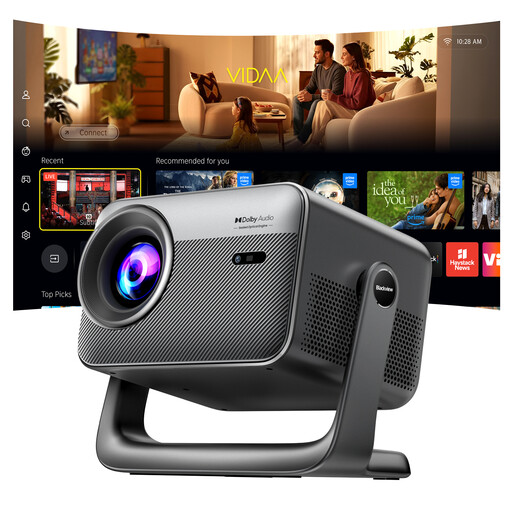 Image unavailable
The stated rotatable design may be useful if you want flexibility when setting the projection direction; check that the final position works with your screen.
Specifications in the product name: 1,000 ANSI lumens, native 1080P, 4K decoding, 40–150 inches, 360° rotatable design and TOF autofocus. Dolby Audio and Wi-Fi 5 are also listed.
 Image unavailable
The stated rotation and digital zoom are worth considering if you want flexibility when positioning the projection; assess your set-up and the corrected picture in advance.
Specifications in the product name: 50–200 inches, 50%–100% digital zoom, 180° rotation, Wi-Fi 6 and Bluetooth. HDMI compatibility is also listed.
 Image unavailable
Optical zoom may be useful if you want to adjust the image size within a fixed set-up; also check the distance needed from the screen.
Specifications in the product name: 1080P Full HD, 1,600 ISO lumens, RGB triple laser, optical zoom and Harman Kardon sound.
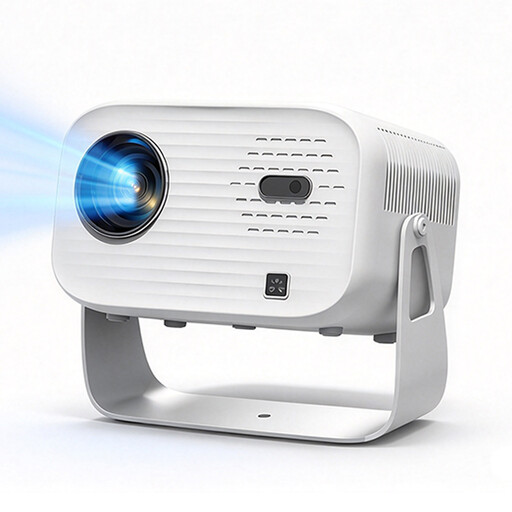 Image unavailable
Automatic keystone correction is listed; check the corrected picture at your intended screen size and placement.
Specifications in the product name: 360° rotation mount, native 1080P, 4K decoding, Wi-Fi 6 and BT5.4. Built-in stereo speakers are also listed.
No. Lens shift does not change the sofa’s viewing angle; it moves the projected image. For seats at the sides, compare their positions with the viewing angle of the exact screen material.
First check whether you can align the projector optically using lens shift. Angled projection can cause geometric distortion; BenQ lists potential effects of keystone correction, including on sharpness and image size.
Check the output on the exact projector model and the input on your sound system. BenQ specifies eARC for the W4100i; Epson lists Bluetooth pairing with a soundbar for the EH-TW7000. So, connection options are not necessarily the same.
Electronic equipment is subject to the applicable EU product rules and CE requirements; check what applies to the exact product. According to the Dutch government, online purchases from a business usually come with a 14-day cooling-off period, subject to exceptions and conditions.
Keep your purchase details and check who the seller is. The Dutch government states that if a product breaks within the first year, the seller must prove that the consumer caused the problem. If they cannot, you are entitled to a free repair or replacement.