
Viewers who like to keep the lights on
You want to keep some lights on during the concert film and make sure everyone can see the picture. Picture size and ambient light both play a part, as BenQ explains in its guide to projector brightness.


Choose a projector based on the light in the room, the picture size you want and the distance from the wall. Then decide how you want to play the concert audio. A portable model is easier to move, but don’t compare ISO and ANSI lumens as if they were measured on the same basis. If your business is showing a film to employees or visitors, check which screening rights apply.
You want to keep some lights on during the concert film and make sure everyone can see the picture. Picture size and ambient light both play a part, as BenQ explains in its guide to projector brightness.
You want everyone to hear the music clearly, so you’re planning the audio connection too. Built-in speakers and connectivity vary from model to model.
You want to fit the set-up into a small room or take it to another room. Check the projection distance, positioning and power supply for your chosen location.
| What to consider | What to look for | Who should pay extra attention? |
|---|---|---|
| A clear picture with ambient lighting | Decide which lights will stay on and how large the picture needs to be; check how the stated light output was measured. | If I’m keeping some lights on, I want the picture to remain visible to the group. Around 31% of consumers say visibility in their chosen lighting is their top buying priority. |
| Music for everyone | Check the speaker specifications and make sure the projector, source device and any sound system support the audio connection you want. | I want the music to be easy to hear without making the set-up more complicated than necessary. Around 25% of consumers give their audio set-up top priority. |
| Picture size and positioning in the room | Measure the distance to the wall and check what picture size the exact model supports at that distance. | In a smaller room, I want to know in advance where the projector can go and what picture size will fit. Available space comes first for around 25% of consumers. |
| Portability and playback | Check the playback options, power supply and stated battery life against the film’s running time. | If film nights take place in different locations, I want to be able to carry the set-up easily and start the film without any fuss. Around 19% of consumers put portability and playback first. |
Light output figures may be based on different measurement methods. Ambient light and picture size also affect how bright the image looks in your room.
For the exact model, check whether the manufacturer states ANSI lumens, ISO lumens or another light output figure. Assess it against your intended picture size and lighting.
A built-in speaker won’t necessarily be powerful enough for the music in a concert film. A separate sound system may also need the right connections.
Before you buy, plan the connections between your film source, projector and any speakers or receiver.
Depending on the sound you want and the equipment you already have, you may need a separate sound system or a suitable connection.
A picture size corresponds to a particular projection distance. You should also compare the stated battery life with the film’s running time and the conditions of use.
Measure the available space and compare the full running time with the specifications of the exact model.
You may need to reposition the projector or use mains power.
The EH-TW840 is an example of a Full HD lamp projector for a fixed or planned group viewing set-up.
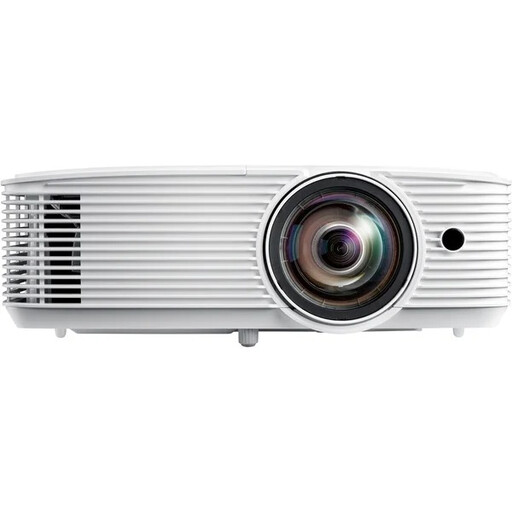
The TK710ST is a short-throw laser projector for anyone planning a large picture in a limited space.
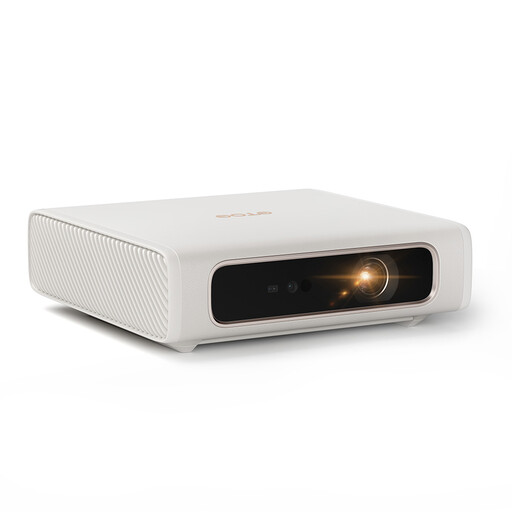
The Halo+ (New) is a portable model with built-in streaming, speakers and a battery.
The Capsule Air is a compact alternative when easy portability matters more than a higher stated resolution or light output.
This selection includes short-throw models and projectors with built-in features for film nights. Check the positioning and playback method that suit your room for each model.
 No image available
Suited to anyone looking to combine streaming and a battery in their projector set-up.
Native 1080p; 800 ANSI lumens; Google TV; HDMI 2.1 and USB-C.
Stated battery life: up to 2 hours. Check whether this covers the film’s running time.
 No image available
A short-throw model to consider if the projector needs to sit close to the wall.
DLP; native WXGA (1280 × 800); 3,800 ANSI lumens; 3D.
 No image available
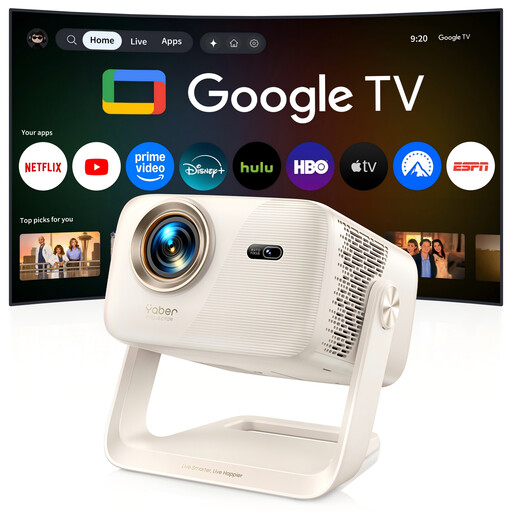
Suited to anyone looking for a short-throw model with built-in streaming and speakers.
Native 1080p; 520 ISO lumens; Google TV; two 5 W speakers; flexible stand.
 No image available
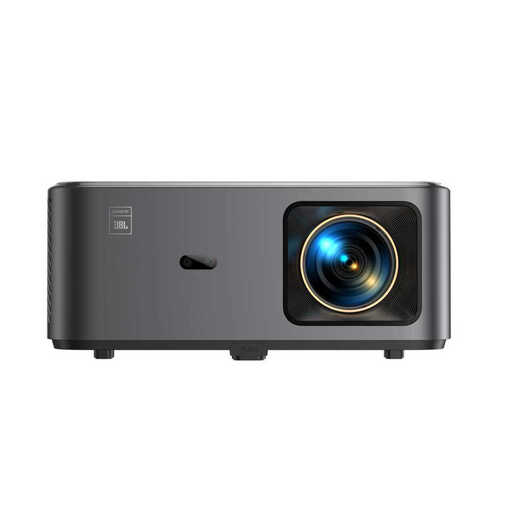
Suited to anyone looking to combine Google TV and built-in audio in their film set-up.
Native 1080p; 4K support; Google TV; Sound by JBL; Dolby Audio.
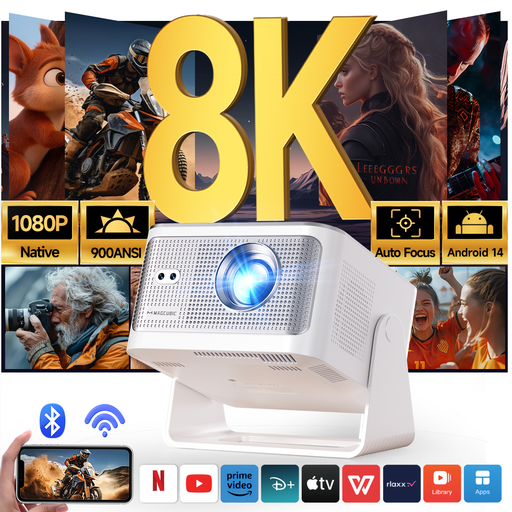 No image available
Suited to anyone looking for native Full HD and a rotating projector set-up.
Native 1080p; 900 ANSI lumens; Android 14; 180° rotation.
Measure the distance from the planned projector position to the wall and check what picture size the exact model specifies at that distance. For example, BenQ states that the TK710ST can project a 100-inch picture from 1.5 metres; that distance doesn’t automatically apply to another model or picture size.
Check the projector’s audio outputs and the corresponding connections on your sound system. For ARC/eARC, the devices involved must support the connection being used; an HDMI connection alone doesn’t confirm this.
The Dutch government states that a business in the Netherlands showing films to employees or visitors from a streaming or download service, or from DVD or Blu-ray, needs a FilmService licence. FilmService describes this licence as permission for public screenings outside the home. Don’t automatically treat a gathering at home with friends as equivalent to a business or public screening, and check the terms of the film service you’re using too.
In the Netherlands, when you buy as a consumer, you’re entitled to a product that conforms to the contract; according to the Dutch government, there is no fixed statutory warranty period. For online purchases from a business, a 14-day cooling-off period applies in many cases. The exact rules depend on the purchase and any legal exceptions.