
If you want to watch during the day
You want to follow animated films without having to black out the living room completely. Consider the light on the screen wall and assess the projector and screen as a combination.


When choosing a projector for animated films in a bright living room, consider the light on the screen wall, your preferred image size and the available projection distance. A single lumen figure cannot predict how the picture will look in your room. Compare white and colour light output measured on the same basis, and factor in the screen and connections too. The performance figures quoted are manufacturers’ specifications, not results measured side by side in the same living room.
You want to follow animated films without having to black out the living room completely. Consider the light on the screen wall and assess the projector and screen as a combination.
You want colourful scenes to remain easy to make out, even with ambient light. So look beyond white light output and consider colour light output and the measurement method used.
You have little space between your seating area and the screen wall, or want to put the projector on a TV stand. Measure the distance and image width before choosing between standard and ultra-short throw.
Start by considering the lighting and screen position. Then check your preferred image size and projection distance before comparing picture specifications.
| What to consider | What should you check? | Who should consider this? |
|---|---|---|
| Visibility in ambient light | Check where the windows and lights are in relation to the screen. Compare light output only when it is measured using the same definition, and factor in the screen type and image size. | If I watch during the day, I want to be able to follow what’s happening on screen without having to black out the room every time. Around 33% of consumers prioritise visibility in ambient light. |
| Colour and film detail | Check the stated white and colour light output. Also check whether the projector offers Full HD, native 4K or image enhancement. | For colourful animated films, I want to assess colour and detail in relation to the source and the image size I want. Around 27% of consumers prioritise colour and film detail. |
| Projection distance and positioning | Measure the available distance, wall width and space on your furniture. Check the throw ratio for the exact model. | When there’s limited room for positioning, I want to know in advance whether the projector can produce the image I want from the intended spot. Around 20% of consumers prioritise a suitable set-up. |
| Complete film set-up | Check the connections and which playback features or components are included with the exact model. Also work out what you’ll need for the screen and sound. | I want to be able to watch films without discovering later that I’m missing essential components. Around 20% of consumers prioritise ease of use and a complete set-up. |
ANSI lumens and figures for light-source or LED brightness are not measured in the same way. Comparing the figures alone can therefore give you a misleading impression.
Check how each figure is measured, and compare white and colour light output separately when both are stated. BenQ explains the differences between brightness measurements.
A projector can only produce the image you want from a suitable position. Throw ratios vary by model and may limit where you can place the projector.
Measure the distance to the screen, the available wall width and the space on your furniture. Then check the throw ratio and permitted image size for the exact model.
An unsuitable distance may mean you have to change the projector’s position or choose another model.
The screen, playback source and sound can all affect whether you can use your film set-up as you’d like. What’s included can vary by model.
Check what’s in the box, the connections and whether the screen is suitable for your chosen position.
A screen and any equipment needed for playback or sound may be additional parts of a complete set-up.
The CO-FH02 and EH-LS800W offer different options: a Full HD model with standard throw and an ultra-short-throw model with image enhancement.
The TK710 is a standard-throw 4K UHD laser projector for anyone who also wants to compare 4K sources.
The UHZ66 is a standard-throw laser projector for a set-up with enough distance between the projector and the screen.
These projector options are intended for watching films at home and include standard-, short- and ultra-short-throw models. Compare their picture specifications with the distance and image size that work for your living room.
 No image available
An option for anyone looking for 4K UHD who has room to adjust the projection distance to suit their preferred image size.
The description lists 3,800 lumens, native 4K UHD, DLP, a dual-laser light source, 1.3× manual zoom and two HDMI 2.0 inputs.
The stated throw ratio is 1,21:1–1,59:1; check that it works with the distance available.
 No image available
A good fit for anyone who wants to watch colourful films and can position the projector to suit the available distance.
The description lists 3-colour laser projection, 3.000 ANSI lumens, 4K UHD and a colour gamut of 1,07 billion colours.
The throw ratio is 1,2:1. According to the description, the adjustable gimbal is designed to project onto walls, ceilings or floors.
 No image available
An option for anyone looking for 4K UHD who can make the stated throw ratio work in their living room.
The description lists DLP, a DuraCore laser light source, 3.500 lumens and 4K UHD resolution of 3840 × 2160.
The throw ratio is 1,21:1–1,59:1 and the stated projection distance is 1–8 m. The manual zoom is 1,3×.
 No image available
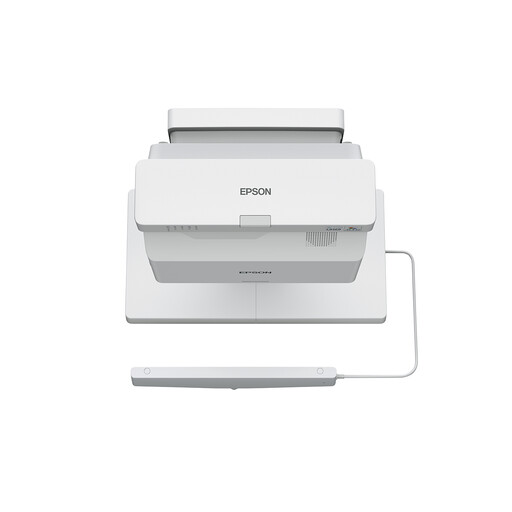
The short throw ratio may be useful if the projector needs to be close to the screen; bear in mind the lower native resolution.
The specifications list 3.800 ANSI lumens, WXGA resolution of 1280 × 800, a throw ratio of 0,52:1 and a built-in 10 W speaker.
WXGA offers less film detail than Full HD or 4K. Check whether this resolution suits your preferred image size and viewing distance.
 No image available
The ultra-short throw ratio is useful if you want to position the projector close to the screen; check the resolution against the level of film detail you need.
The stated specifications are 4.100 ANSI lumens, 3LCD and WXGA resolution of 1280 × 800.
The throw ratio is 0,27–0,37:1. WXGA offers less film detail than Full HD or 4K.
No. A lumen figure on its own cannot tell you how visible the picture will be in your living room. Compare how the figure is measured and also consider ambient light, image size and the screen. Manufacturers’ figures for different models are not measurements taken in the same living room.
Measure the available distance between the projector and screen, then check the throw ratio and permitted image size for the exact model. For example, Epson specifies a throw ratio of 0,16–0,40:1 and an optical image size of 80–150 inches for the EH-LS800W; these figures do not automatically apply to other models.
Not for every set-up. Epson says an ALR screen is designed to reflect projector light towards the viewer and block light from other directions. Check that the specific screen suits the direction of projection and the size you want.
For consumer purchases in the Netherlands, the Dutch government says the seller—not the manufacturer—is responsible for providing a solution if there’s a problem with the product. Your rights and the solution depend on the circumstances and the consumer rules that apply.
Business.gov.nl says that sellers of electrical and electronic equipment must ensure their products comply with the applicable European rules. CE marking is mandatory for product groups covered by that requirement; don’t assume which rules apply to a specific model based only on its brand name or product listing.