
Viewers who want to see fine details
You want to make out brushstrokes, subtitles and other details. Compare the native resolution and image sharpness at the screen size you plan to use.


Start by considering the ambient light and distance from the projection wall, then compare native resolution, connections and audio. A brighter model may give you more flexibility in a room with ambient light, while a compact model is easier to put away but may need a darker room. Manufacturer specifications are useful for comparing models, but they don’t prove how accurately a projector reproduces art colours; check the product information for the exact listing too.
You want to make out brushstrokes, subtitles and other details. Compare the native resolution and image sharpness at the screen size you plan to use.
If the shared space is sometimes bright, start by considering the lighting conditions. A lumen rating on its own doesn’t guarantee image quality. Epson Netherlands and BenQ Netherlands describe brightness as a factor to consider in relation to the viewing environment.
If you don’t have a permanent spot for it, consider the distance from the wall, alignment, connections you’ll need and built-in audio. BenQ Netherlands and Philips Netherlands cover these factors for their projectors.
| Factor to consider | What should you check? | Who is this important for? |
|---|---|---|
| Detail and readability | Check the native display resolution, not just the input resolution. Assess it at your preferred image size. | If I want to follow brushstrokes and subtitles clearly, I look for native resolution and sharp image edges. Around 25% of consumers say detail is their top buying priority. |
| Ambient light | Think about when you’ll be watching and whether you can darken the room. Compare brightness ratings, paying attention to the units used. | If the living room can’t always be darkened, I want to know how the projector will perform in the room’s lighting. Around 25% of consumers say watching in ambient light is their top priority. |
| Space for set-up and storage | Measure the distance to the wall or screen and see how the model can be set up. Position the projector as straight as possible in relation to the image. | If the projector has to be put away after every use, I want it to be easy to position and align. Around 19% of consumers say flexible set-up is their top buying priority. |
| Audio and video sources | Check that the connections work with your source and that the available audio solution is right for the room. | If we’re watching together, I want to connect our chosen video source and make sure everyone can hear the dialogue. Around 19% of consumers put audio and connections at the top of their list. |
| Complete set-up and maintenance | Check what’s included, which cables or audio equipment you’ll need, and which parts can be replaced. | If I want to put together a complete, usable set-up and plan for maintenance too, I look beyond the projector itself. Around 12% of consumers say the complete set-up and future maintenance are their top buying priority. |
Brightness, native resolution and set-up all play a part when viewing fine details. Manufacturers’ lumen ratings aren’t automatically comparable to real-world tests.
Compare models in the same lighting conditions, and check both the brightness unit and the native resolution.
BenQ says that stronger digital keystone correction can, among other things, make jagged image edges visible.
Measure the available distance and point the projector as straight as possible at the wall or screen before using image correction.
A projector may not be all you need: think about connecting your video source and the audio you want. Epson lists a replacement lamp for the CO-FH01 as a separate accessory.
Check what’s included with the exact model and what else your viewing space and source require.
Epson Netherlands describes the CO-FH01 as a Full HD 3LCD projector with a stated light output of 3,000 lumens.
BenQ describes the TH575i as a 1080p projector with Google TV, and the portable GP100 as a model for use in dim lighting.
Philips describes the NeoPix 530 as a Full HD projector with two HDMI inputs and built-in 2.1 sound.
Anker describes the Capsule Air as a compact projector with a built-in battery and Google TV.
The Joybuy projectors below are options to compare for a shared viewing space. For each model, consider the native resolution, connections and how it can be set up.
 No image available
The stated native 1080P resolution may be useful if you want to view fine details; also check how the image looks at your preferred size.
Native 1080P; 520 ISO lumens; two built-in 5 W speakers; Google TV; compatible with ceiling mounting and a flexible stand.
 No image available
The native 1080P resolution is worth considering if you want to view details in art documentaries; also check the set-up and available connections.
Native 1080P; 700 ANSI lumens; supports 4K input; HDMI and USB; compatible with Wi-Fi 6 and Bluetooth 5.4.
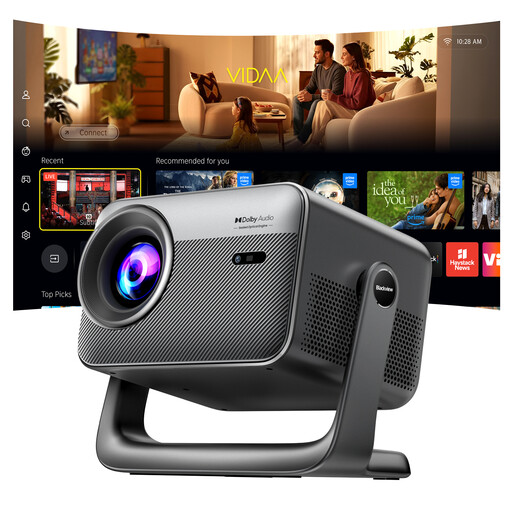 No image available
The stated native 1080P resolution may be a factor when viewing image details; check separately whether the projection distance and image size suit your room.
Native 1080P; 1,000 ANSI lumens; 4K decoding; stated image size of 40–150 inches; 360° rotating design; TOF autofocus.
 No image available
The stated rotating housing may be handy if you need to position the projector in different ways; check that the connections work with your video source.
180° rotation; automatic screen correction; HDMI-compatible; compatible with Wi-Fi 6 and Bluetooth.
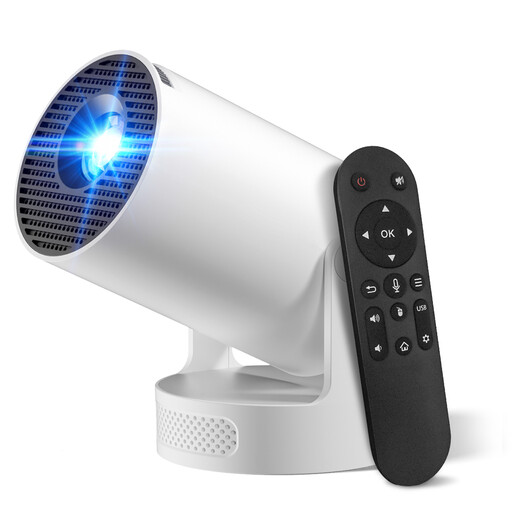 No image available
The stated rotating housing may be handy if you need to position the projector in different ways; check that the connections work with your video source.
180° rotation; automatic image correction; HDMI-compatible; compatible with Wi-Fi 6 and Bluetooth.
Measure the distance from the projector to the wall, work out whether you can darken the room, and check your chosen video source and audio. Position the projector as straight as possible in relation to the image before using a lot of digital keystone correction.
No. Check the display’s native resolution. Philips describes the NeoPix 530 as Full HD 1080p; Anker specifies a 720p display for the Capsule Air.
Electrical and electronic equipment covered by the relevant EU rules must carry the CE marking before it is placed on the market. The European Union explains that the manufacturer uses the marking to indicate compliance with the applicable rules. Check the information for the exact listing; a CE logo is not an independent image-quality test.
When you buy online from a business, you generally have a 14-day cooling-off period; online purchases from private sellers aren’t covered by these distance-selling rules. You’re also entitled to a statutory guarantee that the product is of satisfactory quality. In the Netherlands, there is no fixed general guarantee period, and the seller is your point of contact if something goes wrong, according to the Dutch Government.