
Viewer focused on building details
You pay particular attention to lines, materials and differences in colour in architecture programmes. Compare picture settings and resolution rather than looking at brightness alone.


When choosing a projector for architecture programmes in a dark room, first work out your preferred image size and the distance between the lens and the projection surface. Then compare resolution, colour specifications and placement options; the highest stated brightness may not necessarily be the deciding factor. Also consider picture modes, fan noise, connections and maintenance. Manufacturer specifications alone cannot predict how façades and dark interiors will look in your room.
You pay particular attention to lines, materials and differences in colour in architecture programmes. Compare picture settings and resolution rather than looking at brightness alone.
You already have a spot in mind for your screen and projector, but need some flexibility to get the distance or alignment right.
You want to move the projector occasionally and need a set-up and playback options that work in different viewing locations.
First, measure the distance from the lens to the projection surface and decide how wide you want the image to be. Then compare picture settings, playback options and maintenance for the models that will fit your space.
| Factor | What should you check? | Who should pay particular attention? |
|---|---|---|
| Building details, colour and shadow | Check the resolution, colour specifications and available picture modes for the exact variant. | I want to assess fine lines and differences between materials, so picture detail matters a lot to me. Around 40% of consumers prioritise picture detail. |
| Projection distance and alignment | Measure the distance from the lens to the projection surface and check the distance chart for your preferred image size. | If the projector cannot sit directly in front of the screen, I want to know whether the distance and alignment will still work. Placement is the main priority for around 30% of consumers. |
| Playback and quiet viewing | Check the HDMI connection or app you need, the audio output and the stated noise level for each operating mode. | I want to play my programmes easily and know in advance whether the noise level will suit my set-up. These are the main considerations for around 20% of consumers. |
| Maintenance and running costs | Check the light source type, the stated operating mode and the terms for servicing or replacement. | If I use a projector for long periods, I want to factor in maintenance costs in advance. Around 10% of consumers give maintenance top priority. |
Your preferred image size needs to fit the distance your room allows.
Measure the distance between the planned lens position and the projection surface, then check the distance chart or projection calculator for the exact model variant.
The W2720i is worth considering if you want to compare colour specifications and picture modes for a permanent home cinema set-up.
The EH-TW7100 and EH-TW7000 are lamp-based models you can compare for placement options and maintenance.
The HORIZON 20 Max is a laser option to consider when comparing optical placement options.
The NeoPix 230 Smart is a compact option worth comparing if you want to use your projector in different viewing locations.
These Joybuy products are projectors to compare for watching architecture programmes. For each model, consider its picture specifications, placement and how you want to play your programmes.
 Image unavailable
A portable option to compare if you want to watch in different locations.
Native 1080p; stated colour coverage of 110% BT.2020; Google TV; built-in battery with a stated battery life of 2 hours; HDMI 2.1 and USB-C.
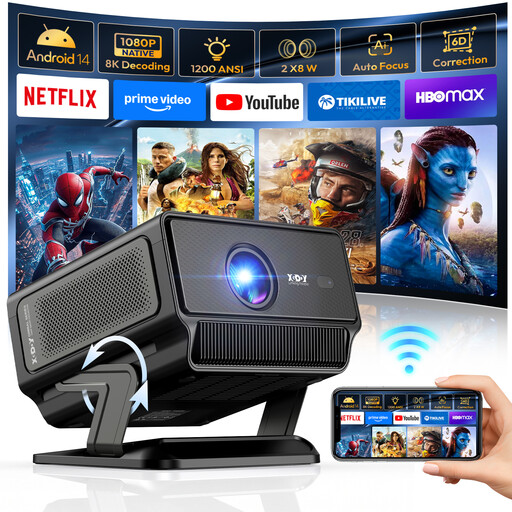 Image unavailable
The gimbal design may suit you if you want to adjust the projection angle.
Native 1080p; 4K/8K video decoding supported; 1200 ANSI lumens; HDR10+; Android TV; HDMI and USB; gimbal stand with a rotation range of 0° to 90°.
 Image unavailable
An option to compare if you want to stream programmes using built-in apps.
Native 1080p; 1000 ANSI lumens; Whale TV OS; Netflix support; gimbal design with 90° rotation.
 Image unavailable
The portable version with a battery is an option to compare if you want to watch in different locations.
Full HD 1080p; 450 ISO lumens; Google TV; Harman Kardon audio; stated battery life of 2.5 hours.
 Image unavailable
An option to compare if you want to use built-in apps and adjust the projection angle.
Built-in apps; compatible with HDMI devices; digital zoom from 50% to 100%; 180° rotation; automatic picture correction.
Measure the distance between the planned lens position and the projection surface, and work out how wide the image can be. Compare these measurements with the distance chart or projection calculator for the exact model; a distance example for another model may not apply.
It depends on the projector and the service you want to use. Philips lists built-in apps for the NPX230/INT; Epson explains that you can connect playback devices to the EH-TW7000 via HDMI. Before buying, check that the app or input you need is available on the exact variant.
Check which operating mode the figure applies to: Epson states 5,000 hours in Eco mode for the EH-TW7000. If you are considering a lamp-based model, also ask about the availability and cost of a replacement lamp. The stated life is not a guarantee of how long it will last with your usage.
According to ACM ConsuWijzer, when you buy online you generally have 14 days after delivery to change your mind, although exceptions apply. You are also entitled to a legal guarantee if a product does not perform as you could reasonably expect under normal use; the retailer is your point of contact.
The Dutch government states that electrical appliances offered on the EU market must carry a CE mark. Check the specific projector and listing: a model page does not automatically confirm that every unit on offer complies.