What should you look for when choosing?
First, check the physical and software layouts, then compare the key map with the debugger and editor shortcuts you use. Next, weigh up desk space, hand position, noise and device connections in relation to how you work.
| What to consider |
What should you check? |
Which consumers does this matter most to? |
| Symbols and layout |
Check the physical ANSI or ISO layout, the active software layout and the characters you type often. |
If I type code and Dutch text on the same keyboard, I want symbols and accented characters to be in predictable places. Around 31% of consumers give the layout and access to symbols top priority. |
| Navigation while debugging |
Compare the key map with your own shortcuts and check where Home, End, Delete and the function keys are. |
When I often navigate through code, I want to reach the keys my editor uses without an awkward detour. Around 25% of consumers prioritise debugger navigation. |
| Hand position during extended typing |
Consider the space available for both keyboard halves and your mouse, and see whether you can try out the layout. |
If I want to position my hands differently, I consider the space available and how long it might take to get used to a different layout. Around 19% of consumers give an adjustable hand position top priority. |
| Noise in a shared workspace |
Check the switch type of the specific version; don’t judge how noisy it will be based on the word ‘mechanical’ alone. |
If colleagues work in the same room, I want to know what the chosen switches sound like before choosing a version. Around 13% of consumers prioritise noise levels. |
| Switching between computers |
Check how many devices are supported, the connection options and whether any features require software. |
When I want to use the same keyboard with several computers, I look at how pairing and switching work. Around 12% of consumers make switching between devices their main consideration. |
Keyboards at Joybuy
This selection features Joybuy keyboards with a TKL or 75% layout, offering a compact typing experience while retaining access to navigation keys.
 No image available
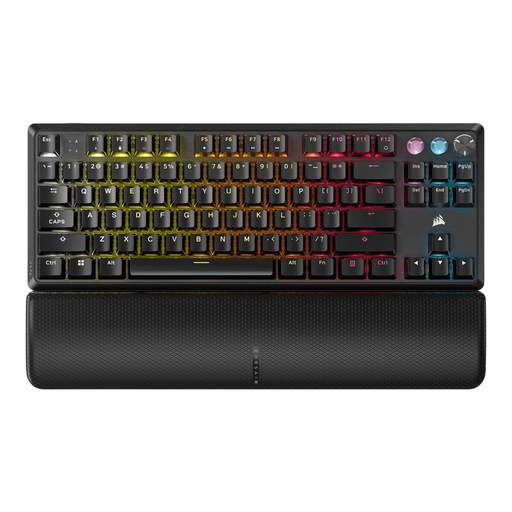
Corsair K70 PRO TKL, US QWERTY, MGX v2, black
The TKL layout may suit you if you don’t need a number pad but want to keep dedicated keys.
US QWERTY layout; wired USB connection and detachable wrist rest, according to the product description.
View at Joybuy
 No image available
Corsair K55 CORE TKL, US QWERTY
The TKL layout is an option if you want to keep dedicated keys without a number pad.
US QWERTY layout; the product description lists quiet membrane keys, four dedicated media keys and an adjustable stand.
View at Joybuy
 No image available
AULA F75 MAX 75%, US QWERTY
The 75% layout may suit you if you’re looking for a more compact keyboard while retaining the navigation keys on this version.
Mechanical; wired, Bluetooth and 2.4 GHz connections, according to the product information.
View at Joybuy
 No image available
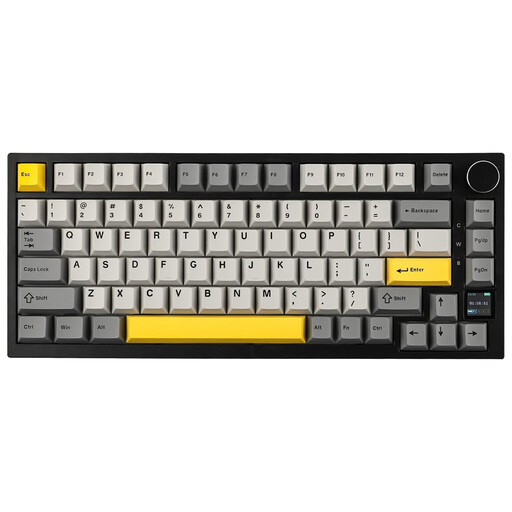
Ajazz AK820 Pro 75%, US QWERTY
The 75% layout is designed for anyone who wants to type on a compact keyboard with essential arrow and function keys.
Wired, Bluetooth and 2.4 GHz connections; hot-swappable switches, according to the product description.
View at Joybuy
 No image available
Razer DeathStalker V2 Pro Tenkeyless, US layout
The tenkeyless layout may suit you if you don’t need a number pad and want a compact keyboard.
The product description lists low-profile optical switches, wired and Bluetooth connections, and switching between three Bluetooth devices.
View at Joybuy
Frequently asked questions
Do you need a keyboard with dedicated function keys for a debugger?
Not necessarily: it depends on your editor, shortcut settings and working style. Check whether the functions you use are available directly or require an Fn combination.
Why don’t quotation marks or brackets match the labels on the keys?
Check that the software layout matches the physical keyboard. US-International uses dead keys for certain accented characters, which can also affect quotation marks in code.
Does an ergonomic keyboard mean you don’t need to take breaks?
No. Arboportaal recommends breaking up screen work, adjusting your workstation to suit you and taking short breaks regularly. A different keyboard is no substitute for these measures.
What are your rights when buying a keyboard online in the Netherlands?
When you buy remotely from a business, you’re usually entitled to a 14-day cooling-off period, subject to exceptions outlined by the Dutch government. You’re also entitled to a product that works as it should; if there’s a fault, contact the seller. According to the Dutch government, there is no set statutory warranty period for all products.
Do you have to use a separate keyboard when programming on a laptop?
This doesn’t apply to every laptop user. According to Arboportaal, employees who work at a screen for more than 2 hours a day must be able to use a screen and keyboard that aren’t attached to each other; when using a laptop, a separate screen or keyboard must therefore be available. Employers may make exceptions subject to certain conditions.


