What should you look out for?
Start with the keys you want to reach quickly while debugging. Then decide what space, key feel and connection type will suit your workspace.
| What to consider |
What to look for when buying |
Who is this more important for? |
| Keys and shortcuts |
Compare the key legends and positions of the arrow keys, function keys and frequently used shortcuts with your IDE. Check whether functions are directly accessible or assigned to a key layer. |
If I often switch between code, navigation and shortcuts while debugging, I want to use the keys I need without extra steps. Around 36% of consumers give direct access to shortcuts and navigation top priority. |
| Hand position and mouse space |
Check the dimensions of the exact version and think about where your mouse will go. A compact model may put functions on key layers; a split model needs space and takes some getting used to. |
If I regularly switch between my keyboard and mouse, I want to arrange my workspace so both are easy to reach. Around 29% of consumers prioritise an adjustable hand position. |
| Sound and key feel |
Check the switch variant and mechanism you’ve chosen. Manufacturer descriptions aren’t comparative sound tests, so try the key feel for yourself if possible. |
If I work in a shared space, I want to choose a key feel that suits it without relying on a product label alone. Around 21% of consumers give quiet keys top priority. |
| Connections and devices |
Check whether you want to use USB-A, Bluetooth or a receiver, and whether the connection is suitable for your computer. If you use several devices, find out how switching between them works. |
If I want to use the keyboard with my work equipment, I want to know in advance which connection and switching features are compatible with my devices. Around 14% of consumers prioritise device compatibility. |
Keyboards at Joybuy
This selection includes compact TKL and 75% layouts for extra mouse space, as well as a full-size keyboard for anyone who wants to keep more keys readily available. Check the key layout and connection type for each version.
 No image available
GXTrust Thado wired TKL keyboard, US QWERTY, PC/PS5
The TKL layout leaves out the number pad and can free up space beside the keyboard for your mouse.
Wired USB connection, membrane keys and media keys. The product description states that it supports up to 10 simultaneous key presses.
View at Joybuy
 No image available
Corsair K55 CORE TKL, US QWERTY
The TKL layout can free up space beside the keyboard; the product description says you can remap keys for custom functions.
USB connection, membrane keys and four dedicated media keys. The product description also mentions an adjustable stand.
View at Joybuy
 No image available
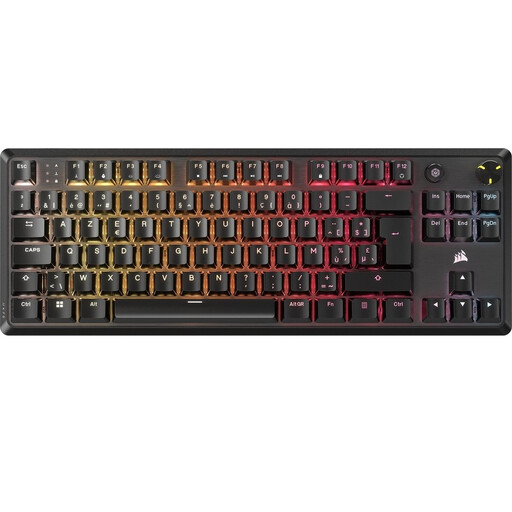
Corsair K70 CORE TKL mechanical, BE AZERTY, MLX Red
The TKL design can free up space beside the keyboard. Check that the Belgian AZERTY layout suits your software settings.
The product description mentions macros, up to five saved profiles and a detachable USB-C cable.
View at Joybuy
 No image available
Ajazz AK820 Pro 75%, US QWERTY
According to the product description, the compact 82-key layout retains the arrow and function keys, which is useful if you want quick access to them while debugging.
Mechanical keyboard with Bluetooth, 2.4 GHz and USB-C. The description mentions macros and custom key functions saved to internal memory, as well as compatibility with Windows and macOS.
View at Joybuy
 No image available
Trust Vaiya wireless, full-size, US QWERTY
The full-size layout with a number pad keeps more keys readily available, but takes up more desk space than a compact model.
Low-profile keys with a scissor mechanism. The product description mentions connection via USB receiver or Bluetooth, and switching between up to four devices.
View at Joybuy
Frequently asked questions
Is a smaller keyboard automatically more convenient when the debugger is open?
No. Work out which arrow, function and shortcut keys you use, then check whether they’re directly accessible on the version you’ve chosen or use a key layer. After that, consider whether the extra mouse space suits your workspace enough to make up for any changes to how you use those keys.
How do you get started with a programmable keyboard?
First, make a note of your most important debugging shortcuts, then customise the layout. According to ZSA, the Voyager works straight away for regular typing, and configured key layers stay in the firmware. Depending on your operating system, changing the layout may require a few extra steps.
Is an ergonomic keyboard enough to help with discomfort from screen-based work?
No. Arboportaal also highlights repetitive actions, static strain, workspace setup and variation. If you’re starting to experience discomfort, Arboportaal recommends contacting the occupational health doctor and, if appropriate, arranging a workplace assessment. A keyboard is no substitute for this.
What are your rights if a keyboard bought online doesn’t suit you or breaks too soon?
For online consumer purchases, ACM ConsuWijzer says you generally have a 14-day cooling-off period after delivery, subject to legal exceptions. Separately, statutory guarantee rights apply if a product doesn’t perform as you could reasonably expect under normal use; the seller must then offer an appropriate solution. This doesn’t mean every keyboard comes with a fixed two-year guarantee.
Does Dutch law require a particular type of keyboard for screen-based work?
Arboportaal’s government guidance doesn’t specify a brand or mechanical switch type. For employees who work with a screen for more than two hours a day, the screen and keyboard must not be attached to each other; laptop users must be able to use a separate screen or keyboard. This is a conditional workplace requirement, not a general product rule for all buyers.


