
Vandaag of morgen in huis

Kwaliteit gegarandeerd

Welkomstaanbiedingen ontgrendelen: GRATIS bezorging | Tot 80% korting | Gratis 30 dagen JoyPlus-proefperiode
Download de app
Selecting the right display for your business is a critical decision. You need a screen that not only conveys your message clearly but is also reliable enough for daily, intensive use. A consumer television often falls short of the demands of a commercial environment. This article will help you make an informed choice by focusing on the specifications that truly matter for a professional digital signage display.
The market offers many options, which can make the choice complex. By focusing on a few key factors, you can find a model that fits your business needs.
One of the biggest differences between a consumer television and a professional display is its designed operational lifespan. A 24/7 display is built with components engineered to withstand continuous operation without the risk of overheating or image burn-in. This is essential for applications in retail stores, stations, or hotel lobbies where the screen is on all day. The warranty on consumer TVs is often voided by commercial use, whereas professional models are designed and warrantied for this type of deployment.
Your content must be clearly visible under all lighting conditions. A 4K digital signage display (3840x2160 pixels) ensures a crystal-clear presentation of text, images, and videos, contributing to a professional image. Also, pay attention to the brightness, measured in candelas per square meter (cd/m?). A value around 500 cd/m? is typically suitable for most indoor environments. A matte or anti-glare screen surface is another key advantage, as it minimises distracting reflections from lights or sunlight.
Modern digital signage screens are often more than just displays. A display with Android OS or a similar integrated system offers the ability to manage and play content directly from the screen, eliminating the need for an external media player. This simplifies installation and maintenance. Also, check the available connections. Essential ports include HDMI, USB (for content playback), and an RJ45 Ethernet port for a stable network connection.
Based on the criteria above, we have selected several models suitable for various business applications. These recommendations are based on their specifications and features.
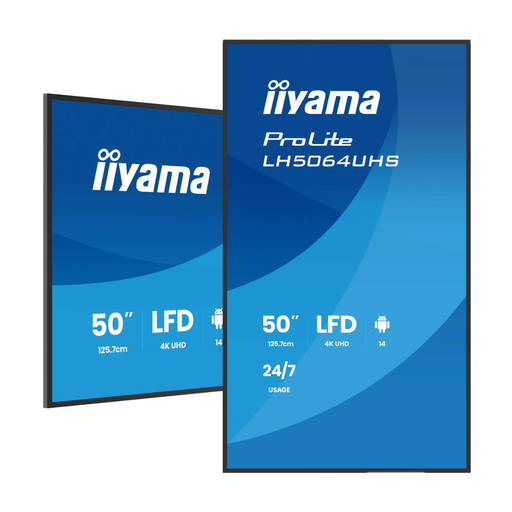
Why it stands out: This 50-inch digital signage display combines a 4K resolution with a robust design for 24/7 operation. Its built-in Android operating system and 500 cd/m? brightness make it a versatile solution for many commercial environments. The IPS panel ensures wide viewing angles and accurate color reproduction.
Advantages:
Who is this for? Businesses in retail and hospitality looking for a reliable advertising display of a standard size. Also suitable as an information screen in reception areas or meeting rooms.
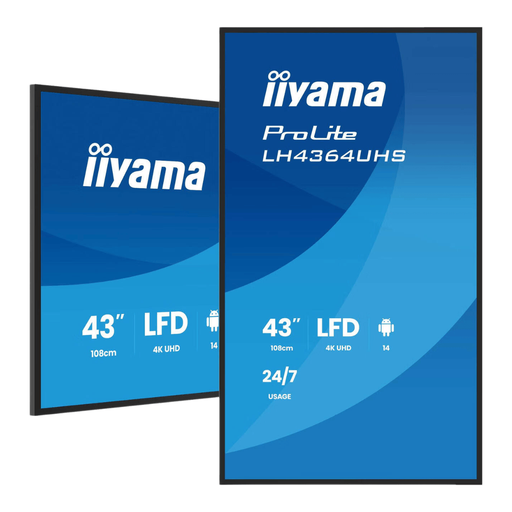
Why it stands out: This more compact 43-inch model offers the same professional features as its larger counterparts, including 4K resolution and 24/7 operational capability. Its VA panel delivers a high static contrast ratio (4000:1), resulting in deep blacks. This makes it an excellent choice for spaces where high-contrast image quality is important.
Advantages:
Who is this for? Organisations that need a professional display for smaller spaces, such as in an elevator, next to a product display, or in a treatment room. Its sharp image quality makes it ideal for showing detailed information.
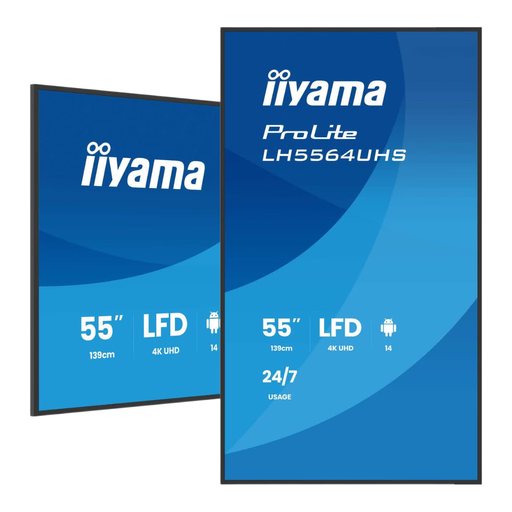
Why it stands out: For situations where the message truly needs to stand out, this 55-inch model offers a large and impressive picture. Like the other iiyama digital signage models, it is designed for 24/7 use and features a 4K resolution. The VA panel provides a very high 5000:1 contrast ratio, which makes images extra vibrant.
Advantages:
Who is this for? Large retail spaces, reception halls, auditoriums, and control rooms where a large, bright screen is needed to effectively communicate information or advertising to a broad audience.
Every space and application is unique. If these models don't precisely meet your requirements, or if you're looking for a different size or specific features, there's more to explore. View our full range and find the solution that fits your project.
View all digital signage displays
1. What is the difference between a professional digital signage display and a regular TV? A professional display is built for long-term, continuous use (often 24/7), has higher brightness, an anti-reflection coating, and a commercial warranty that covers this type of usage. A consumer TV is designed for a few hours of use per day, and its warranty is typically voided in a business deployment.
2. Do I need an external media player for a display with Android OS? Not necessarily. A display with Android OS can run content management apps independently. You can load content directly onto the screen via the network or a USB stick and set up playback schedules. This simplifies installation and reduces overall costs. For very complex or synchronised multi-screen setups, an external player may still be desirable.
3. What should I consider when installing a 24/7 display? Ensure there is adequate ventilation around the display to prevent overheating during continuous use. Do not block the ventilation openings. Use a wall mount or stand that is appropriate for the weight and VESA size of the screen. Installation by a qualified professional is recommended to ensure a safe and stable mounting.
