
Making individual cards
You want to print directly onto card-sized paper. Check the paper feed, dimensions and supported paper type for each model. For example, Canon Netherlands lists a card size of 91 × 55 mm for the PIXMA TS7650i.


Start by checking the size and type of paper: support for A4 doesn’t automatically mean a printer can handle individual, sturdy cards. Then decide between black-and-white and colour. If you print regularly, factor in the cost of refills too, and check how everyone can print from their own device. Automatic duplex printing isn’t necessarily available for card paper.
You want to print directly onto card-sized paper. Check the paper feed, dimensions and supported paper type for each model. For example, Canon Netherlands lists a card size of 91 × 55 mm for the PIXMA TS7650i.
You want to print from different devices without making things unnecessarily complicated at a shared desk. Compare the connection options and check that they work with the devices people have. Canon Netherlands and Brother Netherlands list wireless connections for the models discussed here.
You often create new sets and want to weigh up the purchase price and running costs, including whether you need colour. The Consumers’ Association discusses print volumes and running costs, while Epson Netherlands and HP Netherlands describe models with refillable ink tanks.
| What to consider | What should you check? | Who does this matter most to? |
|---|---|---|
| Size and paper | Check the paper feed, dimensions, paper type and supported weight for the exact model. | If I want to feed individual cards made from my chosen paper, I’ll first check that the size and material are suitable for the printer. Around 33% of consumers give paper compatibility top priority. |
| Shared access | Compare Wi-Fi, USB and the supported devices for the connection method you plan to use. | If several people are printing from their own phone or computer, I want to know which devices and connections will work. Shared access is the top priority for around 25% of consumers. |
| Running costs for frequent printing | Compare the compatible ink or toner based on your own print volume and use of colour. | When I’m printing card sets regularly, I want to weigh up the purchase price and refills against how much and how often I print. Around 25% of consumers put ongoing printing costs first. |
| Colour or black-and-white | Decide whether your design needs colour and check which types of print the model supports. | If colour codes or images convey meaning on my cards, black-and-white may not be enough. Around 17% of consumers give colour in their prints top priority. |
A weight limit may apply to a specific type of paper. Canon lists separate conditions for plain paper and Canon photo paper for the PIXMA TS7650i; these don’t automatically apply to other card materials.
Compare the type and weight of your card paper with the specifications and paper feed for the exact model.
Using unsuitable paper can waste test sheets.
Canon limits the automatic duplex function on the TS7650i and TR4755i to A4 or Letter plain paper. HP also distinguishes between manual and automatic duplex printing across its Smart Tank series.
Check the conditions for both size and material. Print a test first to see how the paper needs to be loaded.
Depending on the printer, you may need to turn the paper over by hand or cut cards from larger sheets.
The Consumers’ Association includes ink or toner costs when comparing printers, and points out that an inkjet printer may use ink for cleaning if you don’t print much.
Compare the printer and compatible refills for the same expected usage, including your balance of black-and-white and colour prints.
As well as ink or toner, you’ll use paper. If you print infrequently, cleaning can use extra ink.
PIXMA colour inkjet models are worth considering if you want colour and need to compare paper sizes by model.
The DCP-L2627DWE is a black-and-white laser option for anyone who mainly prints text and also wants to scan or copy.
EcoTank models are worth including in your comparison if you print regularly and are considering refillable ink.
Smart Tank colour models are worth comparing if you’re considering refillable ink.
These Joybuy products are suited to study notes, shared printing, and colour or black-and-white work. For cards, check the supported paper size, type and weight for each model.
 No image available
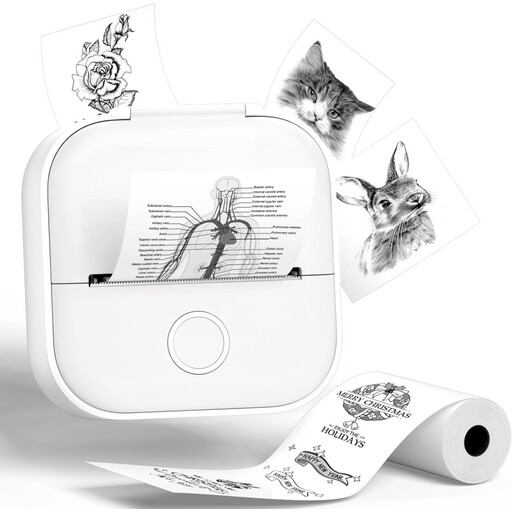
For anyone who wants to print study notes from a smartphone; the product description mentions Bluetooth and thermal printing.
 No image available
A colour printer for shared use and frequent printing; the product description mentions dual-band Wi-Fi and printing from a phone.
The description also mentions automatic duplex printing and included ink bottles. Check separately whether your card paper is suitable for the duplex function you want to use.
 No image available
For anyone who wants to print in colour and black-and-white and connect the printer to a computer; the product information lists USB 2.0.
The stated paper input capacity is 60 sheets. Check the model specifications for suitable paper types and sizes for individual cards.
 No image available
For colour printing in a shared working environment; the product information lists Wi-Fi and Ethernet.
Automatic duplex printing is listed. Check the paper requirements for cards separately.
 No image available
For shared black-and-white printing; the product information lists Wi-Fi, Ethernet and USB.
Automatic duplex printing is listed. Check whether your chosen card size and paper weight are suitable for this model.
Not just because ‘automatic duplex printing’ is listed. Canon limits this function on the TS7650i and TR4755i to A4 or Letter plain paper. Check the manual for the exact model if you want to print individual cards, or print both sides on a supported sheet.
First, use a single sheet to test the front and back, as well as the loading direction. Check in advance that the size and paper are supported: small-format printing and automatic duplex printing are separate specifications.
Compare the printer and compatible ink or toner for your expected usage. The Consumers’ Association points out that an inkjet printer may use ink for cleaning if you don’t print much. Factor this in alongside the number of black-and-white and colour prints you make.
No. According to the Dutch government, there’s no fixed statutory warranty period in the Netherlands: you’re entitled to a product that works properly, and what you can expect depends on the product and the circumstances. If a product is faulty, contact the seller; any manufacturer’s warranty is in addition to this.
For a qualifying distance purchase by a consumer, the Dutch government says you’ll generally have a 14-day cooling-off period. Check whether your purchase is covered by these rules; for example, buying online from a private seller doesn’t automatically count as a distance purchase in this sense.