If you regularly dry damp garden herbs or larger harvests, an electric food dehydrator with an adjustable temperature and enough space to spread the leaves in a single layer could be a good fit, provided you have room to use and store it in your kitchen. For small bunches of hardy herbs such as rosemary, sage or thyme, air-drying in a dry, well-ventilated place may be enough. Freezing is an option for herbs you’ll use later in hot dishes, but they’ll turn limp once thawed. Before choosing, check the drying space, the instructions and the CE marking on the version on offer; the Dutch government states that electrical appliances placed on the EU market must carry a CE marking.
Who is this buying guide for?
Grower of soft garden herbs
You might harvest basil or mint, for example, and want to dry the leaves carefully. The University of Georgia’s National Center for Home Food Preservation recommends using a low preheat setting on a food dehydrator for herbs.
Cook with limited worktop space
You want to dry herbs, but also need to be able to store the appliance and its trays. So compare the appliance’s full dimensions, not just the number of tiers.
Preserver with a variable harvest
You may want to process more herbs at once from time to time. Separate trays and enough space to spread the leaves in a single layer are useful points of comparison.
What should you look for when choosing?
Electric food dehydrator
Choose this if: you want to dry garden herbs regularly in separate layers and adjust the temperature.
Keep in mind: you’ll need worktop and cupboard space, and the appliance will use electricity.
Air-drying
Choose this if: you can hang small bunches of hardy herbs, such as rosemary, sage or thyme, in a dry, well-ventilated place.
Keep in mind: you have less control over temperature and airflow; damp, soft herbs need attention as they dry.
Freezing
Choose this if: you want to preserve a small quantity for use later in hot dishes.
Keep in mind: herbs become limp after thawing and are generally unsuitable as a garnish.
| What to consider |
What should you check? |
Who is this most important for? |
| Controlled drying |
Check the adjustable temperature, air circulation and space to spread leaves in a single layer. The University of Georgia’s National Center for Home Food Preservation gives 95–115 °F (approximately 35–46 °C) as the preheat setting for herbs. |
If I’m drying damp herbs such as basil or mint, I want to be able to control the temperature and how they’re spread out. Controlled drying is the top priority for around 36% of consumers in this decision-making context. |
| Kitchen and cupboard space |
Compare the appliance’s width, depth and height when in use and in storage; also measure the space available for the trays. |
With limited worktop space, I want to know whether the appliance will fit in my cupboard after use. Space is the top priority for around 29% of consumers in this decision-making context. |
| Quantity per drying cycle |
Compare the usable tray area and number of trays with the size of your usual harvest; don’t just look at the number of tiers. |
With a variable or larger harvest, I want to be able to spread the leaves in separate layers. The amount you can dry per cycle is the main concern for around 21% of consumers. |
| Cost and ease of use |
Consider how often you’ll dry herbs, and compare the controls and cleaning requirements. The wattage alone doesn’t tell you how much electricity a drying cycle uses. |
If I only preserve herbs occasionally, I don’t want to buy and store an appliance if a simpler method will do. Cost and ease of use are the top priorities for around 14% of consumers in this decision-making context. |
Common buying mistakes
-
Comparing only the number of trays
It’s best to dry leaves in a single layer. The number of trays alone doesn’t tell you how much usable drying space you have or how much room the appliance will take up.
Compare the tray area and the appliance’s full dimensions with your available worktop and cupboard space.
A small drying area may mean splitting your harvest across several batches. An appliance that doesn’t fit in your kitchen will also be harder to store.
-
Assuming the timer means the herbs are dry
Drying times vary. A timer alone can’t tell you whether the leaves and stems are dry enough.
Check the herbs before storing them: the leaves should crumble and the stems should snap when bent.
Brands compared
Fritel
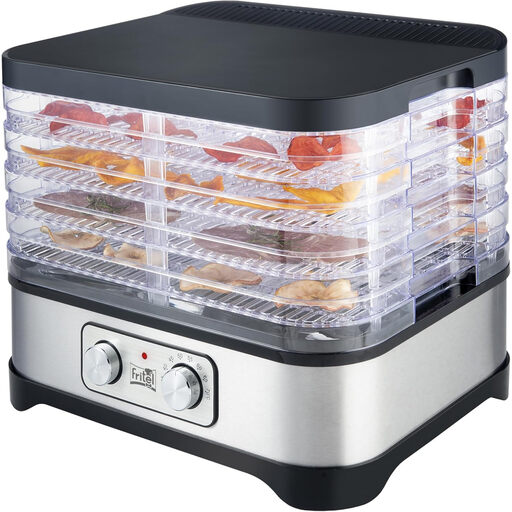
The DH 2025 is a stackable dehydrator with five plastic trays, designed for drying items including herbs. It’s worth considering if you want to compare tray layouts and appliance size.
- Fritel says the DH 2025 has an adjustable temperature range of 35–70 °C and two ways to stack the trays.
- These are manufacturer specifications, not the result of independent drying or safety tests. Fritel states that the product carries a CE marking; check the marking and product information for the version you intend to buy.
WMF
The KITCHENminis 415250011 Snack to-go is a five-tier food dehydrator. Its stated timer makes it worth considering if you want to set drying cycles in advance.
- According to WMF, the temperature can be adjusted from 30–70 °C, the timer runs from 0–24 hours and the appliance switches off automatically.
- The descriptions “quiet” and “space-saving” are manufacturer claims, not comparative measurements. Check the full dimensions and the CE marking on the version on offer.
Rommelsbacher
The DA 350 is an option to compare if you want to look at the stated drying area, rack layout and appliance dimensions side by side.
- According to Rommelsbacher, the DA 350 has five height-adjustable racks, a drying area of 0,42 m², an adjustable temperature range of 35–75 °C and a 36-hour timer. Its stated dimensions are 31,50 × 33,70 × 25,30 cm.
- These specifications apply to the DA 350 and don’t automatically apply to other models. Check the CE marking and product information for the specific version.
Food dehydrators at Joybuy
These electric food dehydrators are for anyone who wants to dry garden herbs using an appliance. Compare the temperature control, usable drying area, dimensions and CE marking for each version.
 No image available
Fritel DH 2025 food dehydrator
A good fit if you want to dry herbs across several trays and temperature control matters to you.
According to the product name: five trays, 35–70 °C, 250 W and two stacking options. Check that the dimensions suit your space and verify the CE marking on the version on offer.
View at Joybuy
 No image available
WOOX food dehydrator with five trays and timer
A good fit if you’re looking for an electric food dehydrator and want a timer to suit the way you use it.
The product name lists five trays, a timer and temperature control. Before buying, check the settings, dimensions and CE marking on the version on offer.
View at Joybuy
 No image available
Rommelsbacher DA 650 food dehydrator
Worth comparing if you’re looking for an electric food dehydrator for garden herbs.
For the version on offer, check the temperature settings, usable drying area, dimensions and CE marking.
View at Joybuy
Frequently asked questions
What temperature should I use to dry garden herbs, and how do I know when they’re ready?
The University of Georgia’s National Center for Home Food Preservation recommends preheating the food dehydrator to 95–115 °F, approximately 35–46 °C. Arrange rinsed and shaken-dry leaves in a single layer and check them regularly: the leaves should crumble and the stems should snap when bent. Drying times vary, so follow your appliance’s instructions too.
How should I store home-dried herbs?
Store fully dried herbs in a sealed jar in a dark place, away from heat and moisture. The Netherlands Nutrition Centre says opened dried herbs can be kept in a kitchen cupboard for six months; this isn’t a guaranteed shelf life for every batch of home-dried herbs.
What can I do if my food dehydrator breaks sooner than expected?
Contact the seller. According to ACM ConsuWijzer, a product must meet what you could reasonably expect of it under normal use; there isn’t a fixed legal warranty period of exactly two years for every appliance.
Can I return a food dehydrator bought online?
For online purchases, you generally have a statutory 14-day cooling-off period from delivery, with some exceptions. ACM ConsuWijzer explains the cooling-off period and exceptions; check the seller’s terms too.
Which marking should I check on an electric food dehydrator?
The Dutch government states that electrical appliances placed on the EU market must carry a CE marking. Check the marking and product information for the specific version. A CE marking isn’t an independent measurement of drying performance.


