
Breakfast lovers who put flavour first
You’re looking for a particular crust, crumb or sourdough flavour for a sandwich or toast. Compare the description of the specific loaf rather than assuming that every bread with a premium name tastes the same.


Choose premium white bread for a weekday breakfast based on the crust and crumb you prefer, and how much time you have in the morning. Bread that needs baking at home takes more preparation than bread that’s ready to eat. You should also check the ingredients, nutritional information and storage instructions for the specific product. A luxurious look or sourdough recipe doesn’t automatically make white bread comparable to wholemeal bread.
You’re looking for a particular crust, crumb or sourdough flavour for a sandwich or toast. Compare the description of the specific loaf rather than assuming that every bread with a premium name tastes the same.
You want to know whether the bread is ready to eat or needs baking at home first. Portion size and storage instructions matter too if you don’t use a whole loaf every day.
You want to compare ingredients, allergens, fibre and salt for each product. If the presence of iodised salt matters to you, check the ingredients list for the specific loaf.
First decide what kind of bread texture you’re looking for and how much preparation fits into your weekday morning. Then read the label of the variety you want to buy: the shape of the loaf and its premium name don’t tell you everything about its ingredients or nutritional value.
| What to consider | What to check when buying | Who is this important for? |
|---|---|---|
| Flavour and texture | Check the type of bread and the product description for details of the crust and crumb. Albert Heijn describes its Liefde & Passie OerDesem as bread made using a slow process; that description doesn’t apply to every sourdough loaf. | I want my sandwich or toast to have a distinctive flavour or crust, even on a working day. For around 40% of consumers, flavour and texture are said to be the main reason for choosing. |
| Preparation and storage | Check whether the bread is ready to eat or needs baking at home, and read the storage and freezing instructions on the packaging. | I don’t have much time before leaving, or I only use part of the loaf each morning. For around 30% of consumers, convenience in the morning and storage are said to be the main considerations. |
| Label and nutritional information | Read the ingredients, allergens, fibre and salt information; check separately whether iodised salt is listed. Compare nutritional values on the same basis, for example per 100 g. | I want to know what’s in my everyday sandwich before choosing a variety. For around 30% of consumers, the label and nutritional information are said to be the top priority. |
Sourdough, a hearth-baked shape or seeds on the crust don’t, in themselves, tell you how much fibre the bread contains. The Dutch Nutrition Centre points out that white bread contains fewer nutrients than wholemeal bread.
Choose bread to suit the meal you have in mind. For your everyday bread, also compare the product name, ingredients and nutritional information with those of a wholemeal variety.
The Netherlands Food and Consumer Product Safety Authority describes the addition of iodine through bakers’ salt, but that doesn’t mean every individual loaf contains iodised salt. Albert Heijn does list it for its specific Liefde & Passie Biologisch wit product.
For packaged bread, look for iodised salt or bakers’ salt in the ingredients list. For unwrapped bread, ask which ingredients have been used.
Lidl says its fresh-from-the-oven bread range can vary by store. A specific white hearth loaf from PLUS may also not be available locally.
Check what’s available at your shop or delivery location before planning breakfast around one particular loaf.
According to the Dutch Nutrition Centre, bread is among the products that are often wasted. This is especially worth considering if you only need a few slices for breakfast.
The Dutch Nutrition Centre recommends freezing bread in portions as soon as you buy it. Check the product packaging first, though, as freezing instructions can vary from one loaf to another.
These brands offer different types of white bread that you can compare by preparation, loaf shape and label. The features mentioned apply to the products or ranges described, not to every loaf from a brand.
Liefde & Passie and OerDesem are ranges to consider if you’re interested in sourdough and the crust and crumb described.
Jumbo offers white tiger bread and white rolls, among other types of bread you can compare for a weekday breakfast.
The fresh-from-the-oven range is worth considering if you want to browse freshly baked white rolls in store.
ALDI offers plain white bread as well as varieties such as rustic white, tiger bread and hearth-baked loaves.
PLUS Beiers Vloerbrood wit heel is a specific white hearth loaf to assess for its ingredients, nutritional information and storage instructions.
Bakker van der Akker Vloerbrood zonnepit is a white hearth loaf with sunflower seeds, which Dirk describes as suitable for breakfast or lunch.
This white baguette is an option if you’re looking for a baguette shape for breakfast. Before buying, check the packaging for preparation and storage instructions to make sure it fits into your morning routine.
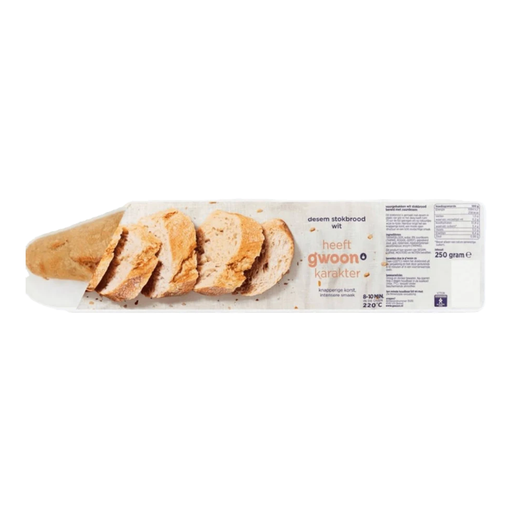 Image unavailable
A baguette-shaped loaf for anyone who enjoys white bread at breakfast. Check the packaging to see whether it needs baking at home and which storage instructions apply.
You can’t tell from a premium name, sourdough recipe or crisp crust. Compare the nutritional information per 100 g for the specific loaves; the Dutch Nutrition Centre says that white bread contains fewer nutrients than wholemeal bread.
You can’t assume this is true of every loaf. For packaged bread, check whether iodised salt or bakers’ salt is listed in the ingredients. For unwrapped bread, ask which ingredients have been used.
It depends on the specific loaf. The Dutch Nutrition Centre recommends freezing bread in portions as soon as you buy it, but Albert Heijn says its Liefde & Passie Biologisch wit isn’t suitable for home freezing. So follow the instructions on the packaging of the bread you buy.
Ordinary white wheat bread isn’t suitable for people with a wheat allergy, and bread containing gluten isn’t suitable for people with coeliac disease. Check the ingredients and allergen information for the specific product, even if it has a premium name.