
Vandaag of morgen in huis

Kwaliteit gegarandeerd

Welkomstaanbiedingen ontgrendelen: GRATIS bezorging | Tot 80% korting | Gratis 30 dagen JoyPlus-proefperiode
Download de app
A pram for a baby and toddler should suit your children’s ages, your daily route and the space you have at home or in the car. A model that handles well on a high street may be awkward on cobblestones. And a spacious tandem pram may not fit through the lift door.
So don’t focus only on colour, price or a promising marketing term. The key differences lie in weight capacity, dimensions, recline position, wheel type and folding mechanism.
Not every buggy is suitable from birth. The seat must offer enough adjustment when your baby cannot yet sit independently. Always check the stated age range and maximum weight per seat. With a double pram, the front and rear seats may also have different age limits.
A description such as “suitable for all terrains” means little without technical details. Look at the diameter, suspension, tread and whether a swivel wheel can be locked. Large wheels and suspension are practical on woodland paths and uneven pavements, while smaller swivel wheels are often more convenient in shops.
A folding pram can still take up a lot of space. Compare its folded dimensions with your boot, storage area and hallway. Also consider the weight: a model weighing 14 kg or more is less convenient if you regularly have to carry it up stairs.
For a pram suitable from birth, a completely flat or deeply reclining backrest is important. An alternative is a pram travel system, where you attach a carrycot or compatible car seat to the frame.
Pay attention to these points:
For the Chicco Seety Carrycot Boston Grey, the product information states that it can be used from birth up to a maximum of 9 kg, approximately until six months. The manufacturer also refers to EN 1466 for carrycots and stands. Always check the latest instruction manual and the compatibility list for the relevant frame.
A sporty pram for everyday outdoor use often has larger wheels, a lockable front wheel and adjustable suspension. This makes pushing over uneven ground more predictable. For urban use, a narrower design and smoothly swivelling front wheels are often more important.
A pram with large wheels is not automatically suitable for running or intensive exercise. Only use a model for activities that the manufacturer states it is suitable for. On slopes, secure the front wheel and apply the parking brake according to the instructions.
Measure the following before buying:
A compact pram weighing 6 to 8 kg is generally easier to lift. A spacious twin pram or children’s wagon offers more seating and storage space, but usually requires more storage room and greater effort to manoeuvre.
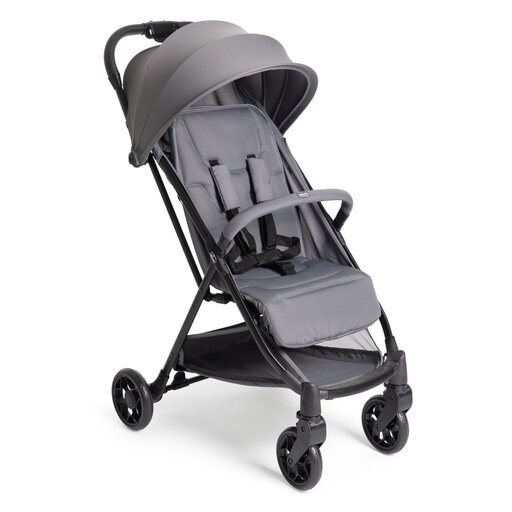
Why it suits this profile: According to the product details, this model weighs 6.3 kg, is suitable from birth up to 22 kg and can remain upright when folded. That makes it a good fit for parents looking for a straightforward pram for everyday urban use.
The stated age range, load capacity and folded dimensions are clearly specified. However, check whether 25 × 53 × 62 cm will fit your storage space.
6.3 kg, one-hand fold, fully adjustable backrest and a large shopping basket.
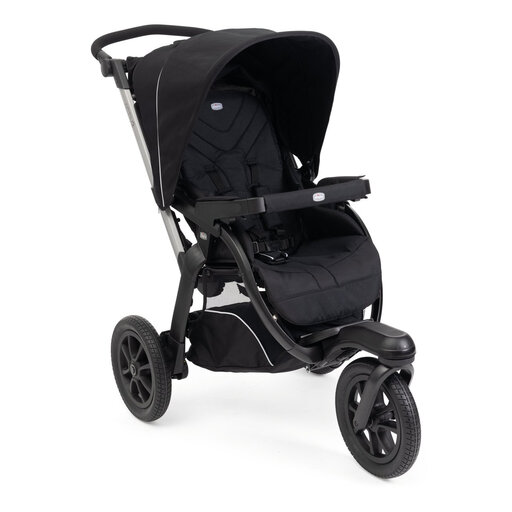
Why it suits this profile: This sporty three-wheeled pram is designed for families who spend lots of time outdoors. The product details mention XL puncture-proof EVA wheels, two-way adjustable suspension and a load capacity of up to 22 kg.
The wheels, suspension, backrest and maximum load are specified. Before buying, check which carrycot or car seat is genuinely compatible.
One-hand folding, lockable front wheel, adjustable backrest and compatibility with Activ3+ accessories.
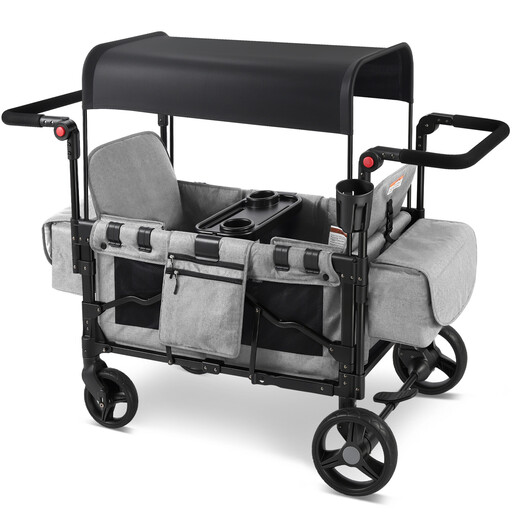
Why it suits this profile: This children’s wagon has two seats, a recommended maximum total weight of 40 kg and large EVA wheels. It may suit families taking longer outings with two children.
The two 5-point harnesses, anti-fold lock and total weight limit are listed in the product description. At 24.28 kg, this is not a lightweight urban buggy.
Two seats, adjustable seating directions, suspension, sun canopy and removable table with cup holders.
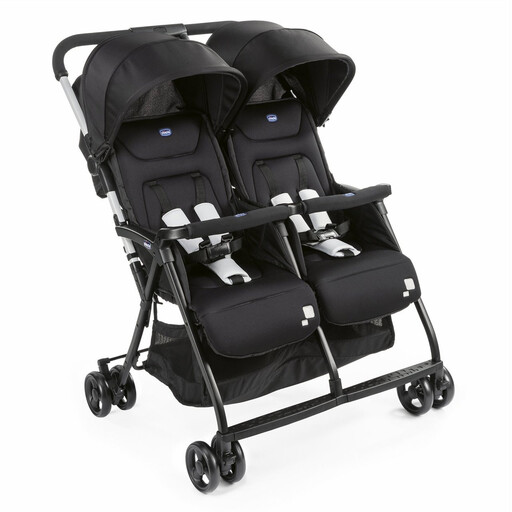
Why it suits this profile: According to the product information, this twin pram weighs 8 kg and is suitable from birth up to 15 kg per seat. The independent backrests allow each seat to be adjusted separately.
Each seat has its own harness and backrest. The width is 78 cm, so measure doors and lift openings beforehand.
8 kg, one-hand umbrella fold, independent backrests, UV50+ sun canopy and included rain cover.
We have put together a complete, up-to-date list of products that fully meet these strict selection criteria and the applicable European safety regulations.
A pram fan can provide additional airflow on hot days. Always use this type of accessory under supervision. The Momcozy Portable Stroller Fan is listed as featuring, among other things, a safety grille with openings smaller than 5 mm, four speeds, a rotating head and a USB-C battery. Attach the fan securely and keep fingers, hair and loose clothing away from the grille.
A pram carrycot is particularly useful when you want to transport a newborn baby in a lying position. Always check that the carrycot is designed for your frame. According to the product information, the Chicco Activ3 Carrycot is only compatible with the Activ3+ and is intended for approximately 0 to 6 months. The Seety Carrycot is designed for the Seety frame.
Choose a model with a suitable recline position for the baby and a seat that can accommodate the toddler’s weight and need for movement. With a tandem pram, check the age limit, maximum load and adjustability for each seat.
This varies from product to product. According to the product specifications, some models are suitable from birth up to 22 kg, while a carrycot is generally intended only for the first few months. Stop using it once your child reaches the stated weight limit or can climb out of the seat independently.
It can be, but first check the width, weight and turning circle. A narrow twin pram is easier to use in shops and lifts. A larger children’s wagon offers more space, but is harder to lift and store.
