
Workshop attendee in the loft
You want to know whether the connection between your router and workshop space will work across the floors. TP-Link Netherlands points out that the electrical wiring affects this.


Choose Ethernet if you work at a fixed computer in one place; choose a powerline kit with Wi-Fi if you want a wireless connection on the workshop floor. Test the adapters in the wall sockets you plan to use: according to TP-Link Netherlands, wiring quality and electrical interference affect the connection. If it drops out during a trial, a network cable or a different network setup is a better option than simply choosing a kit with a higher stated maximum speed.
You want to know whether the connection between your router and workshop space will work across the floors. TP-Link Netherlands points out that the electrical wiring affects this.
You can connect your computer with a network cable and need a LAN port near your workspace. Check how many devices you want to connect by cable there.
You want to use Wi-Fi on the workshop floor. So check that the receiving adapter itself offers Wi-Fi; your router's Wi-Fi function alone doesn't tell you this.
Choose this if: you work in one fixed location and can connect your computer with a network cable.
Bear in mind: a LAN connection on its own doesn't provide a Wi-Fi access point on that floor.
Choose this if: you want to use a laptop, tablet or phone wirelessly in your workshop space.
Bear in mind: Wi-Fi on the receiving adapter won't fix a weak powerline connection between the adapters.
Choose this if: you want a separate connection point on more than one floor.
Bear in mind: you need to check the number of receiving adapters and whether they're compatible with your existing adapters. Devolo states that Magic doesn't work with dLAN or other HomePlug AV products.
Choose this if: the powerline connection keeps dropping out in the sockets you plan to use.
Bear in mind: a cable needs to be routed through the house; a different network setup will need its own positioning and configuration.
If you're considering powerline for a workshop across several floors, your choice mainly depends on the connection at your workspace, the type of connection you need and how many places need network access.
| Factor | What to look for when buying | Who is this important for? |
|---|---|---|
| Connection between floors | Test the kit in the wall sockets you plan to use, and try the connection during the workshop. | If I'm attending a workshop in the loft, I want to know whether the connection through the electrical wiring will work there; around 33% of consumers are most concerned about the connection between floors. |
| Ethernet at one workspace | Check that your computer has Ethernet, that the receiving adapter has a LAN port and that the kit is complete. | If I connect my computer by cable in one fixed location, I want a suitable LAN connection there; around 27% of consumers prioritise Ethernet at their workshop space. |
| Wi-Fi on the workshop floor | Check that the receiving adapter offers Wi-Fi and whether you also need a LAN port. | If I'm using a laptop or another device without Ethernet, I need Wi-Fi on the floor where I'm attending the workshop; around 20% of consumers prioritise Wi-Fi in that location. |
| Multiple connection points | Count the locations where you want to receive a connection and check the model names and compatibility of your existing adapters. | If I want a separate connection on multiple floors, I need to match the number of adapters to the product family; around 20% of consumers prioritise multiple connection points. |
The quality of your electrical wiring and interference from appliances can affect the connection. The maximum speed in a product name doesn't tell you what you'll get from the sockets you choose.
Try the connection in the place you plan to use it and assess it during a trial workshop, rather than relying on the packaging alone.
A receiving adapter with Ethernet only won't automatically broadcast Wi-Fi on the workshop floor.
Check how your device connects and which features the receiving adapter offers.
A router and one receiving point need a basic kit with two adapters. You'll need an extra adapter for another receiving point; whether you can add one may also depend on the product family.
Count the connection points you need and compare the full model names and standards before choosing a separate adapter.
An adapter with a pass-through socket lets you plug another device into that wall socket, but that doesn't mean you should plug the powerline adapter itself into an extension lead. TP-Link Netherlands warns that extension leads and surge protectors can weaken the connection.
Plug the powerline adapter directly into a wall socket and check separately whether the model has a pass-through socket.
The product ranges include kits with Ethernet and kits with Wi-Fi on the receiving adapter, to suit different connection needs.
The Magic range includes models for Wi-Fi in multiple receiving locations and for connecting several wired devices in one place.
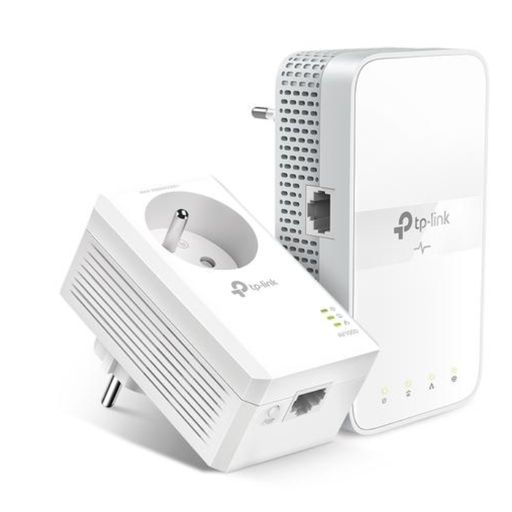
The Powerline 1000 Duo Wi-Fi EU V2 is a kit with Wi-Fi on the receiving adapter as well as a wired connection.
These powerline starter kits provide Wi-Fi or Ethernet at a workshop space. Check which connection suits your device and how you plan to use it for each model.
 No image available
Suitable for a wireless laptop or a device you want to connect by Ethernet at your workshop space.
The kit offers Wi-Fi and Ethernet; according to TP-Link, this model has a gigabit Ethernet port and dual-band AC1200 Wi-Fi. The powerline connection also depends on the electrical wiring.
 No image available
Suitable for a workshop space where you want to use Wi-Fi or connect a device by cable.
The product name lists Wi-Fi, Ethernet and 1200 Mbit/s. This figure doesn't guarantee the speed you'll get from your sockets; that also depends on the electrical wiring.
 No image available
Suitable for one fixed workshop space where you want to connect a computer via Ethernet.
The product name lists 500 Mbit/s and Ethernet. The product description specifies Fast Ethernet (10/100 Mbit/s) per adapter and describes the kit as a wired connection, not a Wi-Fi kit. The stated powerline speed doesn't guarantee the connection you'll get at home.
No. A basic network setup with two adapters is enough for a router and one workshop space. You'll also need a second receiving adapter for another separate receiving point; a kit with three adapters may be suitable.
Connect the base adapter to the router with Ethernet and plug the powerline adapters directly into wall sockets. TP-Link Netherlands warns that extension leads, surge protectors and some electrical appliances can weaken the powerline connection. If necessary, try another wall socket and test again.
Not as a general minimum requirement: the connection you need depends on the platform and how you use it. Zoom recommends around 1.2–1.8 Mbps download for a webinar attendee watching 720p video; different upload and download speeds apply to an active attendee who is broadcasting video. These are Zoom guidelines, not a guarantee that powerline will work well in your home.
That depends on the standard and product family. Devolo states that Magic adapters can be added to one another, but they don't work with dLAN or other HomePlug AV products. Check the full model names before choosing a separate adapter.
Many online purchases from a business come with a statutory 14-day cancellation period, although exceptions may apply. The Dutch government explains that a product in the Netherlands must meet what you can reasonably expect of it; if there's a fault, the retailer is your point of contact. This is separate from any manufacturer's warranty. The cancellation period for a distance purchase and a remedy for a faulty product are different rights.