
Holidaymaker looking for the right connection
You already have a rechargeable fan and want to make sure its specified charging method is compatible with your power bank. For example, Tristar describes the VE-5856G as charging via USB.


First, check your fan’s manual to see whether it charges via USB and which output, voltage and cable it requires. A rechargeable fan won’t necessarily work with every power bank. Then choose the capacity based on how many charging sessions you need to cover, balancing a larger capacity against size and weight.
You already have a rechargeable fan and want to make sure its specified charging method is compatible with your power bank. For example, Tristar describes the VE-5856G as charging via USB.
You don’t always have a socket to hand and need enough reserve power, while also considering size and weight. The Consumers’ Association lists the energy actually delivered and portability as useful points of comparison.
You might want to connect your phone as well as your fan. So check the number and type of outputs, and the power available when devices are connected at the same time.
Start with how your fan charges, then work out how much reserve power and how many connections you’ll need during your stay.
| What to consider | What should you look for? | Who is this important for? |
|---|---|---|
| Compatible charging method | Check the manual for the permitted power source, voltage and cable, and whether the USB port you want to use is an output. | I want to avoid choosing a connection or cable that won’t work with my fan; around 36% of consumers say the connection is their main concern. |
| Reserve power | Check the capacity and, where available, measurements of the energy actually delivered. Also consider the weight and size. | If I can’t get to a socket often, I want to cover the gaps between charges without carrying more than I need. Around 29% of consumers give reserve power top priority. |
| Several devices | Check the number and type of outputs, and the total output power when using them at the same time. | I want to connect another USB device as well as my fan, so I check whether both connections can be used at once; around 21% of consumers put this first. |
| Taking it with you and recharging | Compare dimensions and weight, and check which cables you’ll need to recharge the power bank itself. | I take my power bank out with me too and don’t want to find I’m missing a cable. Around 14% of consumers focus mainly on portability and recharging. |
The capacity on the label alone doesn’t tell you how many times a specific fan can be charged. The Consumers’ Association tests how much energy power banks actually deliver, and portability matters too.
First check that the charging method is compatible, then compare the capacity with measurements of the energy actually delivered, if available. Factor in the weight too.
A USB-C port can be an input or an output. A port designed for charging the power bank won’t necessarily power your fan.
Check whether the port you want to use is labelled as an output, and make sure the output and cable match your fan’s instructions.
If the port or cable isn’t compatible, you may still need a different suitable cable or power bank.
A charging accessory made for one model won’t necessarily work with other fans. Duux states that the battery and charging cable are not included with the Whisper Flex dock.
Check your fan’s manual and the full list of items included in the box before choosing a dock or cable.
With the Duux dock mentioned, remember to account for the parts that aren’t included in the box.
The BoostCharge BPB012btBK is one example with both USB-A and USB-C outputs.
The Fuel Series 5 FS5100 has a capacity of 10.000 mAh and combines USB-C and USB-A ports.
The Avala is a 20.000 mAh model with multiple connections and a charging status display.
The EB-P4520XUEGEU is a 20.000 mAh model with three USB-C ports.
The Zolo A1689 has a built-in USB-C cable, so you may not need to pack a separate cable.
These power banks are designed for portable charging. Before buying, check that the connection and charging method are compatible with your fan.
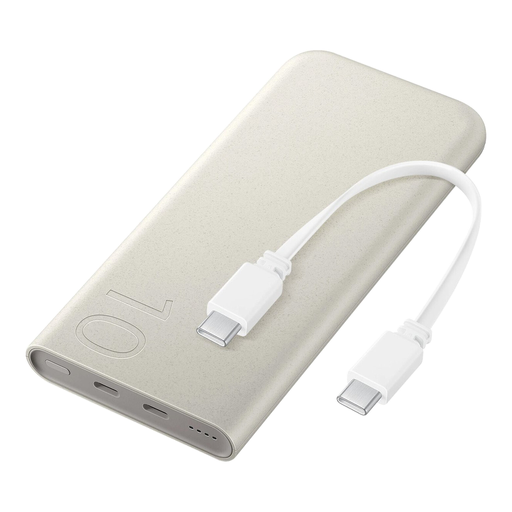 No image available
The integrated USB-C cable may be useful if your fan charges via a compatible USB-C connection.
The stated capacity is 10.000 mAh. The description lists up to 25 W wired charging, wireless charging, up to three devices at once and a weight of 210 g. Check that the wired charging method is suitable for your fan.
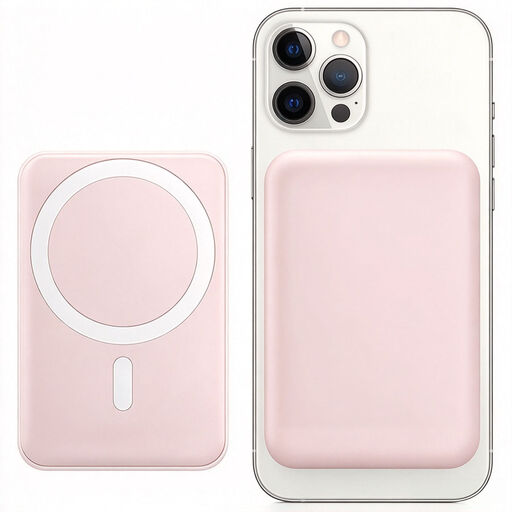 No image available
This may suit you if you also want a magnetic phone stand and wireless charging. Check separately whether the wired connection is compatible with your fan.
The title lists 10.000 mAh. The description mentions wired charging up to 15 W and wireless charging up to 15 W. The type of wired output is not specified in the available product information.
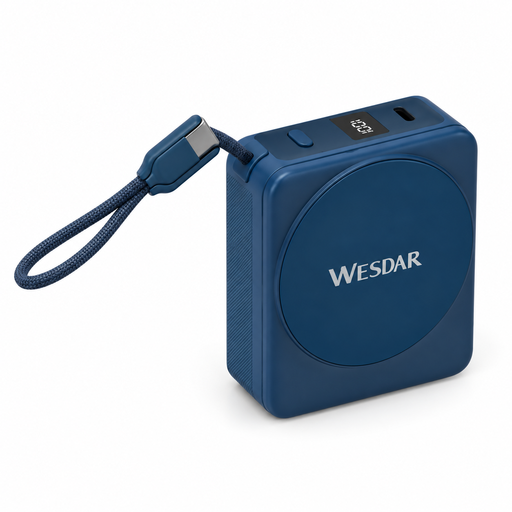 No image available
The integrated USB-C cable could save you packing a separate one if your fan uses the same charging method.
The title lists 10.000 mAh and a built-in USB-C cable. The description mentions wired charging up to 22,5 W, wireless charging up to 15 W and a digital display.
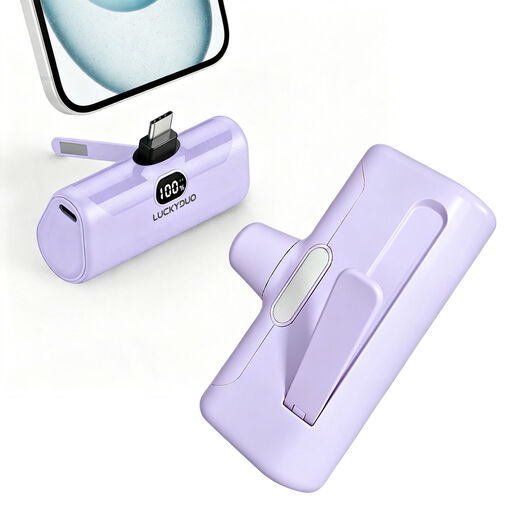 No image available
This compact design may suit you if you mainly want a small power bank to take with you and its USB-C connection is compatible with your fan.
The title lists a capacity of 5.000 mAh and a USB-C connection. The description mentions charging up to 15 W, a foldable phone stand and an LED light.
 No image available
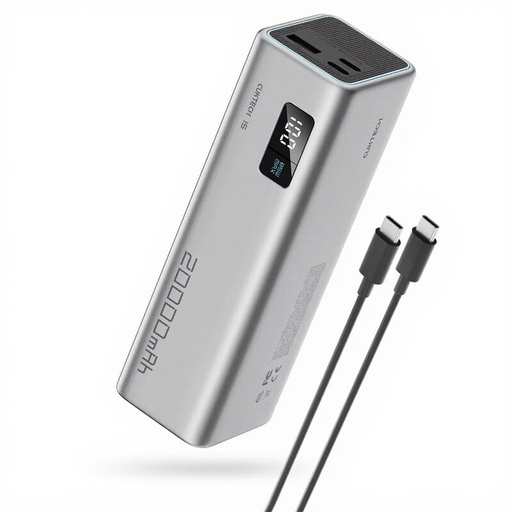
The three outputs may come in handy if you want to connect other devices as well as your fan, provided you have a compatible connection for it.
The title lists 20.000 mAh. The description mentions two USB-C outputs, one USB-A output and up to 65 W via one port. Check which port you need and the available power when using several connected devices.
No. First check how the specific model charges. Tristar lists USB charging for the VE-5856G, while Duux offers a separate charging dock for certain Whisper Flex models. Check the manual for the permitted power source, voltage and cable.
Follow the manufacturer’s instructions and charge the power bank in a clear space where heat can escape. The Fire Service advises, among other things, not to put a charger under a pillow or duvet and not to use damaged cables.
No. A CE mark does not mean that a central EU body has approved the product. The European Commission explains that the manufacturer is responsible for meeting the relevant requirements; which rules apply depends on the product.
If you buy as a consumer in the Netherlands, your statutory guarantee applies alongside any manufacturer’s or seller’s guarantee. According to ACM ConsuWijzer, the seller must offer an appropriate solution if the product breaks during normal use sooner than you could reasonably expect.