
Vandaag of morgen in huis

Kwaliteit gegarandeerd

Welkomstaanbiedingen ontgrendelen: GRATIS bezorging | Tot 80% korting | Gratis 30 dagen JoyPlus-proefperiode
Download de app
A dead battery is always a hassle, whether you're commuting to work, travelling, or facing a long day at university. A good power bank or portable charger is no longer a luxury, but a necessity. However, the market is flooded with models that promise the world, and many of these promises lead to buyer's remorse.
As a Joybuy Product Recommendation Officer, I see the challenges consumers face every day. Before you spend your money, it's crucial to recognise three common pitfalls that manufacturers often use in their marketing.
To avoid a bad purchase, focus on the specifications that truly matter. These are the three most important factors that determine if an external battery is right for you.
As mentioned, the advertised capacity is not what you get. A simple rule of thumb: multiply the capacity in mAh by 0.65.
Choose the capacity that fits your daily routine. A higher number isn't always better if it comes at the cost of portability.
Charging speed is expressed in Watts (W). The higher the wattage, the faster your device will charge, provided your device supports it.
Power Delivery (PD) is the universal standard for fast charging via USB-C, used by Apple, Samsung, Google, and many laptop manufacturers. Always check that both the power bank and your device support the same protocol.
The functionality of a power bank depends on its ports and extra features.
Based on these criteria, we have selected a few popular choices that suit different user profiles.
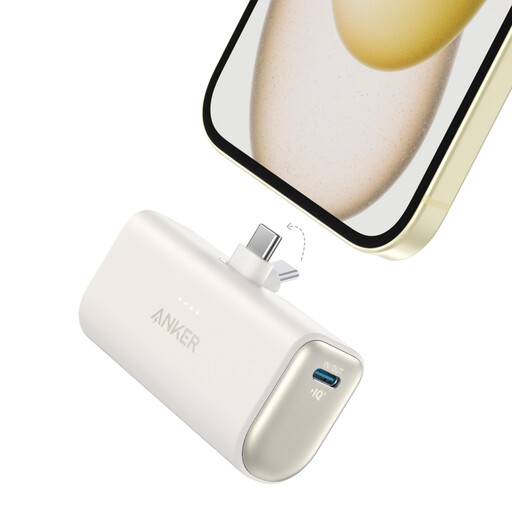
Why This Fits Their Persona: Perfect for those who travel light. This compact power bank fits in your pocket and has a flip-out USB-C connector, so you don't need a separate cable. Ideal for a quick top-up on the train or between appointments.
This Anker power bank tackles the design problem. No fussing with cables, and its size is extremely practical, meaning you'll actually carry and use it.
Built-in USB-C connector: Always ready to use. 22.5W fast charging: Delivers power quickly to compatible devices.
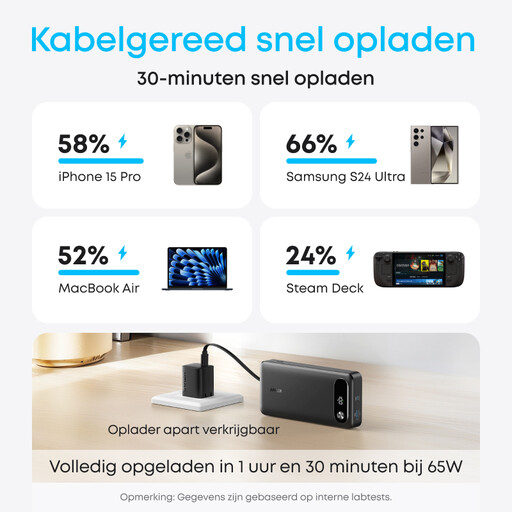
Why This Fits Their Persona: For the user who depends on multiple devices, including a laptop. With 20,000mAh and a powerful 87W output, you can charge your phone, earbuds, and even your MacBook simultaneously.
This power bank cuts through the vague fast-charging claims. It specifies a total output of 87W and up to 65W on a single port, which are concrete and verifiable performance metrics for a laptop power bank.
High output (87W): Suitable for charging laptops. Large capacity (20,000mAh): Charges multiple devices. Built-in USB-C cable: Added convenience.
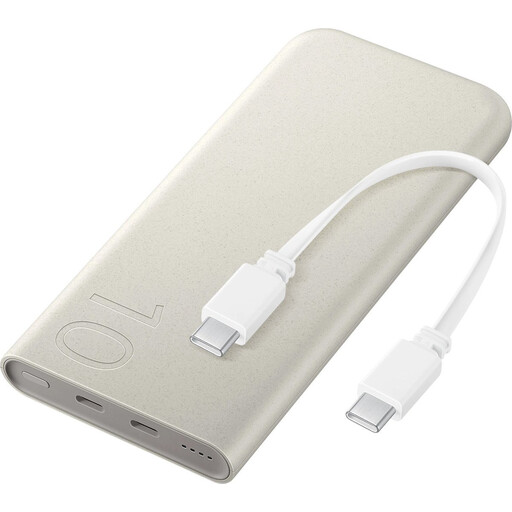
Why This Fits Their Persona: For those who value the convenience of wireless charging but don't want to sacrifice the speed of a cable. This Samsung power bank offers both. Place your phone or earbuds on it for wireless charging, or use the 25W USB-C port for a quick boost.
This model addresses the misleading capacity pitfall by offering a realistic 10,000mAh, combined with clear specifications for both wired (25W) and wireless (7.5W) charging. No false promises.
Wireless and wired charging: Flexibility for all your devices. 25W Super Fast Charging: According to Samsung, this charges compatible devices very quickly. Compact and stylish design.
We've compiled a complete, up-to-date list of products that fully meet these strict selection criteria and safety regulations.
This depends on your phone's battery capacity. For example, an iPhone 15 has a battery of about 3,350 mAh. A 10,000mAh power bank delivers approximately 6,500 mAh in practice. Therefore, you can charge your iPhone 15 almost twice (6,500 / 3,350 ≈ 1.9). For a Samsung Galaxy S24 with a 4,000mAh battery, that's about 1.6 times.
Yes, it is safe. Modern power banks and smartphones use communication protocols like Power Delivery. The power bank and phone "negotiate" the maximum safe charging speed. The phone will never draw more power than it can handle, and the power bank will never supply more than is safe.
Yes, power banks are allowed on airplanes, but only in your carry-on luggage. They are prohibited in checked baggage due to fire risk. Most airlines have a limit of 100 watt-hours (Wh) per battery. A 20,000mAh power bank (at 3.7V) is about 74 Wh and is therefore no problem at all. Models up to 27,000 mAh generally fall within the limit. To be safe, always check the rules of your specific airline.
