
Travellers who need to stay connected
You’ll want enough power for your phone, ticket and calls during the rest of your journey. The capacity you need depends on how long it is until your next chance to charge.


Choose a capacity that suits how long you’ll be away from a socket, and opt for a compact model if you mainly want to top up while you wait. Also check that the connector and cable are compatible with your phone. A higher mAh rating doesn’t automatically mean faster charging or a specific number of phone charges.
You’ll want enough power for your phone, ticket and calls during the rest of your journey. The capacity you need depends on how long it is until your next chance to charge.
If you want to charge your phone by cable during a short break, look for a compatible USB-C connection and suitable output power—not just a high mAh rating.
You’ll want a power bank that’s easy to carry, so weigh up its size and weight, and whether you’ll need to bring a separate cable.
First, work out how long your phone needs to last until your next chance to charge. Then consider the charging connection, output power and how easy the power bank is to carry.
| What to consider | What to look for | Who is this important for? |
|---|---|---|
| Power to last until your next chance to charge | Compare the stated capacity with information about the actual capacity delivered, and take your phone usage into account. | If I have a long journey after the terminal, I want enough reserve without relying solely on the number on the packaging. Around 40% of consumers say power reserve is their main consideration. |
| Quick top-ups | Check the USB-C output power, whether your phone and cable are compatible, and any limitations when charging multiple devices. | If I have a short stop, I want to know whether my phone and cable can make use of the available power. Around 30% of consumers prioritise quick top-ups. |
| Taking it with you on your journey | Compare the weight and dimensions of the exact model with the capacity you need. | If I want to pack light, I weigh up portability against the power reserve I need. Around 20% of consumers put portability first. |
| Connection and cable | Check your phone’s connection, whether a cable is built in or included, and Qi2 or MagSafe compatibility if you want wireless charging. | If I want to connect quickly during a change of transport, I don’t want to be caught out by the wrong plug or a missing cable. Around 10% of consumers say connection convenience is their top priority. |
The stated capacity alone doesn’t tell you how much power a power bank will actually deliver or how much charge your phone will receive. The Dutch Consumers’ Association also considers delivered power and portability when comparing products.
Compare specific models by their delivered capacity and weight, and choose a power reserve that suits the time until your next chance to charge.
A built-in USB-C cable won’t automatically work with a Lightning connection. For magnetic charging, both your phone and its case need to be compatible with the power bank.
Before buying, check the connector and compatibility requirements for the exact model. Belkin says that its tested model with a built-in USB-C cable needs a separate Lightning cable for an iPhone 13 or iPhone 14; the cable isn’t included.
A warning may apply to specific models or production batches. The Netherlands Food and Consumer Product Safety Authority (NVWA) has issued warnings for Anker models A1257 and A1647, Anker Zolo models A1681 and A1689, and certain batches of an imoshion MagSafe power bank.
Check the full model number and, where relevant, the batch number against the latest NVWA information. Don’t use a product covered by a warning.
The models reviewed include a Fiera with a built-in USB-C cable and a Primo version with USB-A and USB-C connections.
The BoostCharge models reviewed include a power bank with an integrated USB-C cable and a Qi2 magnetic version.
The Battery Pack EB-P4520XUEGEU reviewed has a stated capacity of 20,000 mAh and three ports.
This selection includes wired power banks with a range of capacities, as well as a magnetic Qi2 option for compatible phones.
 No image available
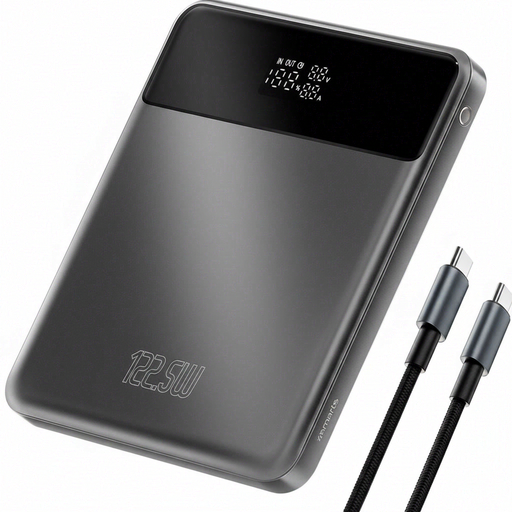
A wired option to consider if you’re looking for extra capacity for the journey after the terminal.
The product name specifies 20,000 mAh and 122.5 W. The product description mentions Power Delivery and Qualcomm Quick Charge.
 No image available
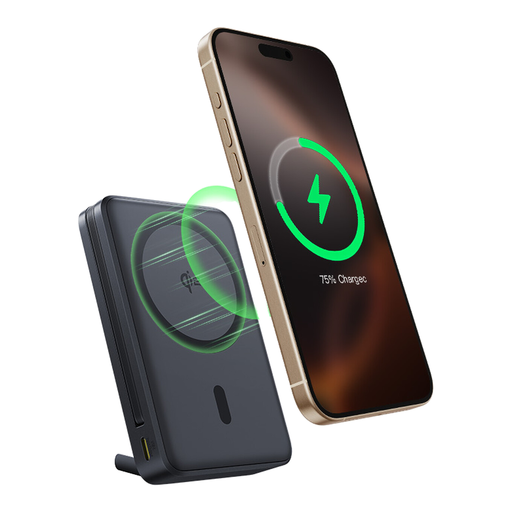
A good option if you’re considering wireless or magnetic charging and would also like a built-in USB-C cable. Check that your phone supports Qi2.
The product description specifies 15 W wireless charging via Qi2 and up to 45 W via the built-in USB-C cable. The Qi2 feature is designed for compatible devices.
 No image available
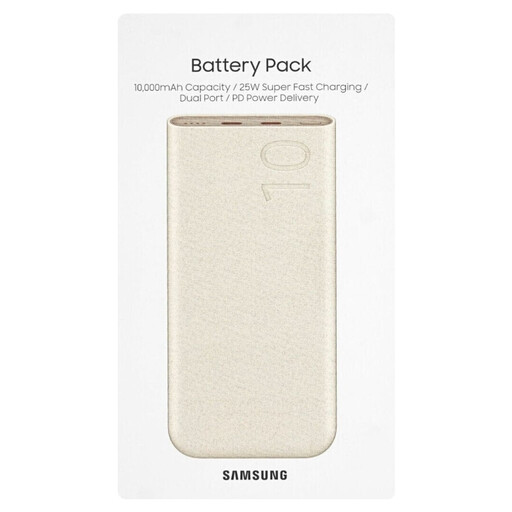
A wired option to consider if you’re looking for a 10,000 mAh model that, according to the product information, can charge two devices at once.
The product name specifies a maximum of 25 W and 10,000 mAh; the product description gives a weight of 210 g. Samsung specifies a maximum of 9 W per device when charging two devices at once.
 No image available
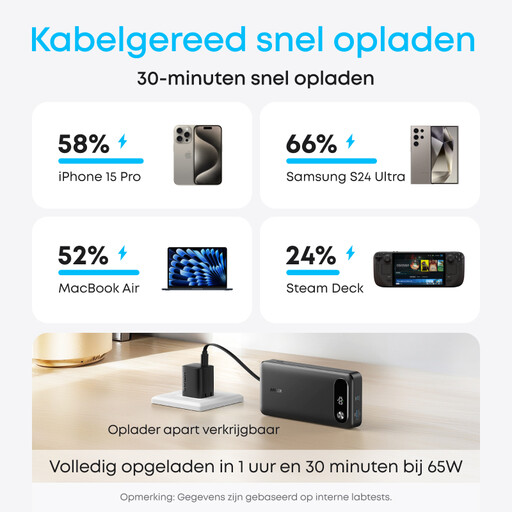
A larger wired power bank to consider if you want more power in reserve and like the convenience of a built-in cable.
The product name specifies 20,000 mAh, 87 W and a built-in USB-C cable. The product description specifies a maximum of 65 W for one device and says it can charge up to three devices at once. Before use, check the full model number: the NVWA warning applies to specific Anker models.
 No image available
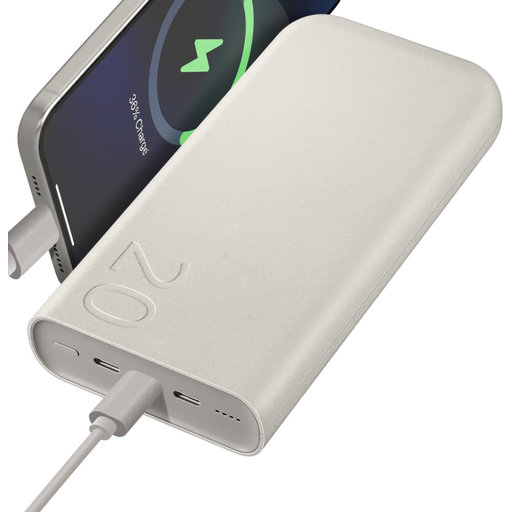
A good choice if you need extra power in reserve and several USB-C connections, and don’t mind carrying a heavier power bank.
The product name specifies 20,000 mAh and three USB-C ports. Samsung specifies a maximum of 45 W when one device is connected; the product description gives a weight of 402 g.
No. Choose based on how long it is until your next chance to charge and what you want to carry. The Dutch Consumers’ Association also assesses the power actually delivered and portability; the stated mAh rating alone doesn’t predict how many times you can charge your phone.
Check that your phone, cable and power bank are compatible, and whether you’re charging more than one device. For the EB-P4520XUEGEU reviewed, Samsung specifies a maximum of 45 W when one device is connected; the maximum varies by model.
Follow the instructions, keep the power bank and cable dry, and don’t use a damaged cable. The Fire Brigade warns that damage, moisture and short circuits can cause fires. Place a device that’s charging somewhere heat can escape.
According to the Government of the Netherlands, the seller must provide a solution if there’s a problem with a product. Take a power bank you no longer need to an appropriate battery collection point, and don’t put it in your general waste.