
Travellers who want to be sure charging will work
Before you set off, check that the port, cable and charging output are suitable for your exact camera model. Comparing the wattage on the power bank alone isn’t enough.


Start by checking the charging requirements for your exact action camera, then consider a power bank’s capacity, ports and size. A higher wattage doesn’t guarantee that your camera will charge faster. GoPro Support Hub lists 5 V/2 A for the HERO models mentioned, while Insta360 links fast charging for the X5 to PD3.0 PPS and specific test conditions. If you have access to a socket in your hotel room and don’t need backup power while you’re out, a suitable USB mains charger may be enough. A power bank can be useful when you need power away from your room or want to charge several devices, but it adds weight and charging times vary by model.
Before you set off, check that the port, cable and charging output are suitable for your exact camera model. Comparing the wattage on the power bank alone isn’t enough.
If you also want backup power when you’re away from your hotel room, weigh up the capacity against the size and weight you’re happy to carry.
If you’re charging between shots, both your camera’s charging protocol and the power bank’s output matter. A phone charging claim doesn’t tell you how quickly your action camera will charge.
Start with your camera’s connection and charging requirements. Then compare the backup power, charging breaks and travel conditions that matter to you.
| What matters when buying | What to look for | Who is this important to? |
|---|---|---|
| Connection and compatibility | For your camera model, check the required port, cable, output voltage, current and, where relevant, charging protocol. | If I want to be sure the power bank can charge my camera appropriately, I check the connection and charging requirements; around 36% of consumers prioritise compatibility. |
| Backup power and portability | Compare the stated capacity with the size and weight; don’t use it to estimate a fixed number of full camera charges. | If I also want to film away from my hotel room, I weigh the backup power I’ll carry against the size; around 29% of consumers prioritise backup power. |
| Charging during short breaks | Compare your camera’s charging mode with the output and supported protocol of the power bank’s relevant port. | During short breaks, I want to know whether my camera supports the power bank’s charging mode; around 21% of consumers let charging time guide their choice. |
| Safe charging and carrying | Use undamaged charging equipment, leave it uncovered and check the Wh rating and your airline’s rules before flying. | If I’m flying, I check my carrier’s conditions and make sure my charging equipment is undamaged and uncovered; around 14% of consumers cite travel safety as their main concern when choosing. |
Charging requirements and fast-charging conditions vary by camera. So a higher stated output doesn’t prove that your camera will charge faster.
Check the manual for your exact camera model and compare its required output with the power bank port and cable.
The stated capacity doesn’t tell you how many full charges you’ll get for your particular action camera.
Use capacity to compare models, but base your expectations on measurements taken with the same camera model under clearly stated conditions.
The Fire Service warns of the risks of charging incorrectly and using damaged batteries or chargers.
Follow the instructions, leave charging equipment uncovered so heat can escape, and don’t use damaged cables or chargers.
The Nano A1259 is a 10,000mAh power bank with a built-in USB-C cable and a stated USB-C output of up to 30 W.
According to Belkin, the BoostCharge BPB021hqPK has a capacity of 10,000 mAh, a built-in USB-C cable, a maximum output of 20 W and a USB-C port for a second device.
According to Xtorm, the Fuel Series 5 FS5100 has a capacity of 10,000 mAh, two USB-C ports, one USB-A port and a USB-C PD output of up to 20 W.
These are wired power banks with a built-in USB-C cable, for anyone who wants to carry backup power. Before buying, check that the connection and charging mode are suitable for your action camera.
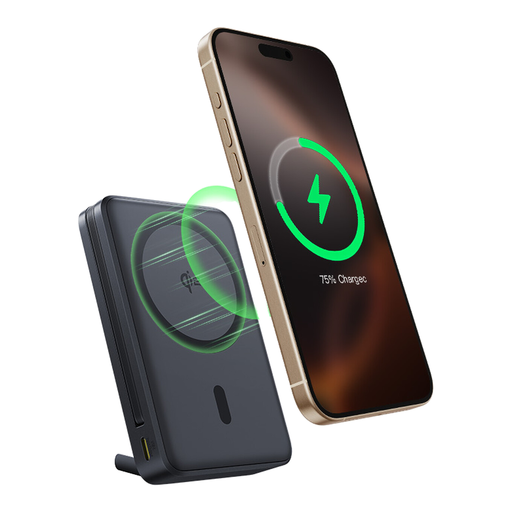 Image unavailable
Could suit you if you want to carry backup power while you’re out and your camera charges through a suitable USB-C connection; check that the built-in cable meets your camera’s requirements.
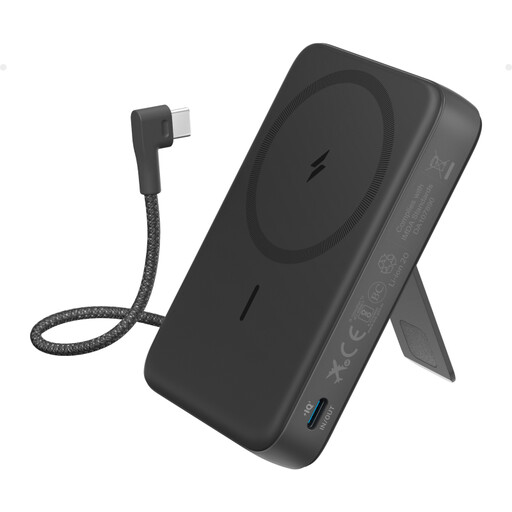 Image unavailable
Could suit you if you’re looking for portable backup power with a built-in USB-C cable; check the connection and charging requirements for your exact action camera.
No. Check the requirements for your exact camera model and the power bank’s output. GoPro Support Hub lists 5 V/2 A for the HERO models mentioned; Insta360 links the stated fast charging time for the X5 to PD3.0 PPS and specific test conditions. Don’t assume your camera will perform like a phone based on a phone charging claim.
Follow the manufacturer’s instructions and leave charging equipment uncovered so heat can escape. The Fire Service advises against charging under a pillow or duvet, and says not to use damaged cables or chargers.
It depends on your airline and flight. Transavia requires spare lithium batteries, including power banks, to be carried in hand or cabin baggage, not checked baggage. KLM has its own conditions, including a maximum number of power banks and restrictions on using them on board. Check your carrier’s latest rules before you travel.
If a product develops a fault sooner than you could reasonably expect under normal use, contact the seller. ACM ConsuWijzer explains that the seller must offer an appropriate solution for a faulty product; a commercial manufacturer’s warranty doesn’t replace your statutory rights.