Who is this relevant for?

Workshop leader with a small shelf

You want a large film image without placing the projector well behind the workstations. Measure the space needed for the entire set-up: XGIMI and BenQ provide placement information for specific models, but the distance from the lens to the wall is not the same as the shelf depth you’ll need.

Teacher who keeps the task lighting on

Your participants need to be able to see the clay while the film is playing. Compare the stated brightness with the image size and the light levels in your room. BenQ and XGIMI list brightness specifications for different models and measurement units.

Workshop leader with changing workspaces

You put the equipment away after each session or use it in different rooms. A portable model may suit your needs, but check the projection distance, connection and power supply at each location. XGIMI lists a built-in stand and battery for the MoGo 4.

What should you look for?

Ultra-short-throw projection

Suitable when: the projector needs to sit close to the wall and the shelf has room for the whole casing, cables and airflow. XGIMI says the AURA 2 can project a 100-inch image from 17,8 cm away from the wall.

Bear in mind: that distance doesn’t tell you how much shelf depth the projector itself and its connections need. Measure the complete set-up.

Short-throw projection

Suitable when: you have a stable spot a little further from the wall, but don’t want to place the projector behind your participants. BenQ lists a distance of around 4,9 feet for a 100-inch image with the TH671ST.

Bear in mind: this option needs more space between the projector and wall than ultra-short-throw projection. Also consider the HDMI source and the sound in the room.

Compact and portable

Suitable when: you want to put the projector away after the workshop and can dim the room well during the film. XGIMI lists a built-in stand and battery for the MoGo 4.

Bear in mind: XGIMI’s stated 450 ISO lumens doesn’t prove that the image will be large and visible enough with the task lighting on. Check the distance and test the film in the room.

Consideration What should you check? Who should pay particular attention?
Will the image fit in the available space? Measure the shelf depth, space for cables, distance to the wall and preferred image width. Compare these measurements with the placement information for the exact model. If my shelf is shallow, I need to know whether the projector, plugs and ventilation space will all fit. Around 36% of consumers put placement first.
Will the film be visible with the task lighting on? Note whether the lights will stay on and decide on your preferred image size. Compare brightness figures only with their stated measurement units. If participants need to keep working during the film, I want them to be able to follow the image. Around 29% of consumers put visibility with the task lighting on first.
Will the picture and sound work for the demonstration? Check the connection to your laptop or media player, how you’ll play the film and how the sound comes across at the workstation furthest away. I want to connect my film and make sure people can hear the spoken instructions at their workstations. Around 21% of consumers give film playback top priority.
Can the projector be stored away and maintained? Choose a stable spot away from directly blown dust, keep the ventilation openings clear and follow the maintenance instructions for the exact model. If the workspace needs to be clear afterwards, I want to be able to put the projector away easily and keep dust to a minimum. Around 14% of consumers put tidying away and dust control first.

Common mistakes

  • Measuring only the distance to the wall

    The stated projection distance doesn’t tell you how much room the casing, plugs and ventilation need altogether.

    Sketch the complete set-up to scale before choosing a model.

    You may need a different stand, furniture arrangement or screen position.

  • Assuming a small projector will work well with the task lighting on

    A portable model and a short-throw model may have different stated light outputs. Without testing it in the room, you can’t be sure how visible the image will be.

    Check the image size and lighting conditions using your own film. Compare brightness figures with their corresponding measurement units.

  • Confusing ‘4K support’ with native 4K

    Yaber lists native 1080p for the K300s, with support for decoding 4K sources. That isn’t the same as native 4K projection.

    Check the native resolution separately from the resolution of sources the device can decode.

  • Leaving the projector in a dusty work area

    BenQ warns that prolonged exposure to dust can affect internal projector components.

    Plan to use a stable spot away from direct workshop dust and follow the maintenance instructions for the exact model.

    Depending on the model, cleaning or filter maintenance may be needed.

Brands and example models

XGIMI

The AURA 2 is an example of ultra-short-throw projection, while the MoGo 4 shows what a portable set-up can offer.

  • XGIMI specifies a throw ratio of 0,177:1 for the AURA 2. For the MoGo 4, the manufacturer lists a built-in stand, battery and 450 ISO lumens.
  • These specifications apply to different models and aren’t claims about the brand as a whole. Check the set-up, task lighting and image size you need for your room.

BenQ

The TH671ST is an example of short-throw projection for a film set-up with space between the projector and the wall.

  • BenQ lists Full HD, 3000 lumens, two HDMI inputs and a 5 W speaker for the TH671ST. For a 100-inch image, BenQ gives a distance of around 4,9 feet.
  • Check whether you have enough space for that distance and whether the brightness, sound and connections suit your workshop room.

Epson

The EF-12 illustrates the trade-offs involved with a compact Full HD laser projector with built-in sound.

  • Epson specifies a throw ratio of 1,00:1, 1000 lumens and dimensions of 175 × 175 × 135 mm for the EF-12.
  • With this throw ratio, a compact casing doesn’t mean the projector can sit close to the wall. Epson also lists an air filter accessory; check which version and accessories are included with the product on offer.

Yaber

The K300S is worth considering as an ultra-short-throw option, but first check the placement information for the version on offer.

  • Yaber lists native 1080p and support for decoding 4K sources for the K300s.
  • A Dutch ranking describes the K300S as ultra-short-throw, while Yaber’s product page also uses the term ‘Standard Throw’. Confirm the projection distance for the exact model before planning your set-up.

Projectors at Joybuy

This selection includes short-throw and ultra-short-throw projectors, as well as a portable model for workshops where easy storage matters. Compare the stated projection distance with the space available and test visibility under the lighting you’ll need during the lesson.

Optoma H117ST short-throw projector, WXGA, 3800 ANSI lumens

Optoma H117ST – WXGA, 3800 ANSI lumens

The short-throw distance may suit you if you’re looking for a stable spot closer to the wall. Check the available distance and image size for your room.

Native WXGA 1280 × 800; 3800 ANSI lumens; throw ratio 0,52:1; HDMI 1.4a; built-in 10 W speaker.

View at Joybuy

Optoma Photon Go portable projector

Optoma Photon Go

The ultra-short-throw ratio may suit you if the projector needs to sit close to the wall. Assess the brightness under the task lighting in your room.

1080p Full HD; 650 lumens; throw ratio 0,18:1; stated projection distance 0,26–0,4 m; HDMI 2.0; dimensions 252 × 157 × 62 mm; net weight 1,72 kg; 2 × 10 W speakers.

View at Joybuy

BenQ MW809STH short-throw projector, XGA, 3600 ANSI lumens

BenQ MW809STH – XGA, 3600 ANSI lumens

This short-throw model may suit you if you have a stable surface and limited space between the projector and wall. Keep the ventilation clear.

XGA 1024 × 768; 3600 ANSI lumens; throw ratio 0,49:1.

View at Joybuy
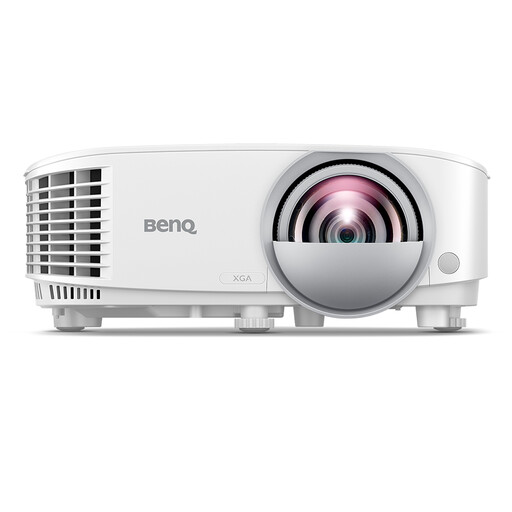
BenQ MX825STH short-throw projector, XGA, 3500 ANSI lumens

BenQ MX825STH – XGA, 3500 ANSI lumens

The short-throw design may suit a smaller room. Check the placement distance and make sure there’s enough room for ventilation.

XGA 1024 × 768; 3500 ANSI lumens; two HDMI inputs; built-in 10 W speaker.

View at Joybuy

Magcubic HY350Max portable projector, native 1080p

Magcubic HY350Max – native 1080p

The portable design and stated 180° rotation may suit you if you want to move the projector after the session. With a throw ratio of 1:1, you’ll also need to allow enough distance from the wall.

Native 1080p; 900 ANSI lumens; throw ratio 1:1; Android 14; 5G WiFi 6; Bluetooth 5.4; HDMI compatibility; automatic focus and keystone correction.

View at Joybuy

Frequently asked questions

How do you check whether a projector will fit on your shelf?

Don’t just measure the shelf: also work out your preferred image width, the distance from the lens to the wall, and the space needed for cables and ventilation. Use the placement information for the exact model. An ultra-short distance from the wall isn’t the same as the total depth needed for the set-up.

What should you do with the projector after a dusty workshop?

Keep it away from directly blown workshop dust while it’s in use, and leave the ventilation openings clear. Once it has cooled down, store it according to the manual and check whether the model you’ve chosen requires filter maintenance. BenQ warns against prolonged exposure to dust; this doesn’t mean every model offers the same protection or has the same maintenance interval.

Is CE marking compulsory for a projector in the Netherlands?

The Netherlands Food and Consumer Product Safety Authority states that CE marking is compulsory for electrical consumer products. Check the marking on the device on offer. According to the NVWA, this doesn’t automatically mean that an independent inspection is compulsory.

Can you show any film you like during a workshop?

Not necessarily. According to the Dutch Government, you may only use a copyright-protected film with the creator’s permission; you can’t make a copy for personal use available to the public. Check the rights for the film and the screening you have in mind.

What rights apply to online purchases and repairs?

If you buy online as a consumer, ACM ConsuWijzer says you’ll generally have up to 14 days after delivery to change your mind, subject to legal exceptions. If a product doesn’t meet what you could reasonably expect under normal use, the seller is responsible for the statutory guarantee. Check the terms separately if you’re buying on behalf of a business.
