Who is this choice relevant to?

Maker with lots of pieces

If you photograph a series of pots or bowls for a catalogue, a repeatable composition and true-to-life colours are important. Canon Netherlands describes a tripod as a way to keep the composition of product photos consistent.

Maker focusing on glaze details

If you want to show small textures or a maker’s mark, consider the lens’s magnification and working distance, as well as how much room you’ll have left for lighting. Nikon Netherlands and Sony Netherlands list dedicated macro lenses for this type of detail.

Photographer with limited stand space

If you need to set up your camera in a confined space, check in advance that the field of view from that distance suits your pieces. Ricoh lists the GR IIIx as having a fixed field of view comparable to 40 mm on full-frame; the Consumers’ Association describes compact cameras as cameras with a fixed lens.

What should you look for when choosing?

Mirrorless camera with standard zoom

A good fit if: you switch between overview shots and different crops from a fixed tripod position.

Keep in mind: a standard zoom is not automatically a macro lens; check the focusing distance and magnification of the included lens.

Mirrorless camera with macro lens

A good fit if: you need to fill the frame with small relief details or maker’s marks, and your set-up allows enough working distance and room for lighting.

Keep in mind: the macro lens is sold separately; at a very short working distance, it can be harder to position lighting around the pottery.

Compact camera with fixed lens

A good fit if: one fixed field of view works from your available camera position and you want a compact set-up you can take with you.

Keep in mind: you can’t change the lens if you need a different field of view or a specialist close-up.

What to consider What should you check? Who does this matter most to?
Repeatable composition Measure the distance to your set-up and check that the lens can fit your largest piece within the composition you want. When I photograph a series of pieces, I want to leave the camera in the same place and still frame everything properly. Around 36% of consumers say a repeatable composition is their main buying concern.
Glaze colour and reflections Check RAW shooting and white balance on the exact model, and take test shots under the trade fair lighting. I want to assess glaze colours without changing light or reflections dominating the shot. Around 29% of consumers give colour reproduction and reflections top priority.
Small details Check the magnification and working distance of the lens that is actually included. When I want to show a small relief detail or maker’s mark, the lens needs to capture it clearly enough from my fixed position. Around 21% of consumers prioritise small details.
Limited stand space Compare the dimensions of your set-up and test whether the field of view from your planned distance suits both your largest and smallest pieces. With limited space on my stand, I want a camera set-up that fits and gives me the composition I need. For around 14% of consumers, limited stand space is their main buying concern.

Common buying mistakes

  • Assuming a standard zoom is a complete macro set-up

    The 1:1 magnification Nikon lists for the Z MC 50mm applies to that separate macro lens, not to the standard zoom included in the Z50II kit.

    Check exactly which lens is in the box and what magnification you need from your fixed camera position.

  • Choosing solely on megapixels for glossy pottery

    High resolution doesn’t automatically determine how glaze colours and reflections will look. White balance and lighting also play a part.

    Take test shots of the actual glaze under the trade fair lighting, then assess the colour and reflections before finalising your set-up.

  • Buying a fixed-lens camera without testing the composition

    According to Ricoh, the GR IIIx has a fixed field of view. This means you can’t change the lens if that field of view doesn’t work from your shooting distance.

    Beforehand, test the composition for both your largest and smallest pieces from the permitted camera position.

  • Treating the Sony ZV-E10 and ZV-E10 II as the same model

    Sony describes the ZV-E10 II as a different model from the ZV-E10; a listing for one version doesn’t confirm that the other is available.

    Compare the full model name and the included lens before making your choice.

Relevant brands to consider

Canon

The EOS R50 with RF-S 18-45mm kit lens is a mirrorless camera option for taking different shots of entire pieces. Canon Netherlands recommends a tripod as a way to keep your composition consistent.

  • Canon lists a 24.2 MP APS-C sensor and vari-angle screen for the EOS R50.
  • These specifications alone say nothing about colour accuracy. Check that your chosen RF or RF-S lens provides enough magnification for small details.

Nikon

The Z50II with Z DX 16-50mm kit zoom is an option for overview shots. There’s also a separate Z MC 50mm f/2.8 macro lens for capturing small details.

  • Nikon lists VR in the kit lens and 1:1 magnification for the separate macro lens.
  • The 1:1 magnification doesn’t apply to the standard kit. Also check that the macro lens’s field of view works from your fixed distance.

Sony

The ZV-E10 II with E PZ 16-50mm OSS II kit zoom takes interchangeable E-mount lenses. Sony lists the separate E 30mm F3.5 Macro as an option for close-up shots.

  • Sony lists RAW photos for the ZV-E10 II and 1:1 magnification for the separate macro lens.
  • The minimum working distance of the E 30mm F3.5 Macro is 2.4 cm from the front of the lens, which can make it harder to position lighting. The ZV-E10 is a different model from the ZV-E10 II.

Ricoh

The GR IIIx is a compact camera option if one fixed field of view works from your stand.

  • Ricoh lists an APS-C sensor and a fixed 26.1 mm lens, with a field of view comparable to 40 mm on full-frame.
  • The fixed lens limits your ability to adjust the field of view and take specialist close-ups. Check beforehand that the crops work from your distance.

Cameras at Joybuy

These Joybuy cameras are relevant to the topic. For each model, check that the stated lens, field of view and available space work for your pottery and fixed camera position.
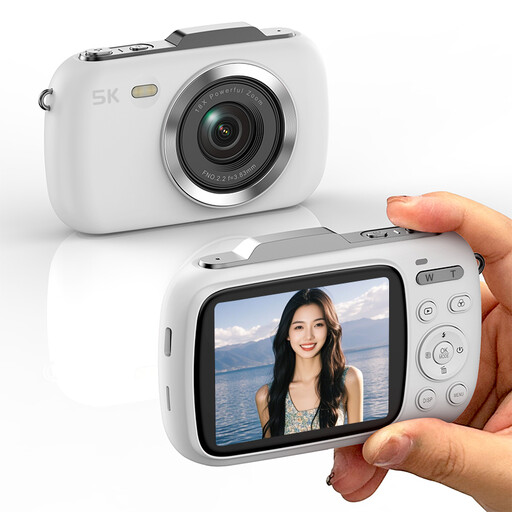
KOMERY G7 5K digital camera, white

KOMERY G7 5K digital camera, white

The product name lists 18× zoom, which may be useful if you want to try different compositions from the same position.

The product name also lists 80 MP. Test from your fixed distance to see whether the zoom gives you the composition you want for your pottery.

View at Joybuy

Komery W6 camera with 12× optical zoom

Komery W6 camera

The product name lists 12× optical zoom; compare this with the composition you need from your planned camera distance.

The product name also mentions 4K and 64 MP. Check whether the lens and focusing distance suit the details you want to photograph.

View at Joybuy

DJI Osmo Pocket 3 camera

DJI Osmo Pocket 3

The product name describes this model as a small camera for photography; compare its dimensions with the space available on your stand.

The product name lists a 1-inch CMOS sensor and 4K/120fps video. Separately, check whether the field of view and set-up are suitable for your still pottery photos.

View at Joybuy

Sony ZV-E10 with 16-50mm zoom lens, black

Sony ZV-E10 + 16-50mm zoom lens, black

The product name lists a 16-50mm zoom lens, which can help you try different compositions without changing the camera position.

This is the ZV-E10, not the ZV-E10 II. Check that the included lens gives you the composition and focusing you need from your working distance.

View at Joybuy

Sony Alpha A6100 with 16-50mm lens

Sony Alpha A6100 + 16-50mm lens

The product name lists a 16-50mm lens; consider whether the zoom range suits the different sizes of pottery you photograph from one position.

Check the focusing distance of the included lens if small relief details or maker’s marks are important to you.

View at Joybuy

Frequently asked questions

How can I make a series of pottery photos from one position look consistent?

Use a stable set-up, keep the composition and background the same, and take a test shot before swapping pieces. Canon Netherlands describes a tripod as a way to maintain a consistent composition. Also check that your chosen lens can frame all the pieces from your working distance.

Does RAW help if the trade fair lighting changes during the day?

RAW gives you room to adjust the white balance later, provided the exact camera model shoots RAW photos. Also set the white balance as accurately as possible while shooting so you can assess the colours. RAW alone won’t prevent reflections on the glaze.

Does a lens for small maker’s marks come with the camera as standard?

Not necessarily. According to Nikon, the standard Nikon Z50II kit includes a 16-50mm zoom; the 1:1 magnification Nikon lists applies to a separate Z MC 50mm macro lens. Check the lenses included, magnification and working distance for the specific version.

What warranty and cooling-off period apply when buying a camera online in the Netherlands?

Under the statutory guarantee for consumer purchases, the seller must provide a solution if the product, when used normally, doesn’t meet what you could reasonably expect from it. Online consumer purchases generally come with a cooling-off period of up to 14 days after delivery, subject to legal exceptions. For a business purchase, check separately which consumer rules apply.

Can I take recognisable photos of visitors and publish photos from the trade fair?

If you’re taking photos on behalf of a company or organisation and visitors are recognisable, the Dutch Data Protection Authority says you need a GDPR legal basis for taking and publishing them. Consent can be one such basis, but it isn’t the only option. Where possible, keep visitors out of product shots and assess publication separately.
