
Photographer at a rehearsal
Photographs musicians in the available indoor light and wants to capture movement sharply. Canon Europe emphasises that a fast shutter speed is needed to freeze movement.


For musicians moving around in low light, a fast lens that fits your camera is a sensible starting point. If you also want to show an instrument or the rehearsal room, consider the angle of view on your sensor and from where you’ll be shooting. Tamron specifies f/2.8 for its 17–70mm zoom, while Sigma, Sony and Canon specify f/1.4 or f/1.8 for the prime lenses discussed here. The zoom gives you more framing options, but has a smaller maximum aperture. Before buying, check the exact mount, sensor format and shooting distance; image stabilisation won’t freeze a musician’s movement.
Photographs musicians in the available indoor light and wants to capture movement sharply. Canon Europe emphasises that a fast shutter speed is needed to freeze movement.
Wants to capture the musician alongside their instrument or in the rehearsal room, so pays attention to the angle of view and the distance from which the photo is taken.
Wants to choose a lens that fits their camera and doesn’t frame too tightly for the available space. To check, confirm the exact mount and sensor format.
| What to consider | What should you check? | Who is this important for? |
|---|---|---|
| Sharpness in low light | Compare the maximum aperture of the exact lens version, and test the shutter speed and focusing in the light available at the rehearsal. | If I photograph moving musicians indoors, I want to be able to choose a shutter speed that keeps their movement sharp. Around 33% of consumers prioritise low light and movement. |
| Capturing the musician and instrument | Assess the angle of view on your camera and from where you’re allowed to stand; check that the face and instrument fit in the frame together. | I want to show more than just a face: I also want to include the instrument or rehearsal room. Around 25% of consumers want to capture the musician and their surroundings together. |
| Compatibility with your camera | Note the full camera model and check the mount and sensor format against the exact lens version. | I want to avoid choosing a lens that doesn’t fit my existing camera or work from where I’ll be shooting. Around 25% of consumers prioritise compatibility and finding the right product for their needs. |
| Close-ups from a fixed position | Work out the available shooting distance and check the minimum focusing distance of the exact model. | If I want to get one musician large in the frame from a fixed position, a tighter crop is important to me. Around 17% of consumers prioritise individual close-ups from the position available to them. |
The same focal length can give you a different crop on cameras with different sensor formats. For example, Sony says its FE 50mm has an angle of view equivalent to around 75 mm when used on an E-mount camera with an APS-C sensor.
Check your camera’s mount and sensor format, and assess the crop in the space where you’ll be taking photos.
Image stabilisation is designed to reduce blur caused by camera shake. You’ll also need a suitable shutter speed for a moving subject.
Take test shots during a similar rehearsal and assess the shutter speed, aperture and focus together.
According to the Dutch Data Protection Authority, there are requirements around consent and security when a school takes or publishes recognisable images. The rules also depend on who takes the photo and how it is shared.
Before the shoot, agree with the school who will take the photos, who will receive them and whether they will be published. Ask the school to arrange the relevant consent.
Canon Europe describes the RF 50mm F1.8 STM as a standard lens for the EOS R system.
Sony lists the FE 50mm F1.8, model SEL50F18F, for full-frame and APS-C cameras with an E-mount.
Sigma lists the 56mm F1.4 DC DN Contemporary as a lens for APS-C cameras, with versions for different mounts.
Tamron describes the 17–70mm F/2.8 Di III-A VC RXD as an APS-C standard zoom and lists separate versions for different mounts.
Fujifilm lists the XF35mmF2 R WR for the X system, with an angle of view comparable to 53 mm on full-frame.
These products include a zoom kit for changing your framing and an ultra-wide-angle prime lens for capturing a musician and their surroundings. Check that each model or mount is right for your needs.
 No image available
The included zoom lens lets you choose between different framings, which could be useful if you switch between portraits and wider shots during a rehearsal.
The product description lists a Sony E-mount camera with an APS-C sensor and a 16–50 mm lens with an aperture range of f/3.5–5.6. That’s a smaller maximum aperture than the f/1.4 and f/1.8 lenses mentioned above.
 No image available
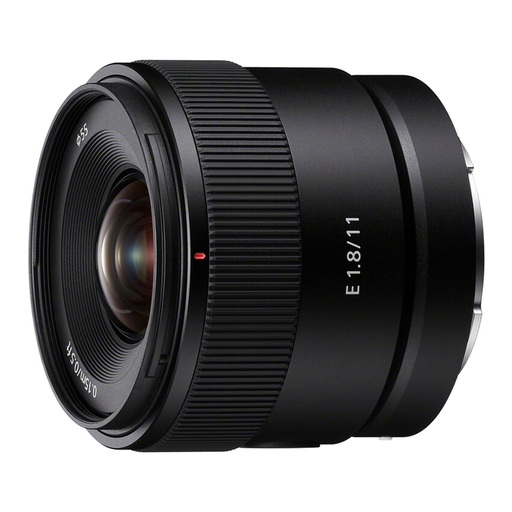
The wide angle of view could come in handy if you want to capture a musician alongside their instrument or in the rehearsal room.
The product description lists a fixed focal length of 11 mm, f/1.8, a Sony E-mount for APS-C and a 104° angle of view. This is an ultra-wide-angle lens, not a standard portrait lens or a zoom.
Image stabilisation reduces blur caused by camera shake, but it won’t freeze a musician’s movement. Choose a suitable shutter speed too, and take test shots in the light available at the rehearsal. Canon Europe explains that movement calls for a fast shutter speed.
Check your full camera model, the lens mount and the sensor format against the exact version of the lens. Sigma and Tamron list separate mount versions for the models discussed here, so comparing focal lengths alone isn’t enough.
Before you start, test the framing, focus and shutter speed from the position where you’re actually allowed to take photos. Put the lens away with suitable caps after use, and check which accessories are included with the version you’re buying.
In the Netherlands, distance purchases from a business usually come with a 14-day cooling-off period, although there are exceptions. The Dutch government distinguishes between buying from a business and buying online from a private individual. Before you buy, check who the seller is and which terms apply to your order.
Not without the relevant consent. According to the Dutch Data Protection Authority, a school needs consent to take and publish recognisable images: from pupils aged 16 and over, and from parents or guardians for pupils under 16. The rules may differ for a project that is purely personal or another way of sharing images. Agree the intended use in advance with the school and the people photographed.