Who is this choice relevant to?

Portrait photographer working in low light

If you photograph individual musicians during rehearsals or performances, you’ll need to balance light-gathering ability with depth of field and movement. Canon UK explains how a wider aperture can allow you to use faster shutter speeds, while Nikon UK lists the 85mm f/1.8 as a portrait option.

Photographer capturing musicians and their instruments

If you want to show the musician, their instrument and some of the surroundings, consider the angle of view and the working distance available. Nikon explains that a shorter focal length captures more of the surroundings from the same position.

Photographer shooting from a fixed position at a venue

If you can’t keep moving closer or further away, a zoom can help you adjust your framing. Compare the zoom range with the weight and maximum aperture of the exact version; TAMRON Europe GmbH lists different weights for each mount of model A058.

What should you consider when choosing?

What to consider What should you check? Who is this important for?
Light when subjects are moving Check the maximum aperture and consider whether the depth of field will be sufficient for your composition. Image stabilisation reduces camera shake, not the musician’s movement. If I’m photographing a moving musician in low light, I want to be able to choose a shutter speed that suits the movement. Around 36% of consumers give top priority to having enough light to photograph a moving musician.
Musician, instrument and surroundings Consider the angle of view for your sensor format and how much space you have to work in. If I want to include the musician, instrument and location in the shot, the framing needs to suit the space. Around 29% of consumers prioritise framing the person, instrument and surroundings together.
Changing your framing Check that the zoom range covers the portraits you want to take, and look at the maximum aperture at the focal lengths you use. When I want to switch quickly between different framings from one position, being able to reframe without moving is important. Around 21% of consumers give top priority to quickly changing their framing from one position.
Portability Compare the weight of the exact lens and mount version with the range you need. If I want to carry my kit for long periods, a portable lens matters more to me than a wide zoom range. Around 14% of consumers give top priority to being able to carry a lens for long periods.

Common things to watch out for

  • Focusing only on 85 mm

    Focal length alone doesn’t tell you how much of a small space will fit in the frame. For the SEL85F18, Sony lists an angle of view on APS-C equivalent to 127.5 mm on full-frame.

    Check the angle of view for your sensor format and work out how much space you have on location for the framing you want.

    You may still need a different lens to get the composition you want.

  • Assuming image stabilisation solves every blur problem

    Image stabilisation is designed to reduce camera shake; a moving musician can still appear blurred, even if you hold the camera steady.

    Choose a shutter speed to suit the movement, and weigh up a wider aperture against the resulting shallower depth of field.

  • Assuming a zoom will automatically be lighter to carry

    A zoom range can make it unnecessary to change lenses, but weight varies by model and mount.

    Compare the exact version with the framings you’ll actually need during your shoot.

Brands to consider

Sony

The FE 85mm F1.8, model SEL85F18, is a prime portrait lens for Sony E.

  • Sony specifies 85 mm, f/1.8 and a weight of 371 g.
  • For Sony APS-C, Sony lists an angle of view equivalent to 127.5 mm on full-frame; according to the specifications, this lens does not have its own optical SteadyShot.

Canon

According to Canon, the RF 85mm F2 MACRO IS STM combines an RF portrait lens with the ability to take close-ups of instrument details.

  • Canon lists an f/2 aperture and image stabilisation; the UK store page gives a maximum magnification of 0.5×.
  • So, macro on this model does not mean 1:1 magnification. This information comes from Canon.

Nikon

The NIKKOR Z 85mm f/1.8 S is a prime 85mm portrait lens for the Nikon Z system.

  • Nikon UK lists a maximum aperture of f/1.8 and a minimum focusing distance of 0.80 m.
  • Image-quality ratings on the product page are manufacturer claims, not an independent comparison.

Tamron

The 35–150mm F/2–2.8 Di III VXD, model A058, offers different framings with a single zoom; choose the version for Sony E or Nikon Z.

  • The zoom range can be useful when you need to change your framing from where you’re standing.
  • TAMRON Europe GmbH specifies 1.165 g for Sony E and 1.190 g for Nikon Z. These are the weights of the versions listed; Tamron’s performance claims are not an independent comparison.

Sigma

The 85mm F1.4 DG DN | Art is a prime full-frame portrait lens available in Sony E and L-Mount versions.

  • Sigma specifies f/1.4 and a weight of 625 g for Sony E or 630 g for L-Mount.
  • The lens has no zoom range. Sigma’s statements about optical performance are not an independent comparison with the other lenses mentioned.

Joybuy product

A Joybuy product pick for portraits that can include the musician, instrument and surroundings together in the frame.
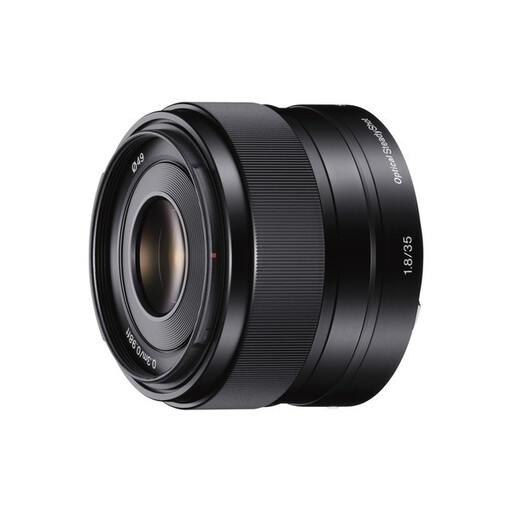
Sony SEL 35mm F1.8 OSS Lens

Sony SEL 35mm F1.8 OSS

The 35 mm prime focal length is worth considering if you want to frame the musician, instrument and surroundings together.

The product name lists F1.8 and OSS. Image stabilisation reduces camera shake, but it doesn’t replace a shutter speed suited to the musician’s movement.

Joybuy

Frequently asked questions

Should I get an 85mm lens to photograph a musician with their instrument?

Not necessarily. First decide how much of the instrument and surroundings you want in the frame, and how much space you have to work in. A longer focal length gives you a narrower angle of view from the same position, and an 85mm lens can give you a narrower angle of view on APS-C than on full-frame.

Does image stabilisation help when a musician is moving?

Image stabilisation helps reduce camera shake, but it won’t freeze the musician’s movement. You’ll also need to choose a shutter speed that suits the movement. A wider aperture can allow you to use a faster shutter speed in low light, but it reduces the depth of field.

How can I check whether a lens is compatible with my camera?

Compare the mount of the exact lens version with your camera’s mount, then check the angle of view for your sensor format. Sony E, Canon RF, Nikon Z and L-Mount are different mounts; Tamron and Sigma sell the models discussed in separate versions.

What can I do if a lens develops a fault too soon under normal use?

According to ACM ConsuWijzer, you have a legal guarantee if a product does not meet the standard you could reasonably expect. If your complaint is justified, the seller must resolve the issue by repairing or replacing the product or, where appropriate, refunding you. Any manufacturer’s warranty does not affect these statutory rights.

Can I exhibit identifiable musicians in the Netherlands without further permission?

Don’t assume you automatically have permission to publish the images. The Dutch Data Protection Authority states that identifiable people may be personal data and that publication requires an applicable legal basis under the GDPR. Consent is often one possible basis, but it is not the only one. The Dutch government portal also highlights image rights. Discuss the planned use of the portraits with the people concerned and the organiser in advance.
