
Photographer with an existing camera
You want to find a lens that fits your camera’s mount and sensor before choosing a portrait style.


Start with your camera’s mount and sensor format, then choose an angle of view that lets you take a head-and-shoulders portrait in the space available. A 50mm lens can be versatile, while an 85mm lens needs more shooting distance for the same framing; a zoom lets you switch between different crops. A wide maximum aperture can blur the background, but it doesn’t replace the right distance or careful focusing.
You want to find a lens that fits your camera’s mount and sensor before choosing a portrait style.
You want to frame a head-and-shoulders portrait without having to step further back than the room allows.
You want to switch quickly between different crops during a session, or keep the same portrait framing throughout.
Start with your camera’s mount and sensor. Then choose based on the framing you want, the distance available in the room and whether you want to change the framing during the session.
A good fit if: you want to show some of the surroundings as well as the portrait, or you’re looking for a narrower angle of view on APS-C. Nikon Nederland describes its Z 50mm lens, among other things, as suitable for portraits that include the surroundings.
Bear in mind: a prime lens doesn’t zoom, so check the framing where you’ll be taking the photos.
A good fit if: you want less of the surroundings in the frame and have enough space. Canon Nederland and Sony Nederland describe their 85mm models as portrait options.
Bear in mind: for the same framing, 85mm needs more distance than 50mm on the same camera; check that it will work in the room.
A good fit if: you want to switch quickly between wider portraits and headshots during a session without changing lenses. Fotografie.nl explains that a zoom lets you use different focal lengths without changing lenses.
Bear in mind: check that the focal range will work in your space and find out the maximum aperture of the version you’re considering.
| What to consider | What should you check? | Who is this important to? |
|---|---|---|
| Camera compatibility | Note your camera model, mount and sensor format; check the exact lens version. | I want to make sure the lens fits my camera first; around 33% of consumers give compatibility top priority. |
| Framing in the space | Test your preferred framing at the shooting position and consider focal length alongside sensor format. | In a small room, I want to frame my headshot without having to step further back; around 27% of consumers prioritise getting the right framing within the available space. |
| Background and light | Compare the maximum aperture of the exact version and take some test portraits beforehand. | I want to control the background and available light without losing sight of sharpness on the face; around 20% of consumers prioritise background and light. |
| Switching between crops | Decide whether you’ll use one fixed headshot set-up or need several different framings during the session. | When photographing several pupils, I want to switch quickly between crops without changing lenses each time; around 20% of consumers prioritise this flexibility. |
The mount determines whether the lens fits your camera, and the sensor format affects the angle of view. Focal length alone therefore won’t tell you whether you can get the framing you want in your space.
Check your camera model, mount and sensor format, and test the framing at the location before choosing.
A wide maximum aperture gives you the option of a blurred background, but the distribution of sharpness still needs to suit the portrait.
Take some test shots and check both the sharpness on the face and the background before photographing the whole session.
A zoom won’t automatically make up for a lack of physical shooting distance. You’ll still need enough room to get an 85mm framing.
Try the head-and-shoulders framing you want in the room before you buy.
The shooting position may mean you have to move or change lenses after all.
Canon offers RF prime lenses for EOS R cameras, including 50mm and 85mm models.
The FE 85mm F1.8 is an E-mount lens for anyone looking for an 85mm portrait angle of view.
The Nikon Z system includes 50mm and 85mm prime lenses for different portrait framings.
The 56mm F1.4 DC DN | Contemporary is an APS-C prime lens available in several mount versions.
The 70-180mm F/2.8 Di III VC VXD G2 is a zoom lens for a range of portrait framings.
This selection focuses on Sony E-mount lenses: a 50mm prime for consistent framing and an 18–105mm zoom for changing crops.
 No image available
Suited to a fixed portrait set-up where you decide on the framing from a single camera position.
Specifications: E mount, 50 mm, f/1.8 and OSS.
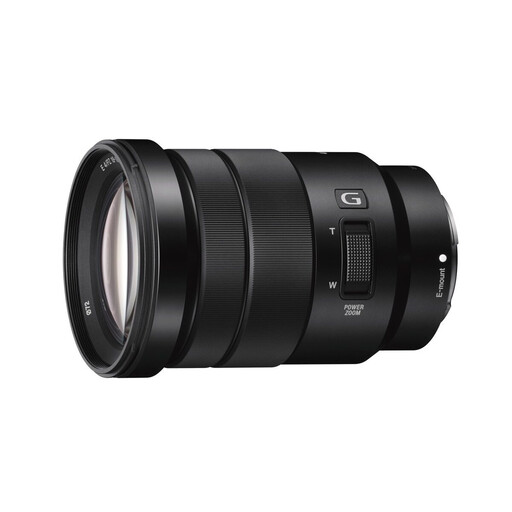 No image available
Suited to a session where you want to take different crops without changing lenses, provided the focal range works in your space.
Specifications: E mount, 18–105 mm and f/4.
Look up the mount and sensor format for your camera model and compare them with the exact lens version. Sigma offers the 56mm lens mentioned above in several mount versions, so the product range name alone isn’t enough.
Test the framing, background and focus at your planned shooting position beforehand. With a prime lens, keep the camera position as consistent as possible; choose a suitable zoom if you want to switch quickly between crops during the session.
According to ACM ConsuWijzer, the seller is responsible if a product used normally doesn’t do what you could reasonably expect; the statutory guarantee doesn’t have a fixed two-year term. For an online purchase, you generally have up to 14 days after delivery to change your mind. Check which exceptions and returns terms apply to your purchase.
The Dutch Data Protection Authority says that permission is needed to publish recognisable photos of pupils for school purposes. For pupils aged 16 or over, the school asks the pupil for permission; for younger pupils, it asks a parent. Agree with the school beforehand on how the images will be used and protected; this doesn’t cover every situation involving private use only.