To frame both the musician and their instrument in a small studio, start with a wider angle of view or a suitable standard zoom. An 85mm lens is mainly an option for a tighter portrait if you have enough room to step back. Before choosing, check your camera’s mount and sensor size. If the musician is moving, remember that image stabilisation corrects camera shake, not subject movement.
Who is this guide for?
Photographers capturing musicians and their instruments
If you want to photograph a musician alongside their instrument or part of the studio, the available shooting distance and angle of view are important considerations. Sigma and Tamron offer zoom options for varying your framing, while Canon lists its RF 35mm lens for portraits and close-ups, among other uses.
Photographers capturing musicians in motion
When photographing musicians playing or gesturing in limited continuous light, you need to set the shutter speed to suit the movement. Nikon explains that a fast shutter speed can freeze action; a wider maximum aperture is another specification to consider when choosing a lens.
Photographers taking close-up artist portraits
If you mainly want a head-and-shoulders portrait and can stand far enough back, a longer focal length may be suitable. Nikon specifies that the NIKKOR Z 85mm f/1.8 S is a Z-mount lens with a minimum focus distance of 0.80 m; this figure doesn’t tell you how much room you’ll need for your desired framing.
What should you look for?
First decide which parts of the musician and instrument you want in the frame. Then check the angle of view, sensor size and mount for your camera.
| What to consider |
What should you check? |
Who is this important for? |
| Framing the musician and instrument |
Take a test shot from the camera position available and assess the angle of view on your sensor. Nikon Netherlands gives the example that 50 mm on DX gives a similar angle of view to 75 mm on FX. |
If you can’t move much further back and want to include both the musician and parts of their instrument, the framing from your shooting position matters most. Around 36% of consumers prioritise framing both the musician and instrument. |
| Movement in limited light |
Consider the maximum aperture alongside shutter speed and the depth of field you want. Nikon USA describes stabilisation as correcting camera shake; moving subjects also require a suitable shutter speed. |
If you photograph musicians playing or moving their hands, you’ll want a shutter speed that suits the action while taking the available light into account. Around 28% of consumers prioritise capturing movement in limited light. |
| Switching between different framings |
A zoom lets you adjust the framing during a session. Sigma specifies the 18–50mm F2.8 DC DN for APS-C; Tamron lists full-frame versions of the 28–75mm F/2.8 Di III VXD G2 with Sony E and Nikon Z mounts. |
If you want to switch between a portrait with the instrument and a tighter framing during one session without changing lenses, check that the zoom range and specific mount are right for you. Around 22% of consumers give this flexibility top priority. |
| Tight artist portrait |
Test your desired framing at the actual shooting location before choosing an 85 mm lens. Nikon specifies a minimum focus distance of 0.80 m for the NIKKOR Z 85mm f/1.8 S; this isn’t the same as the distance you’ll need for your composition. |
If you mainly want a tight portrait and can stand far enough back, a longer prime may be an option. Also consider whether you want the instrument to remain in the frame. Around 14% of consumers prioritise a tight artist portrait. |
Common mistakes when choosing
-
Choosing based only on the focal length in millimetres
The angle of view also depends on the sensor size. As a result, a lens with the same focal length can give you a different framing on different camera formats.
Compare the angle of view on your camera and take a test shot from the spot where you’ll be shooting in the studio.
-
Choosing an 85mm prime without checking the distance
A tight framing may leave the instrument or studio surroundings out of the shot. The minimum focus distance doesn’t tell you whether you have enough room for the framing you want.
First take a test shot from the available shooting position and check whether the musician and any parts of the instrument fit in the frame.
-
Confusing stabilisation with freezing movement
Image stabilisation corrects camera shake, but it doesn’t replace a shutter speed suited to a moving musician.
Test shutter speed, light and depth of field together using test shots of the movement you want to capture.
-
Overlooking the specific mount version
Sigma and Tamron zoom ranges are available in separate mount versions, so being part of the same product family doesn’t mean every version will fit every camera body.
Check the full model variant against your camera model before ordering.
Relevant brands for this choice
Canon
The RF 35mm F1.8 MACRO IS STM and RF 50mm F1.8 STM are options for a compatible EOS R body, with different angles of view.
- Canon specifies a maximum aperture of f/1.8 for both models. For the RF 35mm, Canon lists 0.5× magnification.
- According to Canon, the RF 50mm has a minimum focus distance of 0.30 m and no optical lens stabilisation. Check the framing and compatibility with your camera body.
Nikon
For a compatible Nikon Z body, options range from the Z 40mm f/2 to the longer NIKKOR Z 85mm f/1.8 S.
- Nikon specifies a minimum focus distance of 0.29 m for the Z 40mm f/2.
- The stated minimum focus distance for the 85mm f/1.8 S is 0.80 m. The focal length and the space available in your studio will both affect whether you can fit the musician and instrument in the frame.
Sony
The FE 35 mm F1.8 is a full-frame E-mount lens that Sony also lists for use with APS-C bodies.
- Sony specifies f/1.8 and a minimum focus distance of 0.22 m for model SEL35F18F. For APS-C, Sony lists a 35mm-equivalent focal length of 52.5 mm.
- The stabilisation mentioned is in the camera body, not optical stabilisation in this lens. Check your body’s specifications.
Sigma
The 18–50mm F2.8 DC DN Contemporary is an APS-C standard zoom for those who want to adjust the framing during a session.
- Sigma specifies a maximum aperture of f/2.8 throughout the zoom range and lists versions with Canon RF, Fujifilm X and Sony E mounts, among others.
- Mount and compatibility depend on the version. Before buying, check which one is right for your camera body.
Tamron
The 28–75mm F/2.8 Di III VXD G2, model A063, is a standard zoom available in full-frame versions for Sony E and Nikon Z.
- Tamron specifies f/2.8 and a zoom range of 28–75 mm. The stated minimum subject distance varies by zoom setting: 0.18 m at the wide end and 0.38 m at the telephoto end.
- Check the mount of the version you choose and decide whether the range suits the framing you want in your studio.
Joybuy product
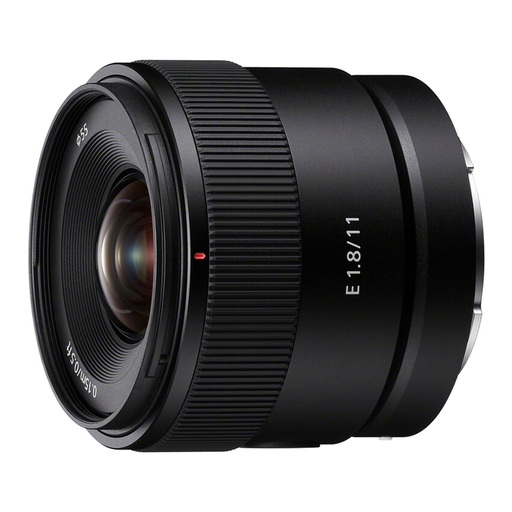
A Sony E ultra-wide-angle lens for wide framing with an APS-C camera.
 No image available
Sony E 11mm F1.8 APS-C (SEL11F18)
This fixed 11mm ultra-wide-angle lens is an option when you want a wide framing from a limited shooting position. It offers a different angle of view from a standard prime, making it less suited to tight portraits.
APS-C; Sony E mount; maximum aperture f/1.8; autofocus.
Joybuy
Frequently asked questions
How can I tell whether a lens will work in my small studio?
Take a test shot from the spot where you can actually shoot, and decide how much of the musician and instrument you want in the frame. Also consider the sensor size: Nikon Netherlands gives the example that 50 mm on DX produces an angle of view comparable to 75 mm on FX. The minimum focus distance isn’t the same as the distance you need for a particular framing.
Will image stabilisation automatically keep playing hands sharp?
No. Nikon describes stabilisation as correcting camera shake; to capture the musician’s movement, you also need a shutter speed that suits the action. Check the results with test shots in the lighting conditions you’ll actually be using.
Will I need an adaptor or extra accessories?
First check the exact mount on the lens and compare it with your camera body. Sigma and Tamron zoom ranges are available in different versions, so whether you need an adaptor and whether it supports the features you want will depend on your combination of equipment. Also check what’s included with the specific version.
What Dutch rules apply when I buy a lens online?
For eligible online purchases from a business, you generally have 14 days to change your mind, according to the Dutch government. There are exceptions, and this right doesn’t apply in the same way to online purchases from a private seller. The Dutch government also states that there’s no fixed statutory warranty period in the Netherlands: you’re entitled to a product that works properly, and the seller is your point of contact if there’s a problem. Check which rules apply to your purchase, especially if you’re not buying as a consumer.


