Who are these lenses for?

Photographer taking polished professional portraits

You mainly take tightly framed headshots and can keep enough distance from your subject. Your choice will depend on the angle of view you want and which mount is compatible with your camera. Zoom.nl explains how focal length affects portrait framing.

Photographer working in a tight space

You need to take a professional portrait with little room behind the camera. So check whether you can get the framing you want from the available distance; Canon describes the RF 50mm F1.8 STM as a compact lens for EOS R cameras.

Photographer taking a range of portraits

You take tightly framed and wider portraits in succession and don't want to keep changing lenses. A compatible zoom could be an option; Tamron lists portrait photography as one of the uses for the 70-180mm F/2.8 Di III VC VXD G2.

What should you look for when choosing?

85mm prime lens

A good fit if: you want a tight portrait crop and can keep enough distance from your subject.

Trade-off: the angle of view is fixed, so you adjust the framing by changing your position. Also check the mount and sensor format.

Shorter prime lens, such as a 50mm

A good fit if: an 85mm framing is too tight for the location, or you want to include the shoulders and surroundings.

Trade-off: you'll generally need to stand closer to get the same tight framing; shooting very close with a wide-angle lens can distort facial proportions.

Telephoto zoom

A good fit if: you often change framing or working distance while taking a series of portraits.

Trade-off: the Tamron 70-180mm F/2.8 Di III VC VXD G2 mentioned here has a maximum aperture of f/2.8, compared with f/1.8 on the 85mm prime lenses mentioned. Check the mount of the version you're considering.

What to consider What should you check? Who is this important for?
Framing and working distance Compare the focal length and sensor format with the framing you want and the space available at the location. If I want a tight headshot, the framing needs to work at the distance I can maintain in the space. That's why around 33% of consumers prioritise framing and working distance.
Light and background Check the maximum aperture and decide how you'll light the face in bright conditions. In bright sunlight, I want to be able to choose how blurred the background is without expecting the lens to remove harsh shadows from the face. Around 27% of consumers give light and background rendering top priority.
Changing your framing Check that the zoom range suits your usual working distances and portrait framing. If I'm taking different portrait shots one after another, I want to adjust the framing without changing lenses each time. Around 20% of consumers prioritise this flexibility.
Mount and purchase choice Check the full lens name, mount and version against your camera body. For my existing camera system, I first want to make sure the lens is compatible and that any extra features serve a purpose. Around 20% of consumers start with system compatibility and their purchase choice.

Things to watch out for when buying

  • Expecting f/1.4 to solve harsh midday sunlight

    A wider maximum aperture gives you more choice over exposure and depth of field, but direct, bright sunlight can still cast harsh shadows across the face.

    First decide how you want to light the face and how much depth of field you need. Then choose a maximum aperture to suit.

  • Choosing an 85mm lens based on focal length alone

    The mount needs to fit your camera, and the sensor format affects the angle of view. For example, Sony lists a different 35mm-equivalent angle of view for the FE 85mm F1.8 on APS-C than on full-frame.

    Check the full model name, mount, camera body and available shooting distance before choosing a lens.

  • Assuming a zoom or prime lens is automatically better

    A zoom can help you change your framing without switching lenses, while the 85mm prime lenses mentioned have a wider maximum aperture than the f/2.8 telephoto zoom mentioned.

    Weigh up how often you change your framing against your working distance and the depth of field you actually want.

Relevant brands and lens ranges

Canon

For EOS R cameras, possible options include an 85mm prime lens and a shorter 50mm focal length.

  • Canon lists an 85 mm focal length and built-in image stabilisation for the RF 85mm F2 MACRO IS STM.
  • The RF 50mm F1.8 STM won't give you the same framing on the same camera as an 85mm lens. Check which angle of view works at your location.

Sony

The FE 85mm F1.8 is an 85mm prime lens for the Sony E mount.

  • For model SEL85F18, Sony specifies a maximum aperture of f/1.8, a minimum focusing distance of 0.8 m and a weight of 371 g.
  • Sony doesn't list image stabilisation in this lens; check your camera body's features separately.

Nikon

The NIKKOR Z 85mm f/1.8 S is an 85mm portrait lens for the Nikon Z mount and full-frame cameras.

  • Nikon specifies a maximum aperture of f/1.8 and a Z mount for this model.
  • Check that the lens is compatible with your camera body and the shooting distance available for your headshot.

Sigma

The 85mm F1.4 DG DN | Art is available in versions for the Sony E and L mounts.

  • For the Sony E version, Sigma specifies a weight of 625 g and a filter size of 77 mm.
  • A maximum aperture of f/1.4 doesn't automatically make the lens suitable for bright sunlight; plan the exposure and depth of field you want.

Tamron

The 70-180mm F/2.8 Di III VC VXD G2, model A065, is a telephoto zoom option for varying your portrait framing.

  • Tamron lists a maximum aperture of f/2.8 and a telephoto range up to 180 mm for this model.
  • Check the exact mount of the version on offer, and weigh up the flexibility against the aperture of the specific prime lenses you're comparing it with.

Joybuy's product selection

A Sony E 50mm lens for portraits where a shorter focal length or wider framing is preferred.
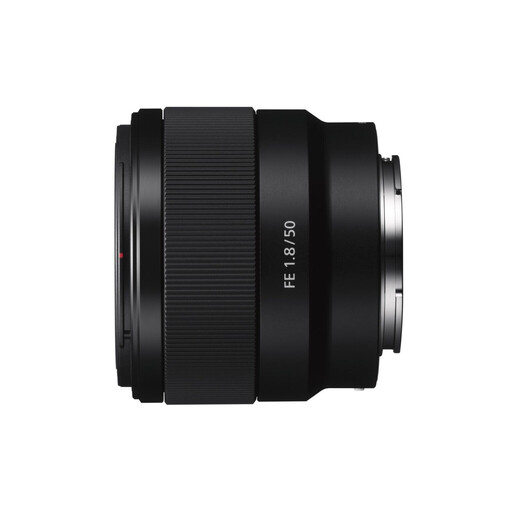
Sony E 50mm f/1.8 OSS Black lens

Sony E 50mm f/1.8 OSS Black

An option for portraits where a shorter focal length or wider framing is preferred; check that the Sony E mount is compatible with your camera body.

Focal length: 50 mm.

Maximum aperture: f/1.8.

Model designation: OSS.

Colour: Black.

View at Joybuy

Frequently asked questions

Do you need f/1.4 or f/1.8 for a headshot in full sun?

No, a maximum aperture of f/1.4 or f/1.8 isn't essential for a headshot in full sun. A wider aperture gives you more choice over depth of field and lets in more light; choose your settings based on the sharpness and exposure you want. Deal with harsh shadows on the face by adjusting your subject's position and lighting setup, not just by changing lenses.

What should I look out for when using a portrait lens for the first time?

First check that the mount is compatible with your camera, then take some test shots at the planned working distance. Assess the framing, sharpness of the face and shadows. In direct, bright sunlight, how you control the light may matter more than having a wider maximum aperture.

What does an additional manufacturer's warranty mean when buying in the Netherlands?

According to the Dutch Government, consumer products are covered by a legal guarantee, and the retailer is your point of contact if a product is faulty. Compare any additional warranty terms with your existing rights before paying for extra cover. Whether consumer rights apply to a specific business purchase must be assessed separately.

Can a business take and publish professional portraits without any restrictions?

No. According to the Dutch Data Protection Authority, a legal basis under the GDPR is required to take and publish identifiable images professionally or commercially on behalf of a business or organisation. Consent is one possible legal basis, but it isn't automatically the only one. For photographs of employees, the regulator says consent is the legal basis in most cases; assess the specific use and applicable legal basis before publishing.
