
Group family photographer
You want to fit several family members into the frame, even when space is limited. Canon Europe recommends paying attention to posing and depth of field for group portraits.


First, check that the lens mount is compatible with your camera, then consider the sensor format, the space available and how many people will be in the photo. A shorter prime lens or a zoom gives you more options for group shots, while a longer prime is mainly suited to individual portraits when you have enough distance. If you’re printing a photo for an exhibition, assess a test print too: the lens isn’t the only thing that affects how it looks.
You want to fit several family members into the frame, even when space is limited. Canon Europe recommends paying attention to posing and depth of field for group portraits.
You mainly take portraits of one person or small groups, and can adjust your shooting distance. Nikon lists environmental portraits and head-and-shoulders shots as possible uses for the NIKKOR Z 50mm f/1.8 S on a compatible Nikon Z camera.
You want to assess your images as prints, so you’ll need to make decisions about paper and presentation as well as the lens. Canon Europe describes paper, print settings and frames as part of preparing exhibition prints.
A good fit if: you want to photograph families in a small space or include more of the surroundings, provided the angle of view suits your camera.
Bear in mind: you can’t adjust the framing optically, so check your composition where you plan to take the photo.
A good fit if: you want to switch between group shots and tighter framing during a session without changing lenses.
Bear in mind: the Tamron model mentioned has a maximum aperture of f/2.8, compared with f/1.8 for the prime lenses mentioned; choosing the correct mount version is essential.
A good fit if: individual or small family portraits are your priority and you have enough space to get the framing you want.
Bear in mind: an 85mm lens has a narrower angle of view than a 35mm lens; on APS-C, the framing is narrower still.
| What to consider | What should you check? | Who is this important for? |
|---|---|---|
| Mount and sensor | Compare the exact mount and version with your camera model, and take the sensor format into account. Sony lists an angle-of-view equivalent of 52.5 mm for the FE 35 mm F1.8 on APS-C. | I don’t want to find out after buying that the lens doesn’t fit my camera; around 31% of consumers put compatibility first. |
| Group framing and sharpness | Take a test photo of the whole group at your intended location and check the faces in different parts of the frame. Canon suggests f/5.6 or f/8 as possible starting points for achieving definition in group photos. | In a small space, I want to fit everyone in and check faces in different rows; around 31% of consumers prioritise group framing. |
| Framing for one person | Test your desired framing at the location and check how much space you have. Sony lists an angle-of-view equivalent of 127.5 mm for the FE 85mm F1.8 on APS-C; Nikon gives a minimum focus distance of 0.4 m for the NIKKOR Z 50mm f/1.8 S. | If I mainly want to photograph one person, I want to be able to assess the framing and background in advance; around 23% of consumers share this priority. |
| Exhibition print | Ask the venue or printer about the required size and file specifications, and view a test print if possible. | For my exhibition photos, I want to know how the image will look at its final size; around 15% of consumers put presentation first. |
An 85mm lens has a narrower angle of view than a 35mm lens. On APS-C, the framing is narrower still, so you may need more distance to fit the same group into the frame.
Before choosing a focal length, set up a test with your own camera and the actual number of people you’ll be photographing.
If there isn’t enough space, you may need to choose another location or use a second lens.
A lens name or focal length alone doesn’t tell you whether it’s compatible with your camera. For example, the Sigma 28–70mm F2.8 DG DN | Contemporary is available in Sony E and L-mount versions.
Check your camera model, the exact mount and the full version details before choosing.
In a group, faces may be at different distances, so a wide aperture won’t automatically provide enough depth of field for everyone.
Take a test shot with the group in its actual position and check that the faces are sharp before choosing your final photos.
A lens won’t determine which paper, print settings or frame will work for your exhibition.
Ask about the required size and file specifications in advance, and assess a test print before arranging the final print run.
Canon offers, among other options, a 35mm prime lens for compatible EOS R cameras.
Sony offers 35 mm and 85 mm FE lenses for Sony E cameras, with different angles of view.
The NIKKOR Z 50mm f/1.8 S is a standard prime lens for compatible Nikon Z cameras.
The 28–75mm F/2.8 Di III VXD G2, model A063, is a standard zoom for compatible full-frame mirrorless cameras.
The 28–70mm F2.8 DG DN | Contemporary is a standard zoom available in, among other options, Sony E and L-mount versions.
These Sony E-mount lenses include prime lenses for portraits and a zoom for different framing options; check that your chosen model is compatible with your sensor.
 Image unavailable
A prime lens for individual family portraits with a compatible Sony E camera.
50 mm, f/1.8 and OSS; weighs 202 g.
You can’t adjust the framing optically.
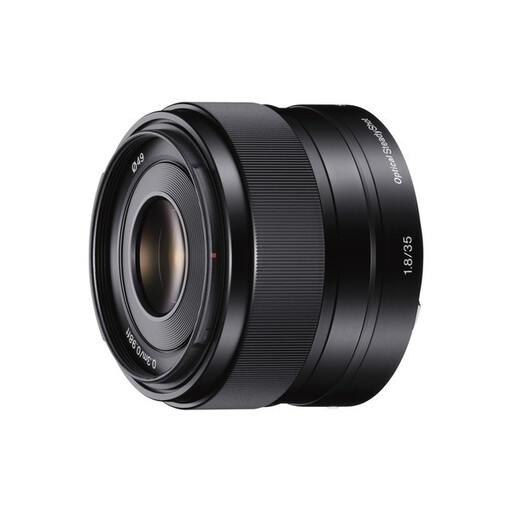 Image unavailable
A 35mm prime lens for portraits when the angle of view suits your camera and the space available.
35 mm, f/1.8 and OSS; autofocus is listed in the product description.
You can’t adjust the framing optically.
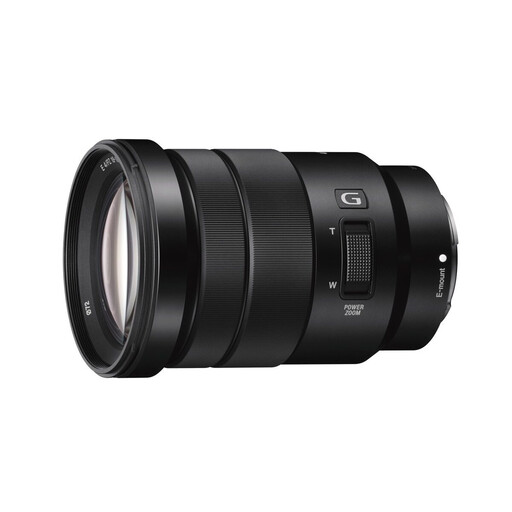 Image unavailable
The zoom offers different framing options without changing lenses; the description specifies Sony E and APS-C.
18–105 mm zoom range, maximum aperture of f/4 and OSS.
Check that the APS-C version listed is compatible with your camera.
No, a wide aperture isn’t always the right choice for a group. If faces are at different distances, you may need more depth of field. Canon suggests f/5.6 or f/8 as possible starting points and recommends assessing the results with your own set-up.
First, check the exact mount and the framing on your sensor format. For example, Sony lists an angle-of-view equivalent of 52.5 mm for the FE 35 mm F1.8 on APS-C; then test your desired framing at the location.
No, a wider aperture doesn’t guarantee a better exhibition print. Check that the people you want in focus are sharp, and discuss the print size, paper and presentation with the printer or exhibition venue.
In addition to any commercial warranty, statutory consumer rights apply: under normal use, the product must meet what you could reasonably expect from it. ACM ConsuWijzer explains that there is no fixed statutory warranty period in the Netherlands; contact the seller if you find a fault.
Don’t assume you can do this without considering the circumstances. The Dutch Data Protection Authority describes identifiable images as personal data and says that a legal basis is needed to take and publish them. The legal basis and other rights that apply to this exhibition depend, among other things, on the organiser, the people shown and how the images are used; discuss the display in advance.