
Vandaag of morgen in huis

Kwaliteit gegarandeerd

Welkomstaanbiedingen ontgrendelen: GRATIS bezorging | Tot 80% korting | Gratis 30 dagen JoyPlus-proefperiode
Download de app
A flat or under-inflated tyre rarely happens at a convenient time. That is why motorists, electric car drivers, motorcyclists and cyclists often look for a portable tyre inflator that fits in the boot, toolbox or rucksack. However, not every compact air pump is suitable for car tyres.
Marketing terms such as “150 PSI”, “fast inflation” and “cordless” do not tell the whole story. The key differences lie in the power supply, actual operating time, pressure setting and accessories. Below, you’ll find what to look for and which models suit different usage scenarios.
A 150 PSI tyre inflator can look impressive on paper. For an ordinary passenger car, the recommended tyre pressure is usually much lower. The maximum pressure mainly indicates the device’s upper limit, not necessarily its speed or suitability for an SUV, caravan or commercial vehicle.
So also look at:
A mini air compressor with a high PSI rating may still work slowly on a larger car tyre.
Some small pumps are designed for air beds, pool inflatables or other high-volume, low-pressure products. The Baseus PocketGo, for example, specifies a pressure of 3,5 kPa, or approximately 0,5 PSI. According to the product information, this model is not suitable for car, SUV or motorbike tyres.
Always check the unit: PSI, bar and kPa are not the same. For car tyres, you need a genuine high-pressure pump. A device that only moves a large volume of air is not automatically a portable car tyre compressor.
A cordless tyre inflator is practical in a car park, at a campsite or on a cycle path. However, the battery will run flat, especially if you need to top up several car tyres. So check the battery capacity, charging time and stated operating time.
A 12V tyre inflator is less likely to have this problem: you connect it to the car’s 12V socket. With some models, the engine must be running during use to avoid putting unnecessary strain on the vehicle battery. Always follow the instructions.
A tyre inflator with a digital pressure gauge makes it easier to read the selected value. Useful units include PSI, bar and kPa. Choose a model that lets you set the pressure suitable for your vehicle, preferably in small increments.
For the required pressure, use the value in the owner’s manual or on the sticker inside the driver’s door frame or fuel flap. The value on the sidewall of the tyre is usually a maximum technical rating, not the recommended everyday pressure.
A tyre inflator with automatic shut-off stops, according to the product description, once the selected pressure has been reached. This reduces the need to keep watching the display while inflating. Nevertheless, check the tyre pressure afterwards with a separate gauge if the situation calls for it.
This feature is particularly useful for beginners and when using the pump in low-light conditions. Also pay attention to the controls: clear buttons, an easy-to-read display and well-fitting valve adapters can save time.
An electric tyre inflator with a built-in battery is flexible, but it needs to be charged. A corded model works as long as you have a suitable 12V socket, making it useful as a permanent emergency device in the car.
For corded models, check:
The same applies to electric cars: check that the 12V socket is available and suitable for use. “Suitable for electric vehicles” in a product description is a statement made by the seller; check this in your car’s manual as well.

Why it suits this profile: According to the product information, this corded model uses the car’s 12V socket and does not need to be charged in advance. The presets for cars, motorbikes, bicycles and balls make it easy to use.
The pressure can be set from 3 to 150 PSI, and the product page specifies automatic shut-off at the selected value. You are not reliant on a built-in battery that could run flat.
100-watt motor, digital adjustment in 0.5 PSI increments and three light modes according to the product description.
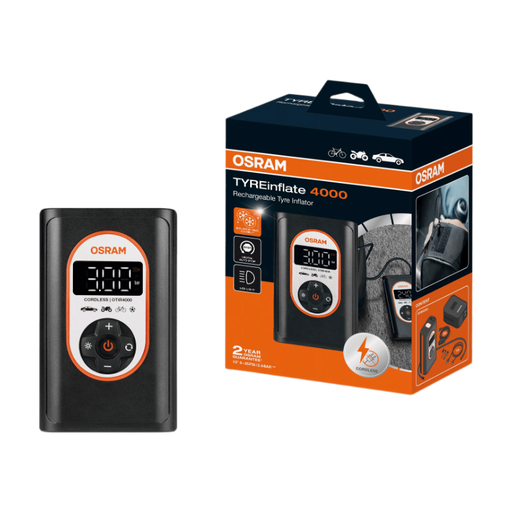
Why it suits this profile: This model combines cordless use with a 12V cable as an alternative. That is practical for long journeys, camping and households with several vehicles.
The dual power supply reduces the disadvantage of a flat battery. The product information also specifies pressure memory for up to four vehicles and a valve for releasing a little air.
Aluminium housing, adjustable PSI, bar and kPa display, automatic stop and a USB-C connection according to the product details.

Why it suits this profile: This cordless portable tyre inflator is aimed at motorists, SUV drivers and users who also want to inflate motorbike and bicycle tyres and balls.
The product page specifies four presets, manual adjustment from 4 to 160 PSI and automatic shut-off. This allows you to adjust the pressure for different applications.
7,500 mAh battery, maximum 160 PSI, 35 l/min and a display showing PSI, kPa and bar according to the product description. The stated operating time is up to 45 minutes; the actual time depends on the tyre type and pressure.
We have put together a complete, up-to-date list of products that fully meet these strict selection criteria and the applicable European safety regulations.
A portable tyre inflator is intended for topping up tyres and practical emergency situations. If a tyre is damaged, the valve is leaking or there is visible tyre damage, inflating it is not a substitute for professional assistance.
It can be, provided the model is suitable for car tyres according to the product specifications and offers an appropriate pressure setting. Pay attention to the battery capacity and operating time. For several large tyres, a 12V model or one with dual power supply may be more practical.
Its lifespan depends on storage, charging habits, frequency of use and cooling breaks. Do not use the device for longer than the stated continuous operating time. Store a battery-powered inflator in a dry place and recharge it regularly, even if you only use it as an emergency device.
With a 12V tyre inflator, the electricity usually comes from the vehicle. A cordless model needs to be charged via USB or USB-C. The cost per charge is generally limited; the main consideration is whether you prefer the convenience of a battery or the immediate availability of a cable.
