
Vandaag of morgen in huis

Kwaliteit gegarandeerd

Welkomstaanbiedingen ontgrendelen: GRATIS bezorging | Tot 80% korting | Gratis 30 dagen JoyPlus-proefperiode
Download de app
A portable tyre inflator should be compact enough to fit in your boot, bike bag or motorbike luggage, but it also needs to be suitable for the vehicle you’ll use it with. A small electric tyre inflator can come in handy if a tyre is slowly losing air or you want to check the pressure before setting off. However, not all mini compressors are suitable for car tyres.
The main pitfalls often lie in the specifications, not the appearance.
A rating of 150 PSI sounds impressive, but it doesn’t tell you how much air the inflator actually moves per minute. A compact model is usually enough for a bike tyre. For an SUV, caravan or completely flat car tyre, airflow, run time and heat build-up are just as important.
Also check whether the quoted maximum pressure is theoretical. Actual performance can vary depending on tyre volume, temperature and battery level.
Some portable air compressors are designed for air beds, pool toys or cushions. They deliver a lot of air at low pressure, but aren’t suitable for car tyres. For example, the Baseus PocketGo is listed with a pressure of 3.5 kPa, or around 0.5 PSI. That isn’t enough for standard car, SUV or motorbike tyres.
Always check that the product is explicitly suitable for your intended use. A bike and car tyre inflator needs to work with both types of tyre and include the right valve adapters.
A cordless tyre inflator works without a 12V cable, but its battery runs down while inflating. A battery-powered tyre inflator is practical for a bike or a small top-up, while a 12V tyre inflator is generally suitable for longer use from your car.
Check:
The recommended tyre pressure for cars is usually well below 150 PSI. You’ll find the correct pressure on the sticker inside the driver’s door frame, on the fuel filler flap or in your car’s handbook. So don’t use the inflator’s maximum pressure as a guide for your tyres.
A model with a range of, for example, 3 to 140 PSI may be suitable for different uses, as long as its accessories and airflow meet your needs. For larger tyres, caravans or more frequent use, a more powerful model makes more sense than a pocket-sized one.
A digital tyre inflator makes it easier to read the pressure you’ve set than a basic analogue gauge. Check which units are available, such as PSI, BAR, kPa or kg/cm². In the UK, tyre pressures are often given in PSI, although some products display BAR by default.
A tyre inflator with automatic shut-off stops when it reaches the pressure you’ve set, according to the product description. This helps prevent over-inflation, but check that the selected unit and pressure are correct before use. A separate tyre pressure gauge is still useful for an independent check.
A bike may have a Presta valve, while cars usually use a Schrader valve. Check whether the inflator includes:
A CE mark indicates that the manufacturer declares the product meets relevant EU requirements. Also check the handbook, importer details and safety instructions. A CE mark doesn’t guarantee that every inflator is suitable for every tyre.
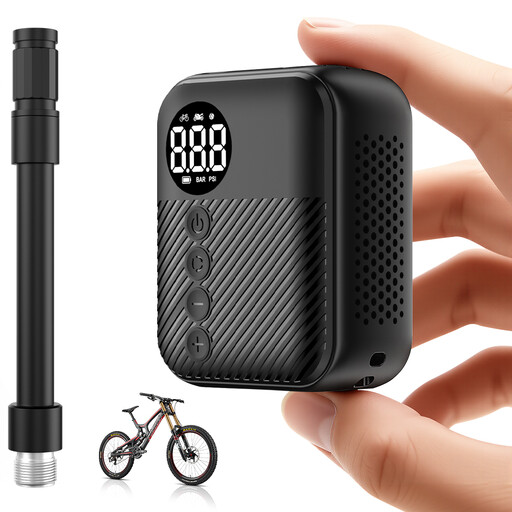
Why it suits this profile: This pocket-sized model is easy to take along on your bike or keep in the glove compartment. According to the product description, it has a digital gauge, a built-in battery and a stated maximum pressure of 150 PSI.
The digital display means you don’t have to rely on guesswork. Check the stated run time beforehand if you plan to use it on larger car tyres.
Cordless design, digital pressure display and, according to the product information, suitable for bike, motorbike and car tyres.
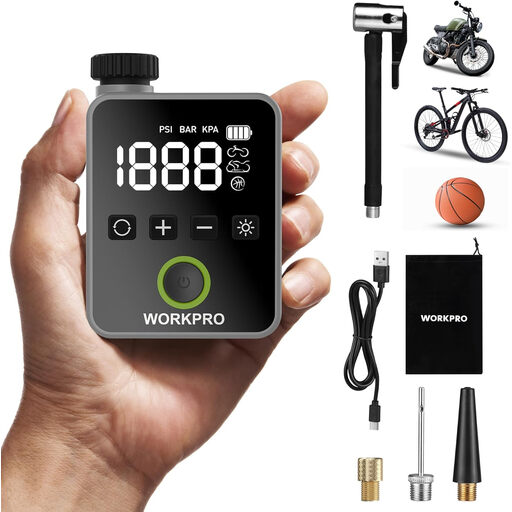
Why it suits this profile: The European version combines a compact design with four modes, an LED screen and automatic shut-off. It’s a good fit for drivers and cyclists who want one device for a range of inflating jobs.
Set the pressure before use and, according to the product information, the inflator stops when it reaches the target. The description also states that this model isn’t designed for lorry or trailer tyres.
Adjustable range of 3–140 PSI, support for BAR and KPA, four nozzles and a built-in light with multiple settings.
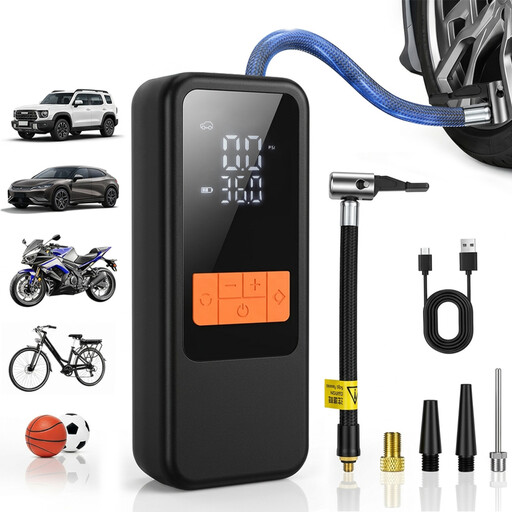
Why it suits this profile: With a stated 4000mAh battery, five inflation modes and an airflow rate of 26 l/min, this model is worth considering if you regularly top up car, motorbike, bike and sports ball tyres.
The product information gives specific usage figures: around 25 minutes of use, approximately 7–8 minutes to inflate a flat car tyre and about 30 seconds for a top-up.
150 PSI according to the product specifications, Type-C connection, power bank function, LED light and five preset modes.
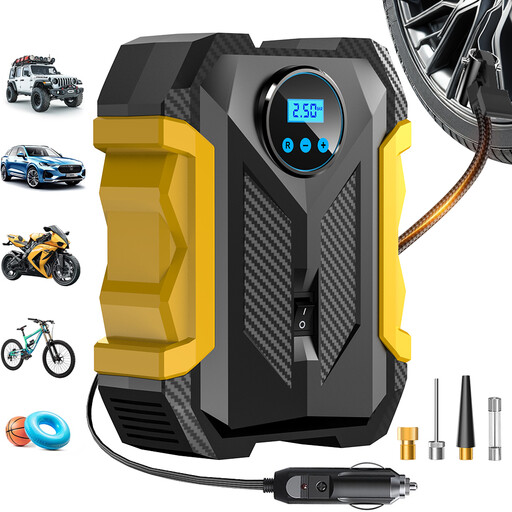
Why it suits this profile: The 12V connection and 3-metre cable are handy when you need to reach several car tyres without having to keep moving the inflator.
You don’t have to rely on a built-in battery. Check whether your car’s engine should be running when you use the 12V inflator, and follow the instructions in the handbook.
Digital pressure display, 150 PSI according to the product description, LED light and a 3-metre cable.
We’ve put together a complete, up-to-date list of products that meet these strict selection criteria and the applicable European safety requirements.
An inflator isn’t a substitute for a repair. If the pressure drops again quickly, have the tyre checked by a garage or breakdown service.
That depends on its stated use, maximum pressure, airflow and run time. The model must be specifically suitable for cars. A low-pressure air pump designed for air beds isn’t suitable for car tyres.
Not necessarily. A cordless model is easier to position and handy on the go. A 12V tyre inflator will keep working as long as your car is available as a power source. Choose cordless for portability and 12V for longer sessions or inflating several tyres.
That depends on the battery capacity, tyre volume, set pressure and product design. Don’t just look at the charging time; check the stated run time and how many tyres it can inflate per charge. Store the inflator somewhere dry and charge the battery according to the instructions.
