
Vandaag of morgen in huis

Kwaliteit gegarandeerd

Welkomstaanbiedingen ontgrendelen: GRATIS bezorging | Tot 80% korting | Gratis 30 dagen JoyPlus-proefperiode
Download de app
A flat car tyre, soft bicycle tyre or motorbike tyre usually happens at the worst possible time. A portable tyre inflator can come in handy, but not every compact device is suitable for every job. Some models are designed for high pressure, while others are intended to move large volumes of air for air beds or inflatable toys.
So don’t just look for claims such as “powerful”, “fast” or “150 PSI”. Check the specifications, power supply and the tasks the inflator is actually designed for.
A maximum pressure of 150 PSI sounds impressive, but it says little about how quickly the inflator works. For a car tyre, airflow, motor capacity and operating time also matter. Even a mini compressor with a high maximum pressure may take several minutes to bring a flat tyre up to pressure.
Treat the maximum pressure as a limit, not a guarantee of fast inflation. Check whether the manufacturer gives an estimated inflation time for your type of tyre, too.
A rechargeable air pump is flexible because you don’t need a 12V socket or a long cable. However, the battery needs enough capacity for the job. Pay attention to the difference between charging time, running time and the number of tyres the product description says it can inflate.
Some models can handle a quick top-up with no problem, but take longer to inflate a completely flat car tyre. If the instructions recommend it, let an electric tyre inflator cool down during intensive use.
A low-pressure pump for air beds, balloons or pool accessories isn’t automatically suitable for car tyres. For example, the Baseus PocketGo lists an air pressure of 3,5 kPa, which the product information says is intended for low-pressure applications, not car, SUV or motorbike tyres. Always check the pressure in PSI, bar or kPa and compare it with the requirements of your tyre.
A car tyre air compressor needs a high pressure capacity. Many portable models in this selection list a maximum of 150 PSI. That’s well above the usual tyre pressure for passenger cars, but actual performance can vary from one model to another.
Airflow is often given in litres per minute, for example, 26 L/min for certain Porbi models. Higher airflow can help with faster top-ups, but check the recommended operating time and heat build-up, too.
A cordless tyre inflator is easy to take to a bicycle, motorbike or car that isn’t near a power socket. However, an in-built battery means you’ll need to charge the inflator in advance. A 12V model uses your car’s power socket, so it may be suitable for longer sessions, as long as the cable is long enough.
Also check:
A digital tyre inflator with a display makes it easier to set a target pressure. Automatic shut-off can stop the inflator once it reaches the pressure you’ve set. This is useful, but it’s best to check the pressure afterwards with a separate tyre pressure gauge.
Check which units the display uses, too: PSI, bar, kPa or kg/cm². You’ll find the recommended tyre pressure on the sticker inside the door frame, on the fuel flap or in your vehicle’s handbook. Don’t automatically use the inflator’s maximum pressure.
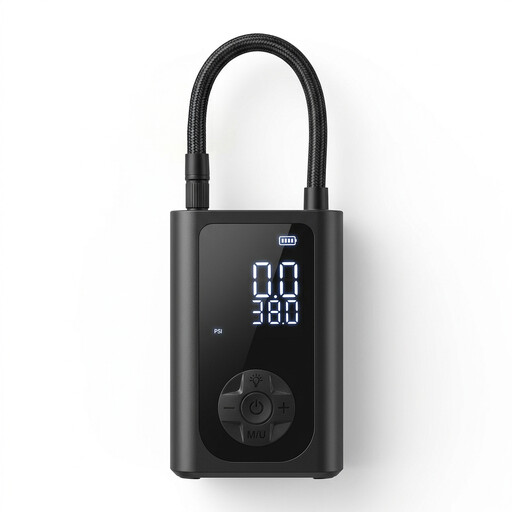
Why it suits this profile: A compact cordless tyre inflator with five modes for cars, motorbikes, bicycles, balls and a custom setting.
The product description gives specific figures: 150 PSI, 26 L/min and around 7 to 8 minutes to inflate a flat car tyre.
4000mAh battery, USB-C connection, LED light and automatic programme modes, according to the product information.
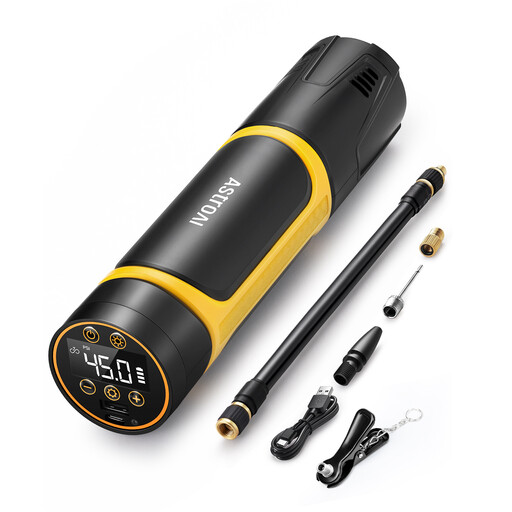
Why it suits this profile: A handy choice if you want one rechargeable air pump for your bicycle, motorbike, car and ball.
The product information lists four pressure units, five modes and automatic shut-off at the set pressure.
150 PSI, LCD screen, USB-C input, USB output and adapters for Presta, Schrader and ball valves, according to the product description.

Why it suits this profile: An interesting option for drivers and campers looking for greater capacity and versatility.
Alongside the maximum pressure, the product information lists a 100% duty cycle and 12V power supply. Check the instructions for the exact operating conditions.
160 PSI, 132 W power, supplied adapters and a stated noise level of 78 dB, according to the product specifications.
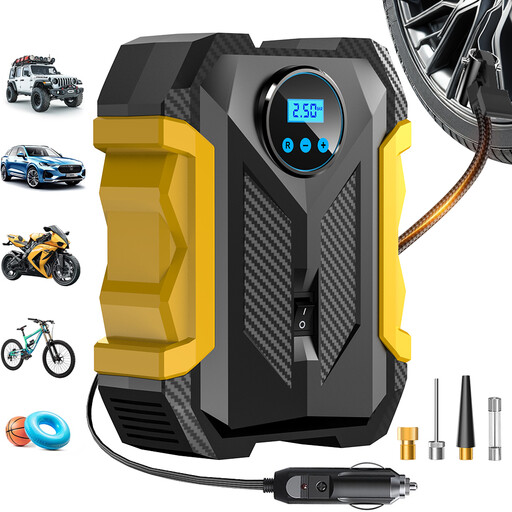
Why it suits this profile: A practical option for use from your car, with a digital pressure display and a long 3-metre cable.
The 12V connection means you don’t need to charge an in-built battery before every use, although the cable limits how far you can be from the vehicle.
150 PSI, digital pressure display, LED light and a 3-metre cable, according to the product information.
We’ve put together a complete, up-to-date list of products that meet these strict selection criteria and current European safety regulations.
Use a tyre inflator to top up a tyre, not as a fix for one that is visibly damaged or losing pressure quickly. Have a leaking tyre checked by a garage or bike mechanic.
That depends on its maximum pressure, airflow and stated purpose. According to their product information, models with around 150 PSI are often designed for car, motorbike and bicycle tyres. Always check the product specifications and the expected inflation time for a flat car tyre.
Running time varies by model and pressure load. For example, the Porbi Q19 lists a 4000mAh battery and around 25 minutes of use on a full charge. Inflating a whole car tyre takes considerably longer than a quick top-up. If you want to keep the inflator in your car or on your motorbike, remember to charge it after use.
With a battery-powered model, your main cost is charging it. A 12V model draws power from your vehicle’s battery. Power use for a top-up is generally low, but the total cost depends on the wattage, how long you use it and how often you use the inflator. So focus on finding the right specifications for your needs, not just the price tag.
