
Vandaag of morgen in huis

Kwaliteit gegarandeerd

Welkomstaanbiedingen ontgrendelen: GRATIS bezorging | Tot 80% korting | Gratis 30 dagen JoyPlus-proefperiode
Download de app
A portable tyre inflator is handy when a tyre is slowly losing air, for a ride outside the city, or for a check before you set off. Not every compact pump is suitable for car tyres, though. A small size, a big number on the box or the term “powerful” on its own tells you little about real-world performance.
Joybuy Product Recommendation Officer sets out the key differences. That way you won’t end up with an electric inflator that’s really meant for airbeds, or a cordless inflator that needs recharging again after just a few minutes.
A high airflow in litres per minute can be useful for airbeds and inflatables. For a car tyre, the maximum working pressure is what matters. A pump with a stated pressure of only 3.5 kPa, such as the Baseus PocketGo, is, according to the product information, not intended for car, SUV or motorbike tyres. This is an important difference between a low-pressure mobile compressor and a true car tyre inflator.
A cordless tyre inflator works without a 12V lead, but its run time depends on battery capacity, tyre size and your target pressure. So check whether the manufacturer provides information on charging time, battery type and operating time. With a flat battery, a cordless model won’t help much on the road unless it can also run from a vehicle socket.
A figure of 150 PSI sounds high, but that doesn’t mean the inflator will bring a car tyre up to that pressure quickly. Actual speed also depends on airflow, the motor, the hose and heat build-up. Also look for an automatic cut-off. Set the desired pressure in advance; according to the product description, the pump then stops at the level you selected.
For city bikes, road bikes and motorbikes, a digital tyre inflator with adjustable pressure is often practical. For a car, a higher maximum pressure and sufficient airflow are more important. Don’t just rely on “suitable for cars”, also check:
The pressure shown on a tyre sidewall isn’t always the recommended tyre pressure. For a car, use the value from the owner’s manual, the sticker in the door jamb or the fuel filler flap.
A battery-powered tyre inflator is easy to take to a bicycle, motorbike or campsite. A USB or USB-C connection makes charging simple, but plan the charging ahead. A 12V tyre inflator takes power from the cigarette lighter or 12V socket in the car. With these models, start the engine as per the product instructions so you don’t unnecessarily drain the vehicle battery.
A hybrid model, such as the OSRAM TYREinflate 4000, combines a built-in battery with USB-C charging and direct 12V power. That’s practical when you want flexibility, but at 730 grams it’s heavier than some mini pumps.
A digital tyre inflator shows the set and measured pressure more clearly than a simple analogue gauge. Check that the inflator supports bar, PSI and kPa. It helps avoid conversion errors.
A tyre inflator with automatic cut-off reduces the risk of over-inflating after you’ve reached the target pressure. Always check the connection to the valve and recheck the pressure afterwards. A built-in LED can help in a breakdown at night, but it doesn’t replace proper lighting or a warning triangle.
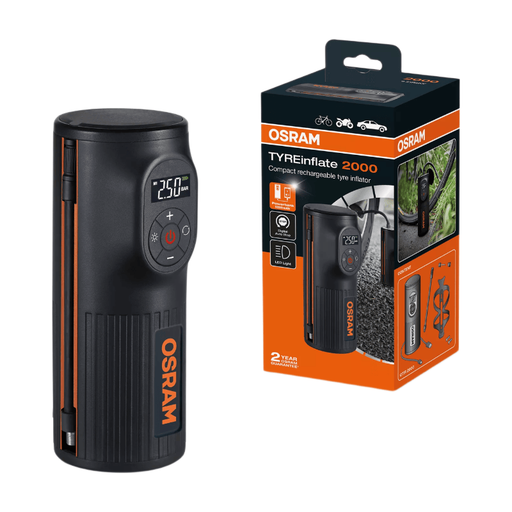
Why this fits the profile: This compact battery-powered tyre inflator is intended for drivers, cyclists and motorcyclists who want one simple device for the road. According to the product specifications it charges via USB and weighs 485 grams.
The product information lists a maximum pressure of 5.5 bar, a digital display and automatic cut-off. That way you can see in advance whether the model suits your use.
USB-rechargeable battery, display with BAR, kPa and PSI selection, LED lighting and adapters for car, bicycle and motorbike.
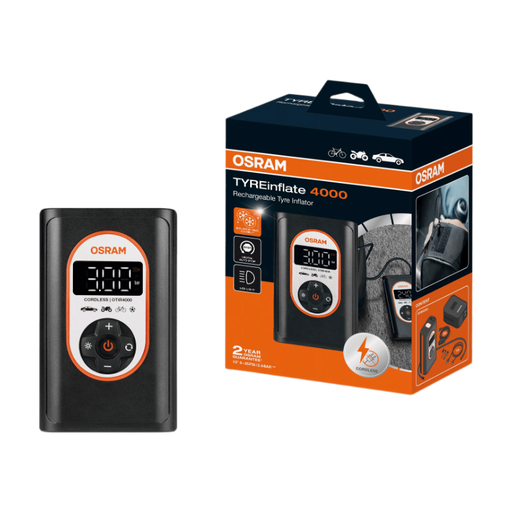
Why this fits the profile: Ideal if you want a cordless tyre inflator with extra control options for car, motorbike, bicycle and trips. According to the product specifications, the housing is aluminium.
As well as automatic cut-off, this model has 12V back-up, so a flat battery isn’t your only power option. The built-in deflation valve helps with small corrections.
Maximum working pressure of 8.3 bar, pressure memory for four vehicles, USB-C, 12V cable and LED light.

Why this fits the profile: A practical choice for drivers who prefer direct 12V power and don’t want to maintain a battery. According to the product information, the inflator is also suitable for motorbike tyres, bicycle tyres and balls.
The specifications list a range of 3 to 150 PSI, five presets and automatic stop. The 3‑metre power cable limits the problem of a lead that’s too short.
100W motor, 12V connection, presets for car, motorbike, bicycle and ball, plus LED lighting with three modes.
We’ve compiled a complete, up-to-date list of products that fully meet these strict selection criteria and current European safety regulations.
With visible damage, a tyre that deflates quickly or a valve problem, inflating isn’t a permanent solution. Have the tyre inspected or repaired.
No. Check the maximum pressure, airflow and explicit vehicle compatibility. A low-pressure air pump may be fine for airbeds, but not for a car or motorbike tyre. Also note the recommended duty cycle.
That depends on how you use it. A cordless model is handy for bicycles, motorbikes and camping. A 12V model doesn’t need a charged battery and is therefore ideal for use next to the car. For long trips, a model with both power options can be practical.
Service life depends on battery capacity, charge cycles, storage temperature and operating time per session. Avoid running it continuously for long periods, charge as per the manual, and store the device dry and out of extreme heat or cold.
