
Vandaag of morgen in huis

Kwaliteit gegarandeerd

Welkomstaanbiedingen ontgrendelen: GRATIS bezorging | Tot 80% korting | Gratis 30 dagen JoyPlus-proefperiode
Download de app
A portable Type 2 3.5 kW EV charger is useful when you want to charge at home, while visiting someone or on the go via a suitable 230V socket. However, not every portable EV charger is suitable for everyday use. A long cable or high wattage means little if the current does not match your socket, the charging status is unclear or the app connection is unstable.
So pay particular attention to these three common pitfalls:
A 16A EV charger can theoretically deliver around 3.68 kW at 230 V. A model described as 3.5 kW is practically close to this figure. However, only use 16 A when the socket and corresponding circuit are suitable for it.
An adjustable charging current is therefore important. With settings such as 8A, 10A, 13A and 16A, you can adapt the load to the situation. A lower amperage may be advisable with an older socket, a longer charging period or when other appliances are connected to the same circuit.
Plug the charger directly into a correctly earthed, suitable Type F socket. Avoid unapproved adapters and extension leads. If you do not know what load your electrical installation can handle, have it checked by a qualified electrician.
Type 2, officially IEC 62196-2, is the standard AC connection for many electric cars and plug-in hybrids in Europe. Before buying, check that your car has this connection and find out what maximum AC charging power its onboard charger supports.
A 5-metre charging cable often provides sufficient reach for a driveway or garage. Measure the distance between the socket and the charging port beforehand. A longer cable is not automatically more convenient: it may be heavier, take up more space and be harder to store. A sturdy carry case is a practical bonus for a portable electric car charger.
Check that the charging controller provides protection against, among other things:
A specification such as IP66 EV charger describes the enclosure’s level of protection against dust and water under specific conditions. It does not mean that you can submerge the charger or leave it unprotected in heavy rain for long periods. Always check the manual and position the controller so that water cannot collect on the plugs and connections.
A display or LED indicator helps you check charging power, status and faults. This prevents you from discovering only after several hours that the charging session never started.
The following choices are based on the stated product details, connections, charging settings, cable length and features. Claims about performance are presented as product specifications from the manufacturer or seller; actual charging performance also depends on the car and electrical installation.
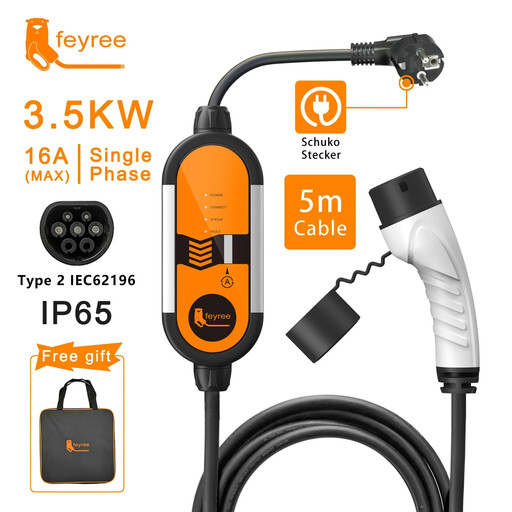
Why it suits this profile: This portable EV charger is designed for straightforward charging via a standard 230V socket. The current can be set to 8A, 10A, 13A or 16A, and the cable is 5 metres long.
The four charging settings mean you do not have to charge at 16 A by default. According to the product description, the OLED display shows the charging status and error messages.
Type 2 connection, 5-metre cable, adjustable charging current and a stated IP65 protection rating.
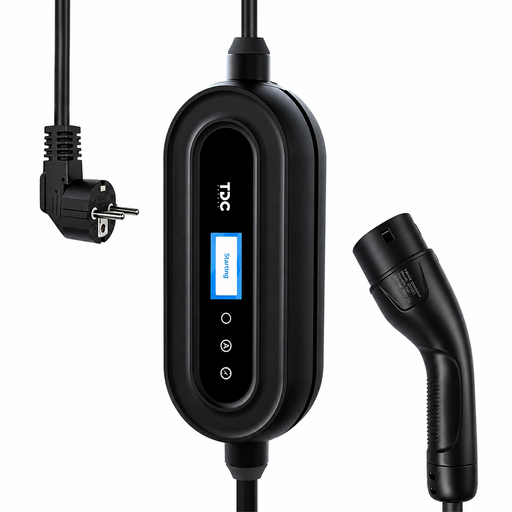
Why it suits this profile: This portable EV charger combines manual controls with Wi-Fi and Bluetooth features. It is a good fit for drivers who value charging schedules and status information.
The charging current can be set to 8A, 10A, 13A or 16A. The 1.9-inch LCD screen and three-colour LED indicator provide extra visibility during the charging session, so you do not have to rely solely on the app.
5-metre cable, approximately 2.1 kg, Wi-Fi and Bluetooth, IP66 according to the product details, plus several stated safety features.
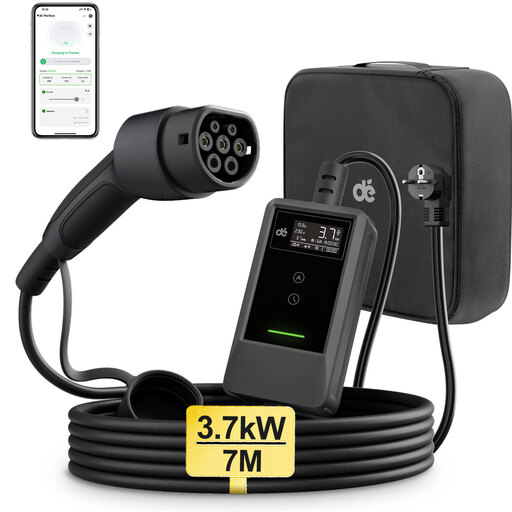
Why it suits this profile: The 7-metre cable is useful when the socket is further from the parking space. The product title states that this is a single-phase Type 2 charger with Wi-Fi and an LCD screen.
The longer cable means you do not need an unsuitable extension lead. However, check beforehand that 7 metres is practical for your driveway or garage.
7 metres of reach, Type 2 connector, single-phase charging and Wi-Fi control according to the product listing.
We have compiled a complete, up-to-date list of products that fully meet these strict selection criteria and the applicable European safety regulations.
Follow these basic steps when using a portable electric car charger:
The actual charging time is determined by the selected charging current, the car’s charging limit, the battery condition and the onboard AC charger. As a result, a plug-in hybrid may have a different charging time from a fully electric car, even when using the same EV charger.
Not without checking first. The socket, circuit, earthing and other connected loads must all be suitable. If in doubt, start with a lower charging current and ask a qualified electrician for advice. Do not use a random adapter or extension lead.
You can estimate the cost by multiplying the number of kilowatt-hours charged by your electricity tariff. A 3.5 kW charger only determines the maximum charging power; the cost depends on how much energy the car actually takes in and the tariff charged by your energy supplier.
Its lifespan depends on how often it is used, how it is stored, the load on the cable, moisture and whether it is connected correctly. Do not coil the cable too tightly, do not pull on it and store the charger in a dry place. Check the plug and connector regularly, and stop using the charger if you notice damage or discolouration.
