
Vandaag of morgen in huis

Kwaliteit gegarandeerd

Welkomstaanbiedingen ontgrendelen: GRATIS bezorging | Tot 80% korting | Gratis 30 dagen JoyPlus-proefperiode
Download de app
A portable Type 2 EV charger is handy if you want to charge at home, at a family member’s house or while travelling, using a suitable socket. However, not every portable electric car charger is right for every situation. A high wattage on the packaging, for example, means little if your socket, consumer unit or car can’t handle that current.
Pay particular attention to the connection, adjustable charging current and safety features. Read on to find out which common pitfalls to avoid, which specifications matter and which models suit different needs.
A 3.5 kW EVSE charger running at 230 V works differently from a 7 kW or 11 kW model. The actual charging speed also depends on the car’s onboard charger, the battery’s condition and the electrical installation. A plug-in hybrid, for example, may draw less power than the charger can supply.
An 11 kW portable charger will usually require a suitable three-phase connection. You can’t simply plug one into a standard household socket.
A Type 2 charging cable with a household plug can only be used with a suitable, properly earthed 230V socket. Don’t use an unapproved adapter or extension lead. It could overheat or put too much strain on the electrical installation’s safety features.
Before buying, check which type of plug is included. A Type F or Schuko plug is different from a 5-pin CEE plug for a three-phase power connection.
A smart EV charger with Wi-Fi can be useful for scheduling and remote monitoring, but the app will only work with a compatible network. Check whether the charger can also start without the app, for example with a button or through plug-and-charge.
A clear display is still useful when you don’t have an internet connection while travelling. Look for information such as charging current, voltage, charging status and error messages.
Several current settings are useful when charging via 230 V. An adjustable charging current of 8A, 10A, 13A and 16A gives you more options for different sockets and circuits. Always choose a current that’s suitable for the connection’s capacity.
At 230 V and 16 A, the theoretical maximum is around 3.5 to 3.7 kW. In practice, the power may be lower. The car, cabling and home electrical installation all affect what’s achievable.
Check whether your car has a Type 2 connection in accordance with IEC 62196-2 and whether the charger is suitable for AC charging. This is the standard connection for many electric cars and plug-in hybrids in Europe, but always check your vehicle’s manual.
A Type 2 plug on the car end doesn’t automatically mean that every mains plug is suitable for your needs. Check both ends of the charging cable:
Portable EV chargers are often used outdoors. An IP rating such as IP65 or IP66 provides information about protection against dust and water under the conditions set out in the relevant standard. This doesn’t mean that the control unit can be submerged in water.
Also look for features such as protection against overload, overheating, overvoltage and undervoltage, earthing faults and leakage current. According to the product information for the selected models, these types of safety features are built in, but always use the charger in accordance with its instructions.
Inspect the plug, cable and connector before each charging session. Stop using the charger if you notice loose parts, damage, unusual heat or error messages.
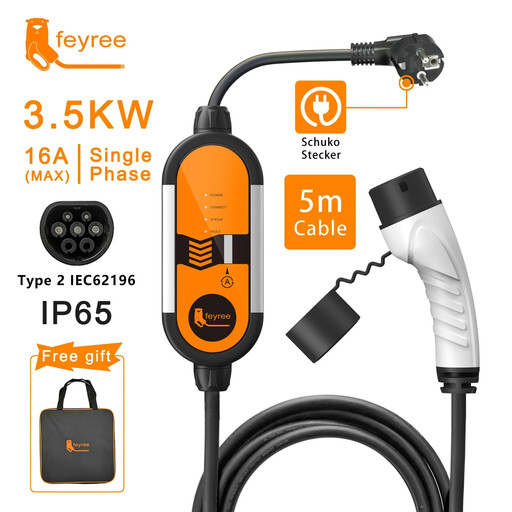
Why it suits this profile: This model is designed for 230V charging via a Schuko plug and offers four adjustable settings: 8A, 10A, 13A and 16A. The 5-metre cable is practical for a driveway or garage.
The current isn’t fixed at 16 A. This means you can choose a lower setting if required by the available circuit or socket.
Maximum power of 3.5 kW according to the product information, OLED status display, IP65 rating and memory for your chosen charging current.
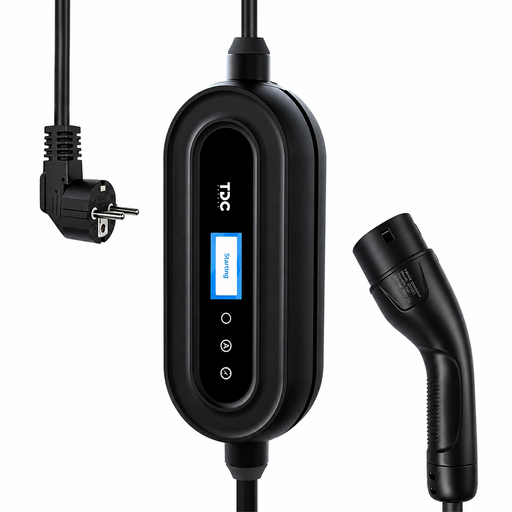
Why it suits this profile: The SNK03 combines 230 V charging with an LCD screen, Bluetooth and Wi-Fi support, and a 5-metre charging cable. It’s a good fit for drivers who want more information and control options at home and on the go.
As well as app control, plug-and-charge and button controls are available. You’re not reliant on Wi-Fi alone.
Adjustable to 8A, 10A, 13A or 16A, 1.9-inch LCD screen, IP66 rating according to the product information, and protection against overheating and earthing faults, among other things.
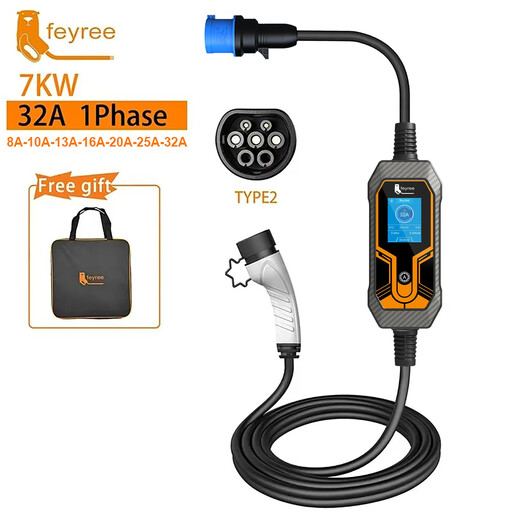
Why it suits this profile: This model is designed for a suitable single-phase connection with a maximum current of 32 A. It’s worth considering if you need more charging power than a standard 230V charger can provide.
The product information lists several settings, from 8A to 32A. Only use the higher settings if the connection, safety features and car are suitable.
Up to 7 kW according to the product listing, 5-metre cable, LCD status information and several safety features. Check in advance that your installation can handle 32 A.
We’ve put together a complete, up-to-date list of products that meet these strict selection criteria and the applicable European safety requirements.
Carry the charger in a protective bag and avoid sharp bends in the cable. Don’t leave the control unit in a puddle, and keep the connector contacts clean and dry. Stop charging using the controls before unplugging it.
If you’re unsure about the circuit, earthing or maximum power, it’s best to consult a qualified electrician. A fixed 7 kW, 11 kW or 22 kW installation has different requirements from a portable 230V EV charger.
No. Only use a suitable, properly earthed socket that can handle the selected current. A lower charging setting can reduce the load, but it won’t make an unsuitable socket safe to use.
It depends on the battery capacity, charge level, car and selected power. A theoretical power output of 3.5 kW isn’t always achieved continuously in practice. Check your car’s specifications for a realistic estimate.
No. Wi-Fi is mainly useful for scheduling, monitoring and remote control. If possible, choose a model that can also start with a button or through plug-and-charge, so you can still charge if the network goes down.
