
Vandaag of morgen in huis

Kwaliteit gegarandeerd

Welkomstaanbiedingen ontgrendelen: GRATIS bezorging | Tot 80% korting | Gratis 30 dagen JoyPlus-proefperiode
Download de app
A portable Type 2 EV charger can be useful if you want the flexibility to charge at home, at work or while travelling. However, the range of options can be confusing. Ratings of 7 kW, 11 kW and 22 kW may sound appealing, but they are not automatically suitable for every electric car, domestic electrical system or charging location.
As a Joybuy Product Recommendation Officer, I focus mainly on verifiable specifications. Below, you’ll find the common pitfalls that can lead to a poor purchase, plus guidance on which mobile EV charger suits different situations.
A 22 kW EV charger will not charge every car at 22 kW. The car and the electrical connection together determine how much power is actually used. For example, many plug-in hybrids and some electric cars accept a maximum of just 3.7 kW, 7.4 kW or 11 kW via AC charging.
Always check:
A 32A electric car charger can deliver approximately 7 kW through a single-phase connection. That does not mean every home or vehicle can support this continuously.
A portable home charger is usually a cable with a control box, also known as an EVSE charging station. The control box manages communication between the car and the power supply and contains safety features. However, you still need a suitable power connection.
For higher power levels, having the installation checked by a qualified electrician is advisable. An 11 kW or 22 kW three-phase EV charger requires a suitable three-phase supply. Do not use an extension lead or unsuitable adaptor to improvise a charging point.
A product with an IP66 rating is protected against dust and powerful jets of water under the relevant test conditions. This does not mean that the charger can be left outdoors indefinitely, submerged in water or used safely in every wet situation.
Also pay attention to:
According to feyree’s own product information, the models mentioned include features such as Type B residual current protection with AC30mA + DC6mA and an IP66 or IP65 rating, depending on the model. Check the latest manual and product specifications before buying.
The right choice depends on your car and electrical connection:
A higher stated power rating therefore does not automatically mean shorter charging times. Check your car’s built-in AC charger and the capacity of the electrical connection.
An adjustable charging current makes a charger more useful in different locations. You can adjust the power when the connection is limited or when other appliances are using electricity at the same time.
The feyree 7 kW charger lists adjustable settings of 8A, 10A, 13A, 16A, 20A, 25A and 32A. The 11 kW version lists settings of 8A, 10A, 13A and 16A. This difference matters if you want to use the charger in several locations.
A Type 2 charging cable compliant with IEC 62196-2 is compatible with the standard Type 2 socket found on many European electric cars and plug-in hybrids. However, check that your car has a Type 2 inlet and whether the cable is permanently attached to the charger.
A Wi-Fi EV charger with a smart charging app can offer features such as:
According to feyree’s own product description, the smart models mentioned work via the Tuya app, and Wi-Fi and Bluetooth are required when adding the device. Check that a suitable 2.4GHz Wi-Fi network is available at your location.
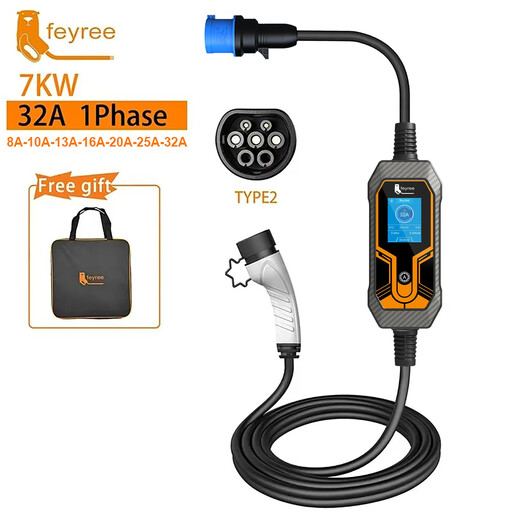
Why it suits this profile: This single-phase mobile EV charger is aimed at drivers looking for a straightforward portable solution and who do not need more power than their car or electrical connection can support.
The maximum power is clearly specified as 7 kW, and the charging current can be adjusted from 8A to 32A. This lets you match the charging level to the available connection.
5-metre cable, LCD screen, adjustable charging current and, according to the product information, IP65 protection and multiple safety features.
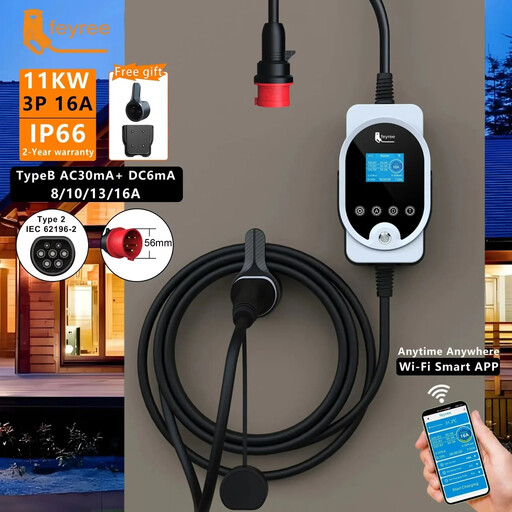
Why it suits this profile: A suitable choice for anyone with three-phase charging support who values app control, scheduling and charging records.
The specification states 11 kW, three-phase and four charging settings up to 16A. This makes it clear which installation requirements need to be checked beforehand.
Tuya app for scheduling and status monitoring, portable with wall-mounting option, plus Type B residual current protection according to the product information.
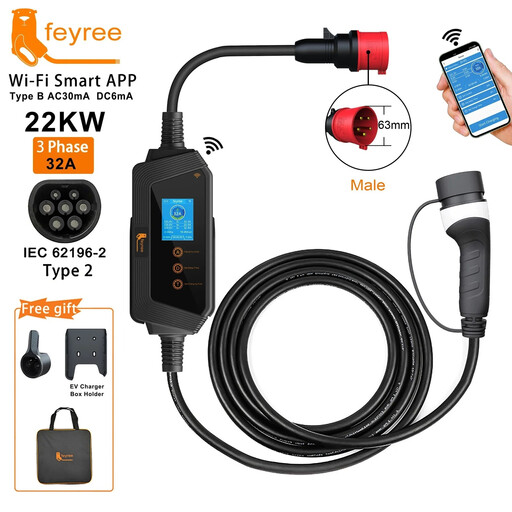
Why it suits this profile: This portable charging station is designed for users with a suitable three-phase connection, a car capable of handling 22 kW AC and a need for maximum flexibility.
The product explicitly states 22 kW, 32A and three-phase. This means you can compare these details directly with your car’s and installation’s specifications.
According to the product information, Wi-Fi app control, charging schedules, adjustable current and IP66 protection are included. The holder supports both portable and wall-mounted use.
We’ve put together a complete, up-to-date list of products that fully meet these strict selection criteria and the applicable European safety regulations.
That depends on the model and plug. A standard household connection is generally not designed for long-term charging at high current. Only use the connection and current setting permitted in the manual. For 7 kW, 11 kW or 22 kW, a suitable fixed connection is usually required.
Its lifespan depends on how often it is used, how it is stored, cable strain and exposure to moisture and heat. Do not coil the cable too tightly, do not pull on the cable when disconnecting it, and store the control box somewhere dry. An IP rating does not replace careful maintenance.
Calculate the electricity cost using: kilowatt-hours charged × your electricity tariff. A smart charging app can help you schedule charging when your tariff is lower, but the actual benefit depends on your energy contract. A higher charging capacity does not automatically reduce the price per kilowatt-hour.
