
Vandaag of morgen in huis

Kwaliteit gegarandeerd

Welkomstaanbiedingen ontgrendelen: GRATIS bezorging | Tot 80% korting | Gratis 30 dagen JoyPlus-proefperiode
Download de app
A portable Type 2 3.5 kW EV charger is useful if you want to charge at home, on holiday or as a temporary emergency solution using a suitable 230V socket. However, many portable electric car chargers look alike. The differences often come down to charging current, protection, plug, cable and controls.
Using too high a charging current with an unsuitable socket can cause overloading. Terms such as “smart”, “waterproof” and “fast charging” also don’t always tell you whether a charger is right for your needs. So check the technical specifications first, then consider any extra features.
A 3.5 kW charger can theoretically deliver a maximum of around 3.68 kW at 230 V and 16 A. Actual charging performance also depends on the car’s onboard charger, the battery’s state of charge and the electrical installation. For example, a plug-in hybrid may accept less power than the charging cable can provide.
So check not only the cable’s maximum power, but also what your car supports.
A Type 2 16A charging cable or portable home EV charger is often connected to a standard household socket. That doesn’t automatically mean every socket is suitable for prolonged use at 16 A.
An older installation, a loose wall socket, a long extension lead or incorrect earthing can pose risks. Plug the charger directly into a suitable, correctly earthed Type F socket and choose a charging current that matches the circuit and connection. If in doubt, have it checked by a qualified electrician.
A smart EV charger with Wi-Fi may let you schedule charging through an app, but Wi-Fi doesn’t change the maximum power or the safety of the circuit. Also check whether a compatible network is required, whether Bluetooth is available and whether you can operate the charger without an app.
For a 230V EVSE charger, the combination of voltage, current and phase is important. A single-phase 3.5 kW charger usually offers these settings:
An adjustable 8A 10A 13A 16A charging current offers more flexibility than a charger with just one fixed setting. The Type 2 plug must match the connection on your electric car or plug-in hybrid.
Check which protective features are actually listed in the product information. Relevant examples include protection against:
The TDC ENERGY SNK03 lists Type A + DC 6 mA leakage current protection, earth continuity monitoring and overtemperature protection. The product information also lists an IP66 rating. IP66 indicates protection against dust and powerful water jets, but it doesn’t mean the charger can be used underwater.
The Feyree Type 2 16A 3.5KW Portable EV Charger is listed as IP65. Always read both ratings alongside the instructions for installation, storage and use.
A 5-metre charging cable often gives you extra reach from the wall or socket to the car. Measure the distance beforehand and make sure the cable won’t run across a road, sharp edge or walkway.
A display or LED indicator shows the charging status. App control is especially useful if you want to charge at set times or schedule a session remotely. Check whether the charger can also be started manually, so you’re not entirely dependent on Wi-Fi or Bluetooth.
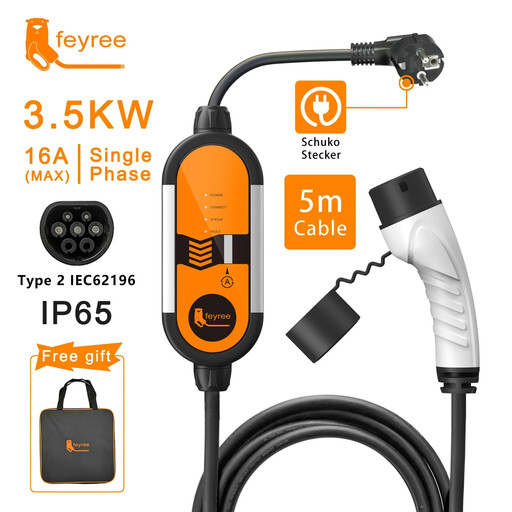
Why it suits this user: This portable plug-in hybrid charger offers a simple connection via a Schuko plug and four charging settings, making it a good choice if you’re new to portable charging.
The current can be set to 8A, 10A, 13A or 16A. According to the product description, the OLED display shows the charging status and error messages.
5-metre cable, Type 2 connection, adjustable current and a listed IP65 rating.
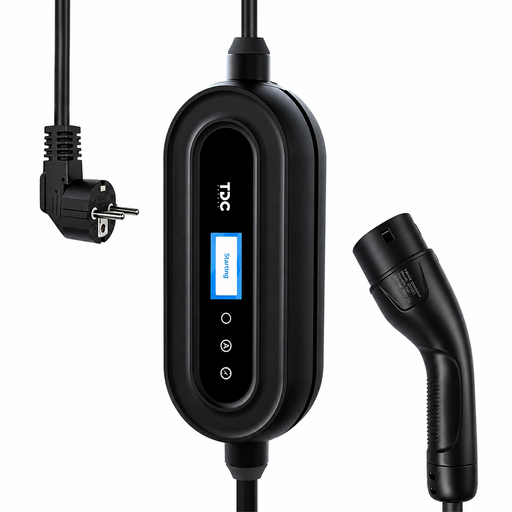
Why it suits this user: A good choice if you want to schedule charging via Wi-Fi or Bluetooth as well as charge manually, and value clear status information.
The four charging settings help ensure that 16 A isn’t automatically the only option. The product information lists several voltage, temperature and leakage current protections.
1.9-inch LCD screen, Wi-Fi and Bluetooth, an IP66 rating according to the product information, and a 5-metre cable.
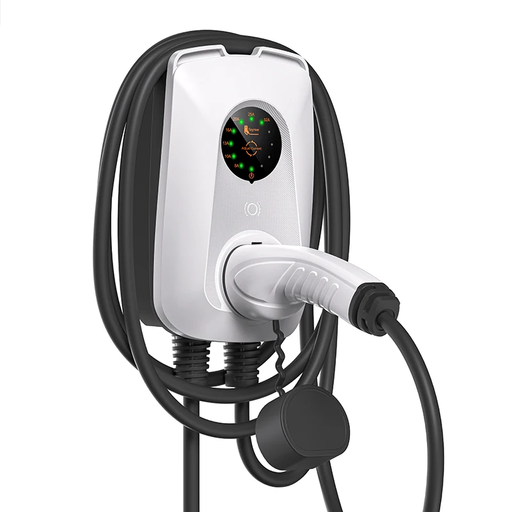
Why it suits this user: For anyone who charges at home regularly and wants a wall-mounted option with adjustable current up to 32 A. This isn’t a standard plug-in charger.
The adjustable settings range from 8 A to 32 A. Only use higher settings with a suitable electrical installation and in accordance with the installation instructions.
Wall-mounted design, 5-metre cable, Type 2 connector and an IP65 rating according to the product description.
We’ve put together a complete, up-to-date list of products that meet these strict selection criteria and the applicable European safety regulations.
Only use a portable charger in accordance with the manual. Keep these points in mind:
An IP rating is no substitute for correct use. If the plug becomes hot, the connection is loose, an error message appears or the cable is damaged, stop the charging session.
Not necessarily. The car must support AC charging via a Type 2 connection. Also check the car’s maximum charging current and the manufacturer’s requirements. According to their product information, the chargers listed are intended for compatible electric cars and plug-in hybrids.
The cost of electricity depends on your tariff and the number of kilowatt-hours you charge. A 3.5 kW charger doesn’t determine the price by itself. The calculation is: kilowatt-hours charged multiplied by the price per kilowatt-hour. Charging losses can increase actual consumption slightly.
That depends on the IP rating and the instructions for the specific model. The cable and control unit should be positioned somewhere dry and stable, where they’re protected from damage. Don’t use the charger underwater, and don’t coil the cable tightly while charging unless the manual explicitly allows it.
