
Vandaag of morgen in huis

Kwaliteit gegarandeerd

Welkomstaanbiedingen ontgrendelen: GRATIS bezorging | Tot 80% korting | Gratis 30 dagen JoyPlus-proefperiode
Download de app
A portable Type 2 EV charger 11 kW may seem like a straightforward purchase on paper. Yet many EV drivers run into the same problems: the car does not charge at the promised power, the plug does not match the socket or the app only works under certain conditions.
As a Joybuy Product Recommendation Officer, I filter the most important product specifications and marketing claims for you. This allows you to compare a portable EV charger based on its connection, charging power, safety features and everyday use in the Netherlands.
An 11 kW charging capacity generally means charging via three phases, at around 16 amps per phase. You need a suitable three-phase connection, a compatible socket and a car whose onboard charger accepts 11 kW.
If your car only has a single-phase onboard charger, a three-phase EV charger will not automatically charge it faster. Therefore, check:
Type 2 refers to the connection on the car side, in accordance with IEC 62196-2. The other end may, for example, have a CEE plug for three-phase use. A model with a Schuko plug is generally intended for single-phase charging and usually cannot deliver 11 kW.
So do not only look for “universal Type 2 compatibility”. Check the complete charging chain: car, cable, EVSE charging box, mains connection and installation.
A smart EV charger with Wi-Fi can offer charging schedules, current adjustment and real-time monitoring. According to feyree’s product descriptions, the device must be connected via Wi-Fi and Bluetooth when adding the charger. Suitable Wi-Fi conditions may also be required for app control.
An app is useful, but it is not the only way to operate the charger. A display or buttons on the control box are helpful when the Wi-Fi signal near the parking space is limited.
A portable Type 2 EV charger 11 kW often works with adjustable charging currents such as 8A, 10A, 13A and 16A. This is practical when temporarily charging on a lower-rated circuit or when you want to limit the load on your connection.
An 11 kW charger is not the same as an 11 kW charging point permanently mounted on the wall. A mobile charging point contains an EVSE charging box that manages the connection and various safety functions, but the power supply must still be suitable.
Check whether the description mentions protection against, among other things:
Some feyree models list Type B residual-current protection with AC 30 mA + DC 6 mA and an IP65 or IP66 rating. These are product specifications from the product information and do not guarantee that every installation is automatically safe. The IP rating also applies to the relevant component under the manufacturer’s stated conditions. Use the charger according to the instructions and have a fixed connection assessed by a qualified installer.
A 5-metre cable often gives you more flexibility on the drive or in the garage, but it also takes up more space during transport. Pay attention to the strain relief, the weight of the control box and how you intend to store the cable.
Water resistance does not mean that you can place the control box underwater. Make sure plug connections are not left in puddles and avoid prolonged exposure to extreme conditions.
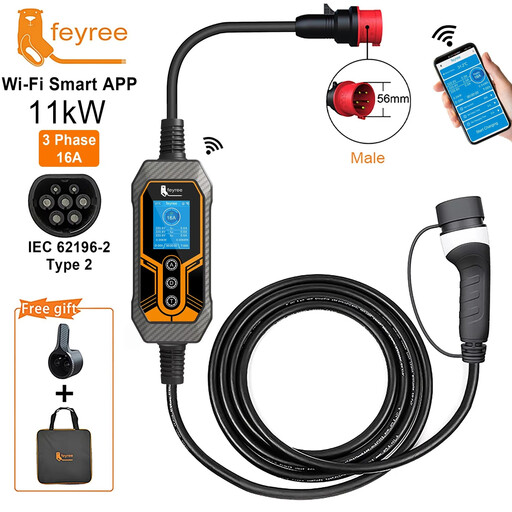
Why this suits the profile: This model combines 11 kW charging with a 5-metre cable, adjustable current from 8A to 16A and control via the app or buttons. That makes it suitable for anyone looking for a single mobile charger for use at home and on the road.
The stated CEE plug makes it clear that this model is intended for a suitable three-phase supply. The charging current can be adjusted, so you do not always have to charge at 16A.
11 kW, Wi-Fi and Bluetooth connectivity, charging schedules, LCD screen and residual-current protection according to the product description.
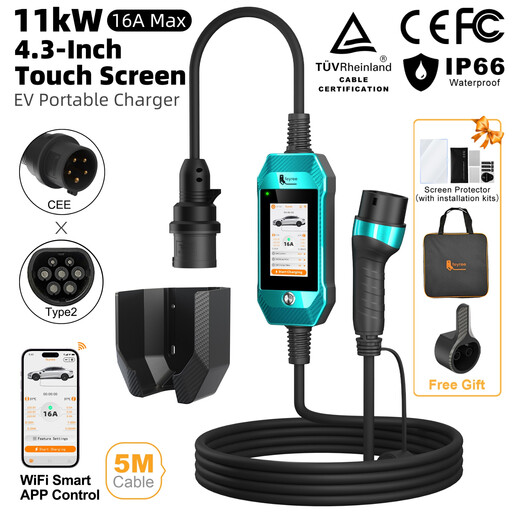
Why this suits the profile: The 4.3-inch touchscreen, charging history and temperature monitoring provide extra information during and after charging. This is ideal for users who want to actively monitor their charging data.
As well as app control, there is a local display. According to the description, the current can be adjusted from 8A to 16A, and the charger can reduce its power when the temperature rises.
4.3-inch touchscreen, charging records, Tuya Smart app, scheduled charging times and temperature monitoring at the plug and control box.
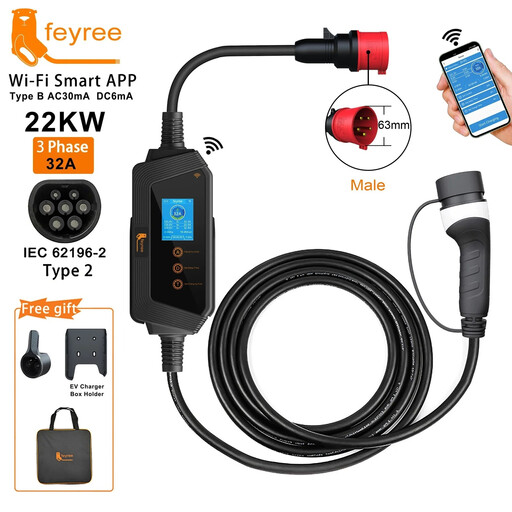
Why this suits the profile: This model is intended for users looking for a three-phase EV charger with a broader current range. However, check that your car and installation can handle more than 11 kW before choosing this variant.
According to the product information, the charging current can be adjusted. This allows you to match the charging power to the available connection rather than always using the maximum setting.
Three-phase use, Wi-Fi app, charging schedules, adjustable current, IP66 according to the product description and a holder for mobile or wall-mounted use.
Only use an 11 kW mobile charging point with a connection that is suitable for it. An existing CEE connection is not automatically protected correctly for prolonged charging. If in doubt, have the circuit, residual-current protection, cable cross-section and connection checked.
Also bear the following in mind:
We have put together a complete, up-to-date list of products that fully meet these strict selection criteria and the applicable European safety regulations.
No. Type 2 describes the physical charging standard, but the car’s internal AC charger determines the maximum charging capacity. Also check whether your home has a suitable three-phase connection.
Not always. An 11 kW model often uses a three-phase CEE plug, while a 3.5 kW portable electric car charger usually works with a Schuko socket. Choose the plug based on your existing connection and have the installation checked.
An EV charger with an app can support charging schedules, for example by charging at a time you choose. Whether you actually pay less depends on your energy contract, tariffs and when your car needs electricity. The app does not automatically reduce electricity consumption.
