
Vandaag of morgen in huis

Kwaliteit gegarandeerd

Welkomstaanbiedingen ontgrendelen: GRATIS bezorging | Tot 80% korting | Gratis 30 dagen JoyPlus-proefperiode
Download de app
A portable Type 2 16A EV charger seems straightforward at first: plug it into a socket, connect the Type 2 plug to your car and start charging. In practice, the socket, adjustable charging current and cable quality are what make the difference. The wrong choice could mean slow charging, an overloaded circuit or a cable that’s awkward to use in your garage.
This buying guide will help you choose a portable electric car charger for an electric car or plug-in hybrid with a Type 2 connection.
A charger with a maximum charging current of 16A can deliver around 3.5 kW at 230V through a Schuko socket. That doesn’t mean every socket or home electrical installation is suitable for a sustained 16A load.
So check:
If in doubt, ask a qualified electrician to check it. A portable charger is no substitute for a properly installed electrical system.
A 5-metre charging cable gives you more reach on a driveway or in a garage, but it also takes up more space. Consider the cable’s weight, how flexible it is in cold weather and how you’ll store it. A cable that’s repeatedly bent sharply may wear out more quickly.
A storage bag is useful if you regularly carry the portable car charger in your boot.
Brands often mention features such as lightning protection, residual current protection, overheat protection and water resistance. Don’t take these as a general guarantee of safe use. Check the detailed product specifications, instructions, plug connection and conditions of use.
According to Feyree’s product description, the model in question includes residual current, overvoltage, overheat and overcurrent protection, and the Type 2 end has an IP65 rating. This information comes from the brand’s product description, and the charger should be used in accordance with the instructions provided.
Most electric cars and plug-in hybrids in the Netherlands use a Type 2 charging socket for AC charging. Always check your car’s connection, though. A Type 2 cable is not the same as a standard USB or household cable, and it can’t be used without suitable EVSE control.
An EVSE charging cable rated at 3.5 kW includes a control box that monitors the connection between the car, charger and socket. The car then determines how much power it can accept.
An adjustable charging current is useful if you don’t always use the same electrical connection. According to the product information, the Feyree charger lets you choose between 8A, 10A, 13A and 16A. A lower setting may be suitable for an older installation or when several appliances are in use on the same circuit.
The theoretical maximum values are approximately:
The actual charging time depends on the battery, the car’s charging limit, the selected current and any losses during charging.
When charging an electric car via Schuko, you use a standard 230V socket. This is handy at home, in a holiday home or somewhere without a dedicated charge point. For frequent daily charging, however, a fixed charging solution may be more practical.
Only use the Schuko plug with a well-maintained socket. Avoid adaptors, multi-socket extensions and extension leads unless the manufacturer and an electrician explicitly confirm that they’re suitable. Stop charging immediately if the plug, socket or control box becomes unusually warm.
As not every accessory in an online range is suitable for EV charging, the recommendations below focus on the model whose listed specifications are compatible with Type 2 charging via Schuko. The three profiles describe different ways of using the same portable charger.
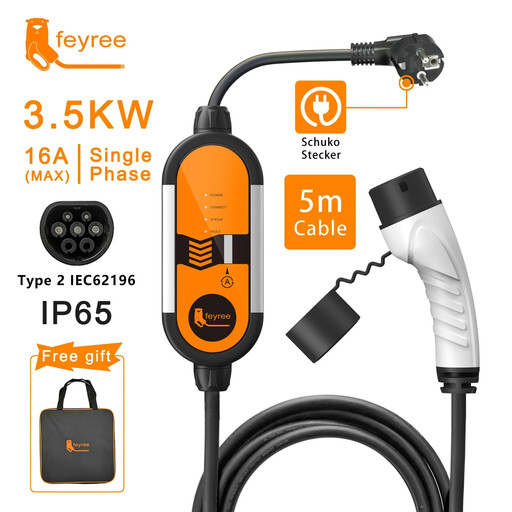
Why it suits this profile: You get a portable Type 2 charger without having to install a fixed charge point straight away. The adjustable current lets you use it with different household circuits.
Before charging, you can choose between 8A, 10A, 13A and 16A, so you don’t have to use the maximum load every time.
Type 2 connector, Schuko plug, 5-metre cable and a stated maximum output of 3.5 kW.
Why it suits this profile: You care about the controls, how clearly the charging status is shown and the control box’s build quality, not just the price.
According to the product description, the OLED indicator shows the charging and connection status. The control box also indicates fault conditions.
Aluminium control box housing, memory function for the selected charging current and an OLED display.
Why it suits this profile: You use the charger in several places, such as at home, with family or at a holiday address with a standard socket.
The 5-metre cable gives you more reach without needing an additional cable straight away. The included bag makes it easier to carry and store.
Operating temperature listed in the product information is -30 °C to 55 °C, with a stated Type 2 IP65 rating.
We’ve put together a complete, up-to-date list of products that meet these strict selection criteria and the applicable European safety regulations.
First, plug the Schuko plug into a suitable 230V socket. Then connect the Type 2 plug to your car and set the required current before charging. Check that the charging status is displayed as expected. Don’t use a damaged cable or connector.
Its lifespan depends on how it’s used and stored, exposure to moisture and temperature changes, and mechanical strain. Coil the cable loosely, avoid sharp bends and keep the control box dry. Regularly check the plug, connector and cable sheath for signs of wear.
The cost depends on the amount of energy used in kilowatt-hours and your electricity tariff. A plug-in hybrid with a smaller battery may charge relatively quickly, while a fully electric car charging at a maximum of around 3.5 kW will take longer. The charging current mainly determines how quickly you charge, not the price per kilowatt-hour.
