
Vandaag of morgen in huis

Kwaliteit gegarandeerd

Welkomstaanbiedingen ontgrendelen: GRATIS bezorging | Tot 80% korting | Gratis 30 dagen JoyPlus-proefperiode
Download de app
A portable Type 2 3.5 kW EV charger may seem straightforward at first glance: plug it into a socket, connect the Type 2 connector to your car and start charging. In practice, the socket, charging current and vehicle compatibility largely determine whether a mobile electric car charger is convenient and safe to use.
For Dutch households and plug-in hybrids, there are several common purchasing pitfalls:
An EVSE charger 16A with several current settings offers greater flexibility than a charger with one fixed setting. Many models support 8A, 10A, 13A and 16A. A lower setting may be more appropriate when you are unsure how much load the socket or circuit can safely handle over an extended period.
Check the following before use:
Do not use an unapproved adapter or extension cable. If you are unsure about the installation, having it checked by a qualified electrician is advisable. The charger’s maximum charging current is not automatically the right charging current for every home.
A Type 2 charging cable uses the IEC 62196-2 connection commonly used in Europe. Check that your electric car or plug-in hybrid genuinely supports AC charging via Type 2. A Type 2 connector does not mean that every vehicle can charge at the same speed.
With a 230V EV charger, the theoretical figures are:
The actual figure may be lower. A 3.5 kW plug-in hybrid charger may also be unnecessary if the car has a smaller onboard charger.
A 5-metre charging cable provides space between the socket and the charging port, but also consider the weight and dimensions of the control unit. A portable charging station should fit easily in the car without the cable being sharply bent.
A display can show the charging current, charging status and faults. With an EV charger with wifi or EV charger with bluetooth, you should also check whether the app functions require a compatible network connection. For occasional charging, button controls may be more practical than an app.
Protection ratings such as IP65 or IP66 provide information about protection against dust and water under the conditions for which the product was designed. This does not mean that the charger can be left underwater. Keep the plug and connector clean and dry, and always follow the instructions.
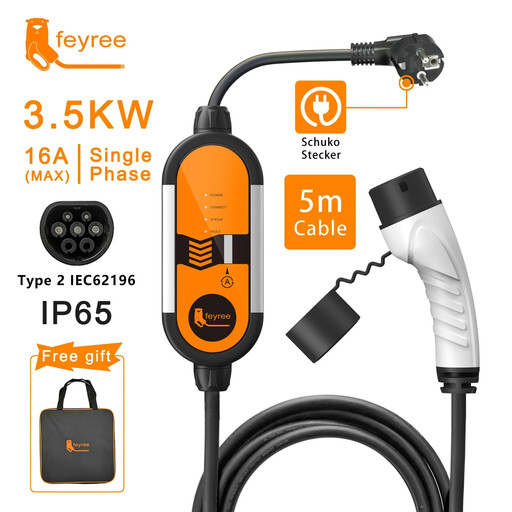
Why it suits this profile: A compact mobile electric car charger for use at home, on the road or as a back-up for an electric car or plug-in hybrid with a Type 2 connection.
According to the product description, the charging current can be set to 8A, 10A, 13A or 16A. This allows you to match the setting to a suitable circuit instead of always using the highest setting.
5-metre cable, OLED status display and a Schuko plug for a suitable 230V socket. The product description states IP65 protection.
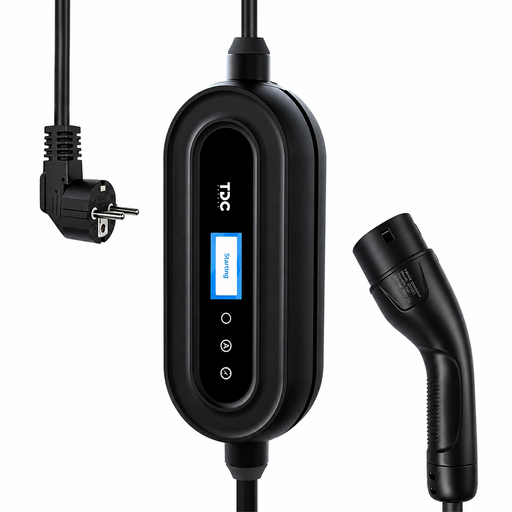
Why it suits this profile: Suitable for drivers who want not only adjustable current, but also clear information and smart control via wifi or bluetooth.
The product specifications list four settings: 8A, 10A, 13A and 16A. The built-in LCD and LED indicator show the charging status without relying solely on an app.
5-metre cable, approximately 2.1 kg, IP66 according to the product information, and support for plug-and-charge, button controls and app functions. The manufacturer states CE compliance.
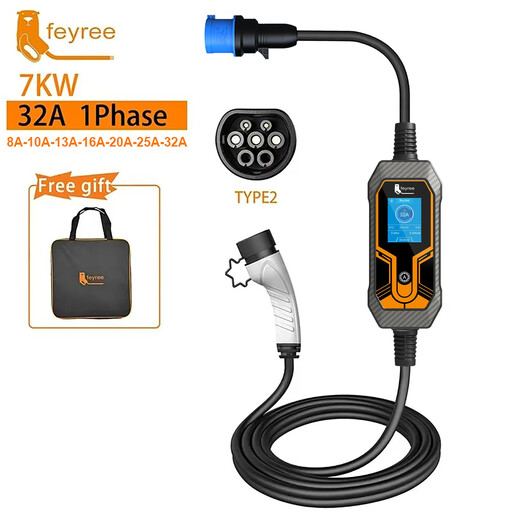
Why it suits this profile: For users with a suitable single-phase installation and vehicle who need more power than a standard 230V solution provides.
This is not a 3.5 kW Schuko solution. The listed settings go up to 32A and the product uses a CEE plug. Check the installation, connection and vehicle limit first.
5-metre cable, LCD display and adjustable current from 8A to 32A according to the product description. Suitable as a portable charger when an appropriate CEE connection is available.
We have put together a complete, up-to-date list of products that fully meet these strict selection criteria and the applicable European safety requirements.
Use the 230V EV charger with a suitable, earthed socket and inspect the mains plug, Type 2 connector and cable before every charging session. Stop immediately if any component is loose, damaged or unusually hot.
Also bear the following points in mind:
A higher IP rating is not a substitute for safe positioning. Even a product with stated protection against overloading, overheating or residual current, among other hazards, must be used in accordance with the instructions.
No. The connection must be correctly earthed and the circuit must be able to handle a continuous load. Choose a lower charging current if the capacity is uncertain and ask a qualified electrician for advice if in doubt. Do not use an arbitrary extension cable or adapter.
This depends on the battery capacity, state of charge, the car’s onboard charger and the selected current setting. At a maximum of 16A, approximately 3.5 kW is possible, but the car or installation may limit the actual charging speed. A plug-in hybrid will usually reach full charge more quickly than a fully electric car with a larger battery.
The cost mainly consists of the electricity tariff and the amount of energy charged. A simple calculation is: charged kWh × price per kWh. Charging losses, the car’s efficiency and any costs associated with a dynamic or fixed energy contract may affect the final amount. Wifi or bluetooth does not change the car’s electricity consumption, but it can help you schedule charging sessions.
